



 Chat with AI
Exam 18: Electron Transport and Oxidative Phosphorylation

Exam 1: Introduction to the Chemistry of Life56 Questions
Exam 2: Water59 Questions
Exam 3: Nucleotides, Nucleic Acids, and Genetic Information68 Questions
Exam 4: Amino Acids68 Questions
Exam 5: Proteins: Primary Structure68 Questions
Exam 6: Proteins: Three-Dimensional Structure60 Questions
Exam 7: Protein Function Part I: Myoglobin and Hemoglobin74 Questions
Exam 8: Carbohydrates66 Questions
Exam 9: Lipids and Biological Membranes59 Questions
Exam 10: Membrane Transport50 Questions
Exam 11: Enzyme Catalysis53 Questions
Exam 12: Enzyme Kinetics, Inhibition and Control55 Questions
Exam 13: Biochemical Signaling50 Questions
Exam 14: Introduction to Metabolism52 Questions
Exam 15: Glycogen Metabolism and Gluconeogenesis50 Questions
Exam 16: Glucose Catabolism50 Questions
Exam 17: Citric Acid Cycle50 Questions
Exam 18: Electron Transport and Oxidative Phosphorylation50 Questions
Exam 19: Photosynthesis50 Questions
Exam 20: Lipid Metabolism51 Questions
Exam 21: Amino Acid Metabolism50 Questions
Exam 22: Mammalian Fuel Metabolism: Integration and Regulation50 Questions
Exam 23: Nucleotide Metabolism50 Questions
Exam 24: Nucleic Acid Structure50 Questions
Exam 25: Dna Replication, Repair and Recombination50 Questions
Exam 26: Transcription and Rna Processing50 Questions
Exam 27: Translation49 Questions
Exam 28: Regulation of Gene Expression50 Questions
Select questions type


Rotenone and amytal
I.inhibition can be restored by addition of succinate
II.inhibition can be restored by addition of cytochrome c.
III.blocks consumption of oxygen.
IV.blocks transfer of electrons from CoQ to Complex III.

Free
(Multiple Choice)
4.8/5  (77)
(77) Correct Answer: Verified
B
Matching
Choose the correct answer from the list. Not all the answers will be used.
-Bacteriorhodopsin is an example of a light-driven ______ .
Free
(Multiple Choice)
4.8/5 (67)
(67) Correct Answer:Verified
VerifiedL
Which statement concerning Complex II of the electron transport chain is FALSE?
I.This complex oxidizes FADH2 and reduces coenzyme Q.
II.This complex includes the covalently bound enzyme succinate dehydrogenase.
III.This complex pumps protons from the matrix to the intermembrane space.
IV.This complex also oxidizes succinate to fumarate in the citric acid cycle.
Free
(Multiple Choice)
4.7/5 (92)
(92) Correct Answer:Verified
VerifiedD
The effects of a poison on actively respiring mitochondria are being studied to determine its mode of action.When the poison is added, every component of the electron transport chain is found to be in its reduced form based on spectroscopic analysis, and ATP production ceases entirely.It is reasoned that the poison is either blocking the final transfer of electrons to oxygen or is blocking the ATP synthase.Which of the following experiments will help unravel this dilemma?
(Multiple Choice)
4.8/5 (78)
(78) Cyanide (CN-)
I.inhibition can be restored by addition of succinate.
II.inhibition can be restored by addition of cytochrome c.
III.inhibits electron transport which stops consumption of oxygen.
IV.blocks transfer of electrons from CoQ to Complex III.
(Multiple Choice)
4.7/5 (89)
(89) Consider the following half-reactions:
 What is the
 for the following redox equation?

What is the for the following redox equation?
(Multiple Choice)
4.9/5 (82)
(82) Which of the following is TRUE regarding the complexes within the electron transport system?
I.Complex II contributes twice as many protons to the gradient than Complex I
II.Inhibition of Complex II would decrease the total number of electrons moving through the electron transport chain.
III.Inhibition of Complex II would not alter the amount of free energy generated from electrons originating from NADH.
IV.Complex I can accept electrons with higher potential than Complex II is able to accept.
(Multiple Choice)
4.9/5 (94)
(94) Which of the following correctly ranks redox centers found in Complex I from lower to higher potential? A correct answer will contain redox centers which are found in only Complex I and will also rank those redox centers in order of lower to higher reduction potential.
(Multiple Choice)
4.9/5 (65)
(65) Antimycin A
I.inhibition can be restored by addition of succinate.
II.inhibition can be restored by addition of cytochrome c.
III.blocks consumption of oxygen.
IV.blocks transfer of electrons from CoQ to Complex III.
(Multiple Choice)
4.8/5 (87)
(87) Matching
Choose the correct answer from the list. Not all the answers will be used.
-The inner mitochondrial membrane divides the mitochondrion into the inner membrane space and the ______.
(Multiple Choice)
4.8/5 (71)
(71) ATP forms (is produced)
I.upon transition from the loose to the tight form of the α and β subunit complex of ATP synthase.
II.as a result of the flux of electrons through the channel formed by Fo
III.as a result of the positive ions pumped into the matrix of the mitochondrion.
(Multiple Choice)
4.9/5 (74)
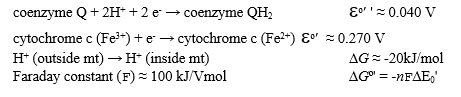
(74) In theory how many protons could be pumped under standard state conditions by Complex III per mol of CoQ oxidized, considering the following information? (NOTE: mt = mitochondria)
(Multiple Choice)
4.7/5 (80)
(80) Which of the following are TRUE statements regarding the structure of ATP synthase?
(Multiple Choice)
4.9/5 (84)
(84) The rate of oxidative phosphorylation
I.is regulated by the availability of ADP and Pi.
II.is reduced when the ratio of [NADH]/[NAD+] is high.
III.increases with a higher concentration of reduced cytochrome c
IV.is regulated by activity of the ADP-ATP translocator.
(Multiple Choice)
4.8/5 (74)
(74) Approximately how many ATP molecules are synthesized from the oxidation of 1 NADH?
(Multiple Choice)
4.9/5 (79)
(79) One method used by newborn mammals to generate heat is referred to as nonshivering thermogenesis.This method utilizes a protein channel called ________ which is present in high levels inside the mitochondria of _____tissue.
(Multiple Choice)
4.9/5 (81)
(81) An animal with the UCP-1 protein would
I.generate excess heat.
II.have lower energy levels.
III.generate ATP efficiently via oxidative phosphorylation.
(Multiple Choice)
4.8/5 (76)
(76) Electrons from FADH2 are delivered to ____ and electrons from NADH are delivered to ____ of the electron transport chain.
(Multiple Choice)
4.8/5 (66)
(66) A typical eukaryotic cell contains up to ____ mitochondria each bound by a smooth outer membrane.
(Multiple Choice)
4.7/5 (66)
(66) Which of the prosthetic groups listed can accept or donate either one or two electrons due to the stability of the semiquinone state?
(Multiple Choice)
4.8/5 (77)
(77) 
Filters
- Essay(0)
- Multiple Choice(0)
- Short Answer(0)
- True False(0)
- Matching(0)