



 Chat with AI
Exam 18: Electron Transport and Oxidative Phosphorylation

Exam 1: Introduction to the Chemistry of Life56 Questions
Exam 2: Water59 Questions
Exam 3: Nucleotides, Nucleic Acids, and Genetic Information68 Questions
Exam 4: Amino Acids68 Questions
Exam 5: Proteins: Primary Structure68 Questions
Exam 6: Proteins: Three-Dimensional Structure60 Questions
Exam 7: Protein Function Part I: Myoglobin and Hemoglobin74 Questions
Exam 8: Carbohydrates66 Questions
Exam 9: Lipids and Biological Membranes59 Questions
Exam 10: Membrane Transport50 Questions
Exam 11: Enzyme Catalysis53 Questions
Exam 12: Enzyme Kinetics, Inhibition and Control55 Questions
Exam 13: Biochemical Signaling50 Questions
Exam 14: Introduction to Metabolism52 Questions
Exam 15: Glycogen Metabolism and Gluconeogenesis50 Questions
Exam 16: Glucose Catabolism50 Questions
Exam 17: Citric Acid Cycle50 Questions
Exam 18: Electron Transport and Oxidative Phosphorylation50 Questions
Exam 19: Photosynthesis50 Questions
Exam 20: Lipid Metabolism51 Questions
Exam 21: Amino Acid Metabolism50 Questions
Exam 22: Mammalian Fuel Metabolism: Integration and Regulation50 Questions
Exam 23: Nucleotide Metabolism50 Questions
Exam 24: Nucleic Acid Structure50 Questions
Exam 25: Dna Replication, Repair and Recombination50 Questions
Exam 26: Transcription and Rna Processing50 Questions
Exam 27: Translation49 Questions
Exam 28: Regulation of Gene Expression50 Questions
Select questions type


Which of the following statements about the mitochondrial inner membrane is TRUE?
I.The inner membrane is permeable to CO2, H2O, and small ions.
II.The inner membrane contains several transport proteins and membrane bound
Enzymes.
III.In general, a higher inner membrane surface area correlates to a higher rate of
Respiration.
IV.The number of cristae reflects the respiratory activity of the cell.
(Multiple Choice)
5.0/5  (85)
(85) Matching
Choose the correct answer from the list. Not all the answers will be used.
-Protons moving through a transmembranc channel by "jumping" through an arrangement of hydrogen-bonded groups are described as moving through a proton ______.
(Multiple Choice)
4.7/5 (80)
(80) Use the table below to rank the redox centers in order to produce a favorable electron flow. 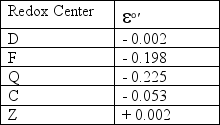
(Multiple Choice)
4.8/5 (66)
(66) Matching
Choose the correct answer from the list. Not all the answers will be used.
-Molecules that prevent oxidative damage by the superoxide radical possess ______ properties.
(Multiple Choice)
4.8/5 (83)
(83) In a newly discovered electron transport complex a researcher has identified the redox center Fe-S, cytochrome c, and coenzyme Q.The researcher also knows that this complex ultimately passes its electrons to oxygen.What is most likely the redox center which completes this task?
(Multiple Choice)
4.9/5 (88)
(88) The electrons formed from the aerobic oxidation of glucose are
I.ultimately transferred to O2 after several other transfer reactions.
II.transferred to the coenzymes NAD+ and FAD.
III.directly transferred to O2 during the citric acid cycle.
IV.transferred to succinate and arachidonic acid.
(Multiple Choice)
4.8/5 (72)
(72) In the electron transport chain, electrons are passed from redox center to redox center ____.
(Multiple Choice)
4.9/5 (71)
(71) According to the proposed reaction sequence presented in the chapter, cytochrome c oxidase obtains a fourth electron from a ____ residue adjacent to the heme a3-ligated O2, thus forming a transient radical.
(Multiple Choice)
4.8/5 (87)
(87) Matching
Choose the correct answer from the list. Not all the answers will be used.
-Complexes I and II each transfer electrons to ______.
(Multiple Choice)
4.9/5 (72)
(72) Based on the estimation presented in the chapter, how many ATP per glucose are synthesized by the aerobic metabolism in eukaryotes?
(Multiple Choice)
4.8/5 (83)
(83) 
Filters
- Essay(0)
- Multiple Choice(0)
- Short Answer(0)
- True False(0)
- Matching(0)