



 Chat with AI
Exam 17: Citric Acid Cycle

Exam 1: Introduction to the Chemistry of Life56 Questions
Exam 2: Water59 Questions
Exam 3: Nucleotides, Nucleic Acids, and Genetic Information68 Questions
Exam 4: Amino Acids68 Questions
Exam 5: Proteins: Primary Structure68 Questions
Exam 6: Proteins: Three-Dimensional Structure60 Questions
Exam 7: Protein Function Part I: Myoglobin and Hemoglobin74 Questions
Exam 8: Carbohydrates66 Questions
Exam 9: Lipids and Biological Membranes59 Questions
Exam 10: Membrane Transport50 Questions
Exam 11: Enzyme Catalysis53 Questions
Exam 12: Enzyme Kinetics, Inhibition and Control55 Questions
Exam 13: Biochemical Signaling50 Questions
Exam 14: Introduction to Metabolism52 Questions
Exam 15: Glycogen Metabolism and Gluconeogenesis50 Questions
Exam 16: Glucose Catabolism50 Questions
Exam 17: Citric Acid Cycle50 Questions
Exam 18: Electron Transport and Oxidative Phosphorylation50 Questions
Exam 19: Photosynthesis50 Questions
Exam 20: Lipid Metabolism51 Questions
Exam 21: Amino Acid Metabolism50 Questions
Exam 22: Mammalian Fuel Metabolism: Integration and Regulation50 Questions
Exam 23: Nucleotide Metabolism50 Questions
Exam 24: Nucleic Acid Structure50 Questions
Exam 25: Dna Replication, Repair and Recombination50 Questions
Exam 26: Transcription and Rna Processing50 Questions
Exam 27: Translation49 Questions
Exam 28: Regulation of Gene Expression50 Questions
Select questions type


Which of the following is TRUE regarding the discovery of the citric acid cycle?
I.One of the first discoveries was the involvement of coenzyme A in the production of GTP.
II.Krebs had knowledge of the sequence of reactions before he was able to demonstrate the link of the cycle to glucose metabolism.
III.The citric acid cycle was the first cyclic pathway discovered.
IV.Krebs demonstrated the involvement of the citric acid cycle in oxidation of amino acid and fatty acids.
(Multiple Choice)
4.8/5  (73)
(73) Which of the following structures represents a molecule that is added to succinate to form CoA and malate?
(Multiple Choice)
4.8/5 (77)
(77) Which of the following coenzymes is required by E1 of the pyruvate dehydrogenase complex for catalytic activity?
(Multiple Choice)
4.8/5 (82)
(82) Matching
Choose the correct answer from the list. Not all the answers will be used.
-The compound ______ is a structural analog and competitive inhibitor of the enzyme succinate dehydrogenase.
(Multiple Choice)
4.7/5 (78)
(78) The reaction catalyzed by _____ requires an enzyme bound flavin coenzyme.
(Multiple Choice)
4.9/5 (76)
(76) Which of the following can be said about the isocitrate product of aconitase?
(Multiple Choice)
4.9/5 (78)
(78) Considering the reactions within the citric acid cycle, which of the following molecules will be produced from the intermediate pictured on the right? 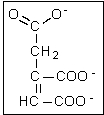
(Multiple Choice)
4.9/5 (83)
(83) Matching
Choose the correct answer from the list. Not all the answers will be used.
-The enzyme ______ is unique because it contains an iron-sulfur cluster but does not participate in a redox reaction.
(Multiple Choice)
4.8/5 (62)
(62) The reaction catalyzed by pyruvate carboxylase is an example of a(n)______ reaction because it replenishes the citric acid cycle intermediates that have been siphoned off for use in other reactions.
(Multiple Choice)
4.7/5 (88)
(88) Which of the following is oxidized by a multienzyme complex that requires five different coenzymes?
(Multiple Choice)
4.7/5 (79)
(79) 
Filters
- Essay(0)
- Multiple Choice(0)
- Short Answer(0)
- True False(0)
- Matching(0)