



 Chat with AI
Exam 8: Carbohydrates

Exam 1: Introduction to the Chemistry of Life56 Questions
Exam 2: Water59 Questions
Exam 3: Nucleotides, Nucleic Acids, and Genetic Information68 Questions
Exam 4: Amino Acids68 Questions
Exam 5: Proteins: Primary Structure68 Questions
Exam 6: Proteins: Three-Dimensional Structure60 Questions
Exam 7: Protein Function Part I: Myoglobin and Hemoglobin74 Questions
Exam 8: Carbohydrates66 Questions
Exam 9: Lipids and Biological Membranes59 Questions
Exam 10: Membrane Transport50 Questions
Exam 11: Enzyme Catalysis53 Questions
Exam 12: Enzyme Kinetics, Inhibition and Control55 Questions
Exam 13: Biochemical Signaling50 Questions
Exam 14: Introduction to Metabolism52 Questions
Exam 15: Glycogen Metabolism and Gluconeogenesis50 Questions
Exam 16: Glucose Catabolism50 Questions
Exam 17: Citric Acid Cycle50 Questions
Exam 18: Electron Transport and Oxidative Phosphorylation50 Questions
Exam 19: Photosynthesis50 Questions
Exam 20: Lipid Metabolism51 Questions
Exam 21: Amino Acid Metabolism50 Questions
Exam 22: Mammalian Fuel Metabolism: Integration and Regulation50 Questions
Exam 23: Nucleotide Metabolism50 Questions
Exam 24: Nucleic Acid Structure50 Questions
Exam 25: Dna Replication, Repair and Recombination50 Questions
Exam 26: Transcription and Rna Processing50 Questions
Exam 27: Translation49 Questions
Exam 28: Regulation of Gene Expression50 Questions
Select questions type


Which of the following is a mixture of two types of polymers?
(Multiple Choice)
4.8/5  (79)
(79) Matching
-Both (1 4)and (1 6)bonds can be found in the plant product______.
(Multiple Choice)
4.9/5 (82)
(82) Which of the following polysaccharides cannot be digested by mammalian salivary, gastric, or pancreatic enzymes?
(Multiple Choice)
4.9/5 (79)
(79) Which of the following statements applies to all artificial sweeteners?
(Multiple Choice)
4.9/5 (81)
(81) This figure is used in questions . 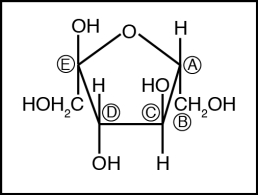 -The configuration around which carbon atom shown in the figure above determines whether this is a D or an L sugar?
 (Multiple Choice)
4.9/5 (82)
(82) Which of the following is an example of a heteropolysaccharide?
(Multiple Choice)
4.9/5 (79)
(79) The figure below shows structures of several types of sugars.Which one is an aldonic acid?
(Multiple Choice)
4.9/5 (71)
(71) A saccharide that has free aldehyde group is called a(n)_____________.
(Multiple Choice)
4.8/5 (77)
(77) This figure is used in questions .
-The structure shown in the figure above represents a
-The structure shown in the figure above represents a (Multiple Choice)
4.7/5 (76)
(76) The bonding of alcohols to the anomeric center of a carbohydrate results in the formation of a(n)__________ bond.
(Multiple Choice)
4.7/5 (84)
(84) Which of the following sequences represents a recognition site for N-linked glycosylation where X is any amino acid except Pro?
(Multiple Choice)
4.7/5 (77)
(77) This figure is used in questions . 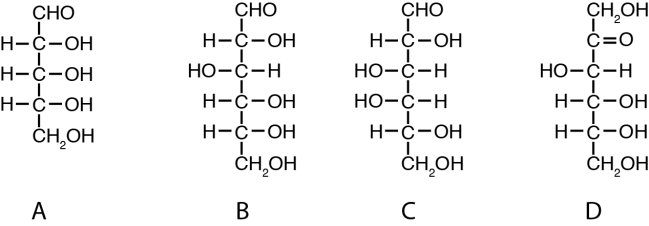 -Which structure shown in the figure above is a ketohexose?
 (Multiple Choice)
4.9/5 (68)
(68) This figure is used in questions 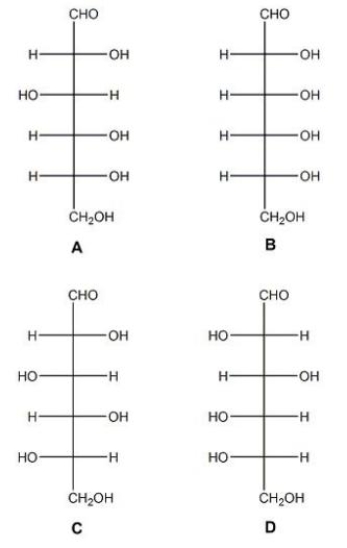 -Which of the sugars shown in the figure above are L sugars?
 (Multiple Choice)
4.8/5 (80)
(80) The structure below shows a Fischer projection of D-idose. 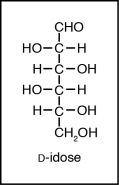 Which of the structures below represents -D-idopyranose
 (Multiple Choice)
4.9/5 (83)
(83) We encounter a great variety of sugars in living organisms.
a.Draw a Haworth projection of an aldohexose in the pyranose form (include all atoms).
b.Draw the Haworth projection of the anomer of the aldose you drew in "a" above.
c.Draw a circle around the carbon that determines whether this sugar is a D or an L sugar.
d.How many chiral carbon atoms are present in each of the structures drawn in "a" and
b" above?
e.How many stereoisomers exist for these pyranoses?
(Essay)
4.8/5 (75)
(75) 
Filters
- Essay(0)
- Multiple Choice(0)
- Short Answer(0)
- True False(0)
- Matching(0)