



 Chat with AI
Exam 14: Chemical Equilibrium

Exam 1: Chemical Tools: Experimentation and Measurement154 Questions
Exam 2: Atoms, molecules, and Ions275 Questions
Exam 3: Mass Relationships in Chemical Reactions159 Questions
Exam 4: Reactions in Aqueous Solutions211 Questions
Exam 5: Periodicity and the Electronic Structure of Atoms168 Questions
Exam 6: Ionic Compounds: Periodic Trends and Bonding138 Questions
Exam 7: Covalent Bonding and Electron-Dot Structures92 Questions
Exam 8: Covalent Compounds: Bonding Theories and Molecular Structure205 Questions
Exam 9: Thermochemistry: Chemical Energy170 Questions
Exam 10: Gases: Their Properties and Behavior188 Questions
Exam 11: Liquids, solids, and Phase Changes141 Questions
Exam 12: Solutions and Their Properties198 Questions
Exam 13: Chemical Kinetics190 Questions
Exam 14: Chemical Equilibrium171 Questions
Exam 15: Aqueous Equilibria: Acids and Bases231 Questions
Exam 16: Applications of Aqueous Equilibria201 Questions
Exam 17: Thermodynamics: Entropy, free Energy, and Equilibrium150 Questions
Exam 18: Electrochemistry212 Questions
Exam 19: Nuclear Chemistry176 Questions
Exam 20: Transition Elements and Coordination Chemistry190 Questions
Exam 21: Metals and Solid-State Materials154 Questions
Exam 22: The Main-Group Elements294 Questions
Exam 23: Connections to Organic and Biological Chemistry290 Questions
Select questions type


The decomposition of ammonia is: 2 NH3(g)= N2(g)+ 3 H2(g).If Kp is 1.5 × 10³ at 400°C,what is the partial pressure of ammonia at equilibrium when N2 is 0.10 atm and H2 is 0.15 atm?
(Multiple Choice)
4.7/5  (92)
(92) If Kc = 0.600,and Kp = 359 for a hypothetical reaction,which of the equations below could represent the reaction at 25°C?
(Multiple Choice)
4.8/5 (80)
(80) The following two isomers of C3H7NO exist in equilibrium with each other in solution: 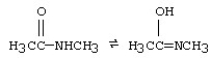 If Kc = 0.57 at 25°C and the initial concentration of the reactant is 0.50 M and the product is 0.70 M,what are the concentrations at equilibrium?
 (Multiple Choice)
4.7/5 (81)
(81) The reaction below virtually goes to completion because cyanide ion forms very stable complexes with Ni2+ ion: [Ni(H2O)6]2+(aq)+ 4 CN-(aq)→ [Ni(CN)4]2-(aq)+ 6 H2O(l)
At the same time,incorporation of 14C labelled cyanide ion (14CN-)is very rapid:
[Ni(CN)4]2-(aq)+ 4 14CN-(aq)= [Ni(14CN)4]2-(aq)+ 4 CN-(aq)
Which statement below is correct with regard to stability and rate of reaction?
(Multiple Choice)
4.9/5 (79)
(79) The reaction CaCO3(s)⇌ CaO(s)+ O2(g)is endothermic 298 K.The effect of adding CaO to the system at equilibrium will ________ (decrease,increase,have no effect on)the total quantity of CaO once equilibrium is reestablished.
(Short Answer)
5.0/5 (87)
(87) The hexaammine cobalt(III)ion is very unstable in acidic aqueous solution: [Co(NH3)6]3+(aq)+ 6 H3O+(aq)→ [Co(H2O)6]4+(aq)+ 6 NH4+(aq)
However,solutions of hexaammine cobalt(III)can be stored in acidic solution for months without noticeable decomposition.Which statement below about the equilibrium constant and the activation energy for the reaction is true?
(Multiple Choice)
4.9/5 (71)
(71) If Kc = 7.04 × 10⁻² for the reaction: 2 HBr(g)⇌ H2(g)+ Br2(g),what is the value of Kc for the reaction:  ?
? (Multiple Choice)
4.8/5 (73)
(73) Consider the interconversion of A molecules (shaded spheres)and B molecules (unshaded spheres)according to the reaction A ⇌ B.Each of the following series of pictures represents a separate experiment in which time increases from left to right. 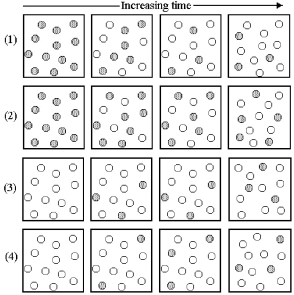 -What is the value of the equilibrium constant Kc for the reaction A ⇌ B?
 (Multiple Choice)
4.9/5 (77)
(77) The decomposition of ammonia is: 2 NH3(g)= N2(g)+ 3 H2(g).If Kp is 1.5 × 10³ at 400°C,what is the partial pressure of ammonia at equilibrium when N2 is 0.40 atm and H2 is 0.15 atm?
(Multiple Choice)
4.9/5 (75)
(75) For the reaction: N2(g)+ 2 O2(g)⇌ 2 NO2(g),Kc = 8.3 × 10⁻¹⁰ at 25°C.What is the concentration of N2 gas at equilibrium when the concentration of NO2 is twice the concentration of O2 gas?
(Multiple Choice)
4.8/5 (83)
(83) The decomposition of ammonia is: 2 NH3(g)⇌ N2(g)+ 3 H2(g).If the pressure of ammonia is 1.0 × 10⁻³ atm,and the pressures of N2 and H2 are each 0.20 atm,what is the value for Kp' at 400°C for the reverse reaction?
(Multiple Choice)
4.8/5 (85)
(85) The pink and blue species below form a violet colored mixture at equilibrium: [Co(H2O)6]2+ (aq)+ 4 Cl- (aq)⇌ [CoCl4]2- (aq)+ 6 H2O (l)
(pink)(blue)
If the concentration of [Co(H2O)6]2+ is increased,what happens to the solution?
(Multiple Choice)
4.8/5 (78)
(78) At 298 K,Kp = 2.1 × 10⁴ for the reaction CO(g)+ 2 H2(g)⇌ CH3OH(g).What is the value of Kc at this temperature?
(Short Answer)
4.8/5 (82)
(82) For the reaction CaCO3(s)⇌ CaO(s)+ O2(g)the equilibrium expression is Kp = ________.
(Short Answer)
4.8/5 (61)
(61) What effect will a change in temperature have on the value of Kp?
(Multiple Choice)
4.8/5 (75)
(75) A catalyst increases the overall rate of reaction by lowering the activation energy,Ea,for
(Multiple Choice)
4.9/5 (72)
(72) As a rule,which of the following phases are not included in the equilibrium constant expression? I.pure liquids II.pure solids III.aqueous solutions IV.gases
(Multiple Choice)
4.8/5 (72)
(72) The following picture represents the equilibrium state for the reaction A2 + B2 ⇌ 2AB.What is the relationship between the rate constant for the forward reaction,kf,and the rate constant for the reverse reaction kr? 
(Multiple Choice)
4.9/5 (87)
(87) Kp is related to Kc by the equation Kp = Kc (RT)n.What is the value of n for the reaction below? NH4NO3(s)⇌ N2O(g)+ 2 H2O(g)
(Multiple Choice)
4.9/5 (88)
(88) 
Filters
- Essay(0)
- Multiple Choice(0)
- Short Answer(0)
- True False(0)
- Matching(0)