



 Chat with AI
Exam 19: Nuclear Chemistry

Exam 1: Chemical Tools: Experimentation and Measurement154 Questions
Exam 2: Atoms, molecules, and Ions275 Questions
Exam 3: Mass Relationships in Chemical Reactions159 Questions
Exam 4: Reactions in Aqueous Solutions211 Questions
Exam 5: Periodicity and the Electronic Structure of Atoms168 Questions
Exam 6: Ionic Compounds: Periodic Trends and Bonding138 Questions
Exam 7: Covalent Bonding and Electron-Dot Structures92 Questions
Exam 8: Covalent Compounds: Bonding Theories and Molecular Structure205 Questions
Exam 9: Thermochemistry: Chemical Energy170 Questions
Exam 10: Gases: Their Properties and Behavior188 Questions
Exam 11: Liquids, solids, and Phase Changes141 Questions
Exam 12: Solutions and Their Properties198 Questions
Exam 13: Chemical Kinetics190 Questions
Exam 14: Chemical Equilibrium171 Questions
Exam 15: Aqueous Equilibria: Acids and Bases231 Questions
Exam 16: Applications of Aqueous Equilibria201 Questions
Exam 17: Thermodynamics: Entropy, free Energy, and Equilibrium150 Questions
Exam 18: Electrochemistry212 Questions
Exam 19: Nuclear Chemistry176 Questions
Exam 20: Transition Elements and Coordination Chemistry190 Questions
Exam 21: Metals and Solid-State Materials154 Questions
Exam 22: The Main-Group Elements294 Questions
Exam 23: Connections to Organic and Biological Chemistry290 Questions
Select questions type


Which of the following statements about positrons is false?

Free
(Multiple Choice)
4.9/5  (69)
(69) Correct Answer: Verified
D
The practical limit for 14C dating occurs when its activity falls to 0.20% of its original value due to interference in detectors by natural background radiation.If the half-life is 5715 years,what is the maximum age of a sample that can be dated by 14C without interference?
Free
(Multiple Choice)
4.8/5 (85)
(85) Correct Answer:Verified
VerifiedC
Iodine-123,used in thyroid therapy,has a half-life of 13.27 hours.How many half-lives are required for a 160 mg sample of iodine-123 to decay to 5.0 mg?
Free
(Multiple Choice)
4.9/5 (74)
(74) Correct Answer:Verified
VerifiedC
In an electron capture reaction a proton is converted into a ________.
(Short Answer)
4.8/5 (86)
(86) Which of the following elements would be expected to be particularly stable?
(Multiple Choice)
4.9/5 (69)
(69) Which of the following reactions correctly shows the transmutation of an element by neutron absorption followed by beta emission?
(Multiple Choice)
4.8/5 (69)
(69) What is needed to balance the nuclear transmutation reaction below?  Am →
 Np + ?
Am → Np + ? (Essay)
4.7/5 (79)
(79) Which of the following statements about gamma radiation is false?
(Multiple Choice)
4.7/5 (83)
(83) In the transmutation reaction that results in the formation of berkelium-243,shown below,the nucleus that is bombarded by alpha particles is ________.
? +  He →
 Bk + 2
 n
He → Bk + 2 n (Essay)
4.7/5 (84)
(84) The decay constant,k,is given for each of the beta emitters below.Which one has the shortest half life?
(Multiple Choice)
4.9/5 (84)
(84) Which reaction below represents  Ti decay by electron capture?
 (Multiple Choice)
5.0/5 (69)
(69) What is the abbreviation used for the curie,a unit used in the measurement of nuclear disintegrations per unit time?
(Multiple Choice)
4.7/5 (100)
(100) Which unit of radiation is frequently used in medicine to describe the amount of tissue damage caused by a radioactive substance?
(Multiple Choice)
4.9/5 (70)
(70) A shorthand way of writing transmutation equations is to show the bombarding particle and the subsequent emitted particle in parentheses.Which of the following equations shows the balanced nuclear reaction for  Li (n,α)?
 (Multiple Choice)
4.9/5 (84)
(84) What percentage of a radioactive substance remains after 6.00 half-lives have elapsed?
(Multiple Choice)
4.8/5 (79)
(79) The term "nucleons" refers to the number of ________ in the atom.
(Multiple Choice)
4.9/5 (76)
(76) Which of the following nuclides is most likely to undergo beta decay?
(Multiple Choice)
4.8/5 (87)
(87)  U2+ nucleus is
Tell the type of decay process occurring in the following nuclear reaction. 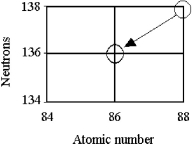
(Multiple Choice)
4.8/5 (72)
(72) 
Filters
- Essay(0)
- Multiple Choice(0)
- Short Answer(0)
- True False(0)
- Matching(0)