



 Chat with AI
Exam 19: Nuclear Chemistry

Exam 1: Chemical Tools: Experimentation and Measurement154 Questions
Exam 2: Atoms, molecules, and Ions275 Questions
Exam 3: Mass Relationships in Chemical Reactions159 Questions
Exam 4: Reactions in Aqueous Solutions211 Questions
Exam 5: Periodicity and the Electronic Structure of Atoms168 Questions
Exam 6: Ionic Compounds: Periodic Trends and Bonding138 Questions
Exam 7: Covalent Bonding and Electron-Dot Structures92 Questions
Exam 8: Covalent Compounds: Bonding Theories and Molecular Structure205 Questions
Exam 9: Thermochemistry: Chemical Energy170 Questions
Exam 10: Gases: Their Properties and Behavior188 Questions
Exam 11: Liquids, solids, and Phase Changes141 Questions
Exam 12: Solutions and Their Properties198 Questions
Exam 13: Chemical Kinetics190 Questions
Exam 14: Chemical Equilibrium171 Questions
Exam 15: Aqueous Equilibria: Acids and Bases231 Questions
Exam 16: Applications of Aqueous Equilibria201 Questions
Exam 17: Thermodynamics: Entropy, free Energy, and Equilibrium150 Questions
Exam 18: Electrochemistry212 Questions
Exam 19: Nuclear Chemistry176 Questions
Exam 20: Transition Elements and Coordination Chemistry190 Questions
Exam 21: Metals and Solid-State Materials154 Questions
Exam 22: The Main-Group Elements294 Questions
Exam 23: Connections to Organic and Biological Chemistry290 Questions
Select questions type


The mass change for the reaction shown below is ________ amu.The atomic masses are 3He (3.0160),4He (4.0026),1H (1.0078).
2  He →
 He + 2
 H
He → He + 2 H (Short Answer)
4.9/5  (86)
(86) Units used for measuring radiation include the becquerel,the curie,the gray,and the sievert,which have the abbreviations ________,________,________,and ________,respectively.
(Essay)
4.9/5 (84)
(84) Which of the following elements would you expect to have the largest number of stable isotopes? Element number:
(Multiple Choice)
4.8/5 (85)
(85) Helium-3,an electron,a neutron,and a proton have masses of 3.016029 amu,5.486 × 10-4 amu,1.00866 amu,and 1.00728 amu,respectively.The mass defect for the formation of helium-3 is ________ amu or ________ g/mol.
(Short Answer)
4.9/5 (78)
(78) Fluorine-18 is a radioisotope widely used in positron emission tomography to investigate brain activity.The half-life is 109.8 minutes.How long will it take for 2.75 μg of 18F to decay to 500 ng?
(Multiple Choice)
4.7/5 (83)
(83) Tritium,  H,is formed in the upper atmosphere when
 N captures a neutron and then decays.What is the other product of this reaction?
H,is formed in the upper atmosphere when N captures a neutron and then decays.What is the other product of this reaction? (Multiple Choice)
4.8/5 (71)
(71) Which of the following statements regarding nuclear stability is true?
(Multiple Choice)
5.0/5 (81)
(81) An element,  X is formed by bombardment of uranium-238 atoms with a beta particle.How many neutrons are produced by this reaction?
 (Multiple Choice)
4.9/5 (73)
(73) Among the types of radiation,α,β,γ,and X,the one that requires the least amount of protective clothing is ________ radiation.
(Essay)
4.8/5 (78)
(78) An archeological artifact was subjected to radiocarbon dating.The artifact showed a carbon-14 decay rate of 13.8 disintegrations/min per gram of carbon.Carbon-14 has a half-life of 5715 years,and currently living organisms decay at the rate of 15.3 disintegrations/min per gram of carbon.What is the approximate age of the artifact?
(Multiple Choice)
4.8/5 (64)
(64) Elements with ________ atomic mass are best possible candidates for a fusion reaction.
(Multiple Choice)
4.8/5 (88)
(88) What mass percent of 235U (the fissionable isotope)is used in the fuel in nuclear power plants?
(Multiple Choice)
4.8/5 (76)
(76) The binding energy for lithium-7 nuclei is 3.79 × 10¹² J/mol.The binding energy per nucleon for lithium-7 nuclei is ________ MeV/nucleon.
(Short Answer)
4.8/5 (88)
(88) The total binding energies for 3He,4He,and 6He are 7.72 MeV,28.29 MeV,and 29.26 MeV respectively.Arrange the 3 isotopes in increasing order of binding energy per nucleon.
(Multiple Choice)
4.9/5 (83)
(83) If a sample of 233Pa takes 62.7 days to decrease to 20.0% of its original mass,what is its half-life?
(Multiple Choice)
4.9/5 (82)
(82) What is the missing product of the nuclear reaction?  Bi +
 p → ? +
 Po
Bi + p → ? + Po (Multiple Choice)
4.7/5 (75)
(75) Human bones found on the west coast of the United States were thought to be remains of a prospector who lived in the 19th century.The bones were subjected to carbon-14 dating.Carbon-14 has a half-life of 5715 years.Living organisms decay at a rate of 15.30 disintegrations per minute per gram of carbon.The bones had a carbon-14 decay rate of 4.660 disintegrations per minute per gram of carbon.To one significant figure the age of the bones is ________ years old,so the person ________ (did,did not)live in the 19th century.
(Short Answer)
5.0/5 (81)
(81) Which of the following figures represents the decay of  K by positron emission to give
 Ar after three half-lives has passed? Unshaded spheres represent
 K atoms and shaded spheres represent
 Ar atoms.
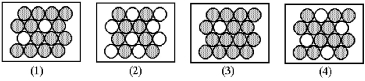
K by positron emission to give Ar after three half-lives has passed? Unshaded spheres represent K atoms and shaded spheres represent Ar atoms. (Multiple Choice)
4.8/5 (84)
(84) Which one of the following statements about isotopes is false?
(Multiple Choice)
4.8/5 (84)
(84) 
Filters
- Essay(0)
- Multiple Choice(0)
- Short Answer(0)
- True False(0)
- Matching(0)