



 Chat with AI
Exam 19: Nuclear Chemistry

Exam 1: Chemical Tools: Experimentation and Measurement154 Questions
Exam 2: Atoms, molecules, and Ions275 Questions
Exam 3: Mass Relationships in Chemical Reactions159 Questions
Exam 4: Reactions in Aqueous Solutions211 Questions
Exam 5: Periodicity and the Electronic Structure of Atoms168 Questions
Exam 6: Ionic Compounds: Periodic Trends and Bonding138 Questions
Exam 7: Covalent Bonding and Electron-Dot Structures92 Questions
Exam 8: Covalent Compounds: Bonding Theories and Molecular Structure205 Questions
Exam 9: Thermochemistry: Chemical Energy170 Questions
Exam 10: Gases: Their Properties and Behavior188 Questions
Exam 11: Liquids, solids, and Phase Changes141 Questions
Exam 12: Solutions and Their Properties198 Questions
Exam 13: Chemical Kinetics190 Questions
Exam 14: Chemical Equilibrium171 Questions
Exam 15: Aqueous Equilibria: Acids and Bases231 Questions
Exam 16: Applications of Aqueous Equilibria201 Questions
Exam 17: Thermodynamics: Entropy, free Energy, and Equilibrium150 Questions
Exam 18: Electrochemistry212 Questions
Exam 19: Nuclear Chemistry176 Questions
Exam 20: Transition Elements and Coordination Chemistry190 Questions
Exam 21: Metals and Solid-State Materials154 Questions
Exam 22: The Main-Group Elements294 Questions
Exam 23: Connections to Organic and Biological Chemistry290 Questions
Select questions type


 He is the symbol for ________.

The ratio of 238U to 206Pb is used to date old mineral samples.Each 1.000 g of 238U that decays eventually produces 0.866 g of 206Pb.If the half-life of 238U is 4.468 × 10⁹ years,what is the age of a mineral that has a 238U/206Pb mass ratio of 2.00?
(Multiple Choice)
4.8/5  (88)
(88) Which of the following processes will decrease the neutron/ proton ratio?
(Multiple Choice)
4.7/5 (79)
(79) Which one of the following processes does not result in transmutation to another element?
(Multiple Choice)
4.7/5 (75)
(75) Fluorine-18 is an isotope used in Positron Emission Tomography (PET)to scan the brain.If a researcher has 1.50 μg of 18F,how long before it decays to 1.0 ng? The half-life of 18F is 109.8 minutes.
(Multiple Choice)
4.7/5 (85)
(85) Calculate the mass defect for the formation of phosphorus-31.The mass of a phosphorus-31 nucleus is 30.973765 amu.The masses of a proton and a neutron are 1.00728 and 1.00866 amu,respectively.
(Multiple Choice)
4.7/5 (78)
(78) Tell the type of decay process occurring in the following nuclear reaction. 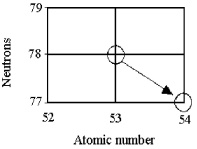
(Multiple Choice)
4.7/5 (73)
(73)  Po decays by electron capture to give
 Bi.If unshaded spheres represent
 Po atoms and shaded spheres represent
 Bi atoms,how many half-lives have passed in the following example?

Po decays by electron capture to give Bi.If unshaded spheres represent Po atoms and shaded spheres represent Bi atoms,how many half-lives have passed in the following example? (Multiple Choice)
4.9/5 (73)
(73) In addition to a beta particle,what is the other product of beta decay of  Tl?
Tl? (Multiple Choice)
4.9/5 (87)
(87) Which of the following decay processes give a product nuclide whose atomic number is one less than the starting nuclide?
(Multiple Choice)
4.8/5 (96)
(96) Tell the type of decay process occurring in the following nuclear reaction. 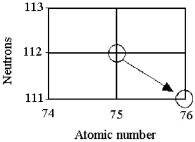
(Multiple Choice)
4.9/5 (88)
(88) The number of protons,neutrons,and total nucleons in  Ru are ________,________,and ________,respectively.
 (Short Answer)
4.8/5 (75)
(75) When  Dy is formed by bombardment of
 Gd,what particle(s)was (were)used for the bombardment?
Dy is formed by bombardment of Gd,what particle(s)was (were)used for the bombardment? (Multiple Choice)
4.8/5 (69)
(69) If a log contains 60.0% of the 14C present in a living tree,how long has the log been dead? The half-life of 14C is 5730 years.
(Multiple Choice)
4.8/5 (79)
(79)  -What kind of decay process is occurring in the decay of isotope B to isotope C in the figure shown above?
 (Multiple Choice)
4.8/5 (84)
(84)
-What kind of decay process is occurring in the decay of isotope A to isotope B in the figure shown above?
-What kind of decay process is occurring in the decay of isotope A to isotope B in the figure shown above? (Multiple Choice)
4.9/5 (82)
(82) 
Filters
- Essay(0)
- Multiple Choice(0)
- Short Answer(0)
- True False(0)
- Matching(0)