



 Chat with AI
Exam 19: Nuclear Chemistry

Exam 1: Chemical Tools: Experimentation and Measurement154 Questions
Exam 2: Atoms, molecules, and Ions275 Questions
Exam 3: Mass Relationships in Chemical Reactions159 Questions
Exam 4: Reactions in Aqueous Solutions211 Questions
Exam 5: Periodicity and the Electronic Structure of Atoms168 Questions
Exam 6: Ionic Compounds: Periodic Trends and Bonding138 Questions
Exam 7: Covalent Bonding and Electron-Dot Structures92 Questions
Exam 8: Covalent Compounds: Bonding Theories and Molecular Structure205 Questions
Exam 9: Thermochemistry: Chemical Energy170 Questions
Exam 10: Gases: Their Properties and Behavior188 Questions
Exam 11: Liquids, solids, and Phase Changes141 Questions
Exam 12: Solutions and Their Properties198 Questions
Exam 13: Chemical Kinetics190 Questions
Exam 14: Chemical Equilibrium171 Questions
Exam 15: Aqueous Equilibria: Acids and Bases231 Questions
Exam 16: Applications of Aqueous Equilibria201 Questions
Exam 17: Thermodynamics: Entropy, free Energy, and Equilibrium150 Questions
Exam 18: Electrochemistry212 Questions
Exam 19: Nuclear Chemistry176 Questions
Exam 20: Transition Elements and Coordination Chemistry190 Questions
Exam 21: Metals and Solid-State Materials154 Questions
Exam 22: The Main-Group Elements294 Questions
Exam 23: Connections to Organic and Biological Chemistry290 Questions
Select questions type


 N +
 e is ________.

 U undergoes alpha decay producing one alpha particle and a single nuclide.To balance the equation ________ and ________ must be added to the right side of the equation below.
 U → ? + ?
U undergoes alpha decay producing one alpha particle and a single nuclide.To balance the equation ________ and ________ must be added to the right side of the equation below. U → ? + ? (Essay)
4.9/5  (79)
(79) A binding energy curve is a plot of binding energy per nucleon versus atomic number.In what region of the binding energy curve are the most stable elements found?
(Multiple Choice)
4.9/5 (78)
(78) Which is more dangerous in terms of short-lived exposure to radiation? One mole of
(Multiple Choice)
4.9/5 (80)
(80) What is the binding energy (kJ/mol)for an element that has a mass defect of 3.33 × 10⁻²⁶ g? Remember that the unit for a joule is kg m-2 s-2.
(Multiple Choice)
4.9/5 (79)
(79) An average person receives 40 mrem of radiation from medical procedures annually.If a dose as low as 25 rem can lead to a decrease in white blood cell count,what is the maximum number of medical procedures that involve radiation allowable before white blood cell count decrease occurs?
(Short Answer)
4.7/5 (76)
(76) Which of the following figures represents the beta decay of  Mg to give
 Al after one half-life has passed? Unshaded spheres represent
 Mg atoms and shaded spheres represent
 Al atoms.
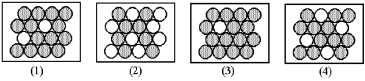
Mg to give Al after one half-life has passed? Unshaded spheres represent Mg atoms and shaded spheres represent Al atoms. (Multiple Choice)
4.7/5 (75)
(75) Which reaction below represents  Th decay by alpha emission?
 (Multiple Choice)
4.9/5 (72)
(72) Which type of radiation is not used for medical applications?
(Multiple Choice)
5.0/5 (84)
(84)  C decays by beta emission to give
 N.If unshaded spheres represent
 C atoms and shaded spheres represent
 N atoms,how many half-lives have passed in the following example?

C decays by beta emission to give N.If unshaded spheres represent C atoms and shaded spheres represent N atoms,how many half-lives have passed in the following example? (Multiple Choice)
4.9/5 (73)
(73) Four heavy elements (A, B, C, and D) will fission when bombarded by neutrons. In addition to fissioning into two smaller elements, A also gives off a beta particle, B gives off gamma rays, C gives off neutrons, and D gives off alpha particles. Which element would make a possible fuel for a nuclear reactor?
(Multiple Choice)
4.8/5 (65)
(65) In addition to a beta particle,what is the other product of beta decay of  I?
I? (Multiple Choice)
4.9/5 (76)
(76) The mass defect for the chemical reaction shown below is ________ g.
2 F → F2 E = -159 kJ/mol
(Short Answer)
4.7/5 (95)
(95) An experiment with 55Co takes 47.5 hours.At the end of the experiment,1.90 ng of 55Co remains.If the half life is 18.0 hours,how many ng of 55Co were originally present?
(Multiple Choice)
4.9/5 (80)
(80) The nuclear decay process that involves the particle having the greatest mass is ________ emission.
(Multiple Choice)
4.9/5 (73)
(73) A shorthand way of writing transmutation equations is to show the bombarding particle and the subsequent emitted particle in parentheses.Which particle is produced by  Li (p,α)?
 (Multiple Choice)
4.8/5 (83)
(83) Breaking a chemical bond requires approximately 102 kJ/mol of energy.What is closest to the order of magnitude of the energy required to split a nucleus in to its individual protons and neutrons?
(Multiple Choice)
4.8/5 (76)
(76) 
Filters
- Essay(0)
- Multiple Choice(0)
- Short Answer(0)
- True False(0)
- Matching(0)