



 Chat with AI
Exam 13: Chemical Kinetics

Exam 1: Chemical Tools: Experimentation and Measurement154 Questions
Exam 2: Atoms, molecules, and Ions275 Questions
Exam 3: Mass Relationships in Chemical Reactions159 Questions
Exam 4: Reactions in Aqueous Solutions211 Questions
Exam 5: Periodicity and the Electronic Structure of Atoms168 Questions
Exam 6: Ionic Compounds: Periodic Trends and Bonding138 Questions
Exam 7: Covalent Bonding and Electron-Dot Structures92 Questions
Exam 8: Covalent Compounds: Bonding Theories and Molecular Structure205 Questions
Exam 9: Thermochemistry: Chemical Energy170 Questions
Exam 10: Gases: Their Properties and Behavior188 Questions
Exam 11: Liquids, solids, and Phase Changes141 Questions
Exam 12: Solutions and Their Properties198 Questions
Exam 13: Chemical Kinetics190 Questions
Exam 14: Chemical Equilibrium171 Questions
Exam 15: Aqueous Equilibria: Acids and Bases231 Questions
Exam 16: Applications of Aqueous Equilibria201 Questions
Exam 17: Thermodynamics: Entropy, free Energy, and Equilibrium150 Questions
Exam 18: Electrochemistry212 Questions
Exam 19: Nuclear Chemistry176 Questions
Exam 20: Transition Elements and Coordination Chemistry190 Questions
Exam 21: Metals and Solid-State Materials154 Questions
Exam 22: The Main-Group Elements294 Questions
Exam 23: Connections to Organic and Biological Chemistry290 Questions
Select questions type


"Instantaneous rate" is defined as the

Free
(Multiple Choice)
4.9/5  (80)
(80) Correct Answer: Verified
C
In aqueous solution,hypobromite ion,BrO-,reacts to produce bromate ion,BrO3-,and bromide ion,Br-,according to the following chemical equation. 3 BrO-(aq)→ BrO3-(aq)+ 2 Br-(aq)
A plot of 1/[BrO-] vs.time is linear and the slope is equal to 0.056 M-1s-1.If the initial concentration of BrO- is 0.65 M,how long will it take one-half of the BrO- ion to react?
Free
(Multiple Choice)
4.7/5 (78)
(78) Correct Answer:Verified
VerifiedD
The following reaction is first order in A and first order in B: A + B → Products Rate = k[A][B]
What is the initial rate of this reaction in vessel (b)relative to the initial rate of this reaction in vessel (a)? Each vessel has the same volume.Shaded spheres represent A molecules,and unshaded spheres represent B molecules present at the beginning of the reaction. 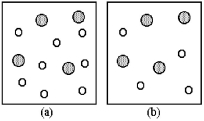
Free
(Multiple Choice)
4.8/5 (84)
(84) Correct Answer:Verified
VerifiedA
The first-order decomposition of hydrogen peroxide occurs according to the equation 2 H2O2(aq)→ 2 H2O(l)+ O2(g)
Using data from a concentration-time study of this reaction,which plot will produce a straight line?
(Multiple Choice)
4.7/5 (81)
(81) Consider a reaction that occurs by the following one-step mechanism:
A2 + B2 → 2 AB
The potential energy profile for this reaction is shown below.  -The activation energy for the forward reaction is given by the difference in energy between which two reaction stages?
 (Multiple Choice)
4.9/5 (88)
(88) Consider a reaction that occurs by the following one-step mechanism:
A2 + B2 → 2 AB
The potential energy profile for this reaction is shown below.
-What is the species present at reaction stage 1?
-What is the species present at reaction stage 1? (Multiple Choice)
4.7/5 (95)
(95) Consider a reaction that occurs by the following one-step mechanism:
A2 + B2 → 2 AB
The potential energy profile for this reaction is shown below.
-What is the species present at reaction stage 3?
-What is the species present at reaction stage 3? (Multiple Choice)
4.9/5 (85)
(85) 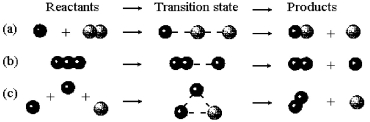 -Which of the elementary reactions shown above has a molecularity of one?
 (Multiple Choice)
4.8/5 (87)
(87) Consider the first-order reaction A → B in which A molecules (unshaded spheres)are converted to B molecules (shaded spheres).Given the following pictures at t = 0 seconds and t = 100 seconds,which picture represents the number of A and B molecules remaining at 300 seconds? 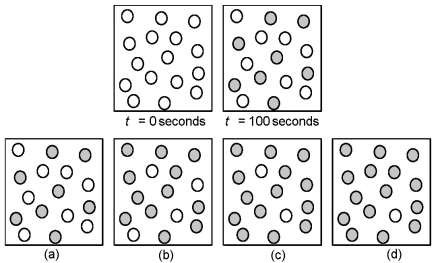
(Multiple Choice)
4.7/5 (62)
(62) The reaction A + B C + D occurs in one step.The activation energy is 132 kJ/mol and ΔE = -236 kJ/mol.What is the activation energy for the reverse reaction?
(Multiple Choice)
4.8/5 (73)
(73)
-Which of the elementary reactions shown above has a molecularity of two?
-Which of the elementary reactions shown above has a molecularity of two? (Multiple Choice)
4.8/5 (69)
(69) A concentration-time study of the gas phase reaction 2 A3 → 3 A2 produced the data in the table below. Time (s)[A3] (M)[A2] (M)
0 4.00 × 10⁻⁴ 0
10 2.00 × 10⁻⁴ 3.00 × 10⁻⁴
20 1.00 × 10⁻⁴ 4.50 × 10⁻⁴
30 5.00 × 10⁻⁵ ?
What is the average rate of decomposition of A3 in the time interval 20-30 seconds?
(Multiple Choice)
4.8/5 (78)
(78) What is the minimum energy barrier that must be overcome for a chemical reaction to occur?
(Multiple Choice)
4.9/5 (81)
(81) Shown is a concentration versus time plot for a reaction involving gases A,B,and C. 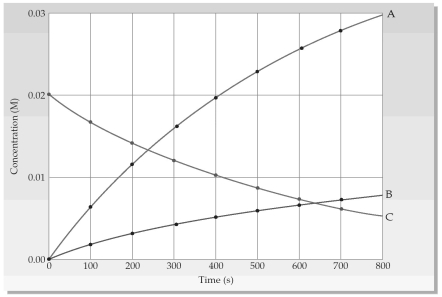 -Over the time interval 300 to 400 seconds,the rate of reaction with respect to A is Δ[A]/Δt = 3.7 × 10⁻⁵ M/s.What is the rate of reaction with respect to A over the time interval 0 to 100 seconds?
 (Multiple Choice)
4.8/5 (71)
(71) The reaction shown below has the rate law: Rate = k[BrO3-][Br-][H+]2. BrO3-(aq)+ 5 Br-(aq)+ 6 H+(aq)→ 3 Br2(aq)+ 3 H2O(l)
What is the order of reaction with respect to Br -?
(Multiple Choice)
4.9/5 (77)
(77) For a reaction that follows the general rate law,Rate = k[A][B]2,what will happen to the rate of reaction if the concentration of B is increased by a factor of 2.00? The rate will
(Multiple Choice)
4.9/5 (79)
(79) A reaction with an activation energy,Ea = 103 kJ/mol has a rate constant,k = 3.5 × 10⁻⁵ s-1 at 25°C.For this reaction the rate constant at 45°C is ________.
(Short Answer)
4.9/5 (82)
(82) For the reaction shown below,if the rate of formation of Br2 is 1.5 × 10⁻⁶ M/s,over the same time period the rate of consumption of H+ is ________ M/s.
ClO2-(aq)+ 4 Br-(aq)+ 4 H+(aq)→ Cl-(aq)+ 2 Br2(aq)+2 H2O(l)
(Short Answer)
4.9/5 (76)
(76) At 300°C decomposition of NO2(g)occurs with a rate law: Rate = - k[NO2]x.If the initial rate of decomposition is 3.2 × 10⁻⁵ M/s when [NO2]o = 8.0 × 10⁻³ M and the initial rate of decomposition is 8.0 × 10⁻⁶ M/s when [NO2]o = 4.0 × 10⁻³ M,then the order of reaction with respect to NO2,x = ________.
(Short Answer)
4.9/5 (93)
(93) Consider a reaction that occurs by the following mechanism:
A + BC → AC + B
AC + D → A + CD
The potential energy profile for this reaction is shown below. 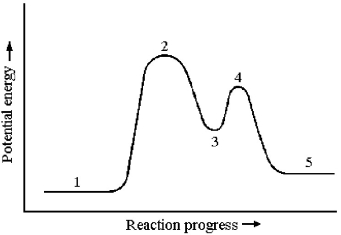 -Intermediates occur at which reaction stages?
 (Multiple Choice)
4.8/5 (82)
(82) 
Filters
- Essay(0)
- Multiple Choice(0)
- Short Answer(0)
- True False(0)
- Matching(0)