



 Chat with AI
Exam 13: Chemical Kinetics

Exam 1: Chemical Tools: Experimentation and Measurement154 Questions
Exam 2: Atoms, molecules, and Ions275 Questions
Exam 3: Mass Relationships in Chemical Reactions159 Questions
Exam 4: Reactions in Aqueous Solutions211 Questions
Exam 5: Periodicity and the Electronic Structure of Atoms168 Questions
Exam 6: Ionic Compounds: Periodic Trends and Bonding138 Questions
Exam 7: Covalent Bonding and Electron-Dot Structures92 Questions
Exam 8: Covalent Compounds: Bonding Theories and Molecular Structure205 Questions
Exam 9: Thermochemistry: Chemical Energy170 Questions
Exam 10: Gases: Their Properties and Behavior188 Questions
Exam 11: Liquids, solids, and Phase Changes141 Questions
Exam 12: Solutions and Their Properties198 Questions
Exam 13: Chemical Kinetics190 Questions
Exam 14: Chemical Equilibrium171 Questions
Exam 15: Aqueous Equilibria: Acids and Bases231 Questions
Exam 16: Applications of Aqueous Equilibria201 Questions
Exam 17: Thermodynamics: Entropy, free Energy, and Equilibrium150 Questions
Exam 18: Electrochemistry212 Questions
Exam 19: Nuclear Chemistry176 Questions
Exam 20: Transition Elements and Coordination Chemistry190 Questions
Exam 21: Metals and Solid-State Materials154 Questions
Exam 22: The Main-Group Elements294 Questions
Exam 23: Connections to Organic and Biological Chemistry290 Questions
Select questions type


The first-order reaction,SO2Cl2 → SO2 + Cl2,has a rate constant equal to 2.20 × 10⁻⁵ s-1 at 593 K.What percentage of the initial amount of SO2Cl2 will remain after 2.00 hours?
(Multiple Choice)
4.8/5  (72)
(72) The relative initial rates of the reaction A2 + B2 → products in vessels (a)-(d)are 1:1:4:4.Unshaded spheres represent A2 molecules,and shaded spheres represent B2 molecules present at the beginning of the reaction.  -What is the rate law for this reaction?
 (Multiple Choice)
4.7/5 (62)
(62) The rate constant,k,for a first-order reaction is equal to 4.2 × 10⁻⁴ s-1.What is the half-life for the reaction?
(Multiple Choice)
4.9/5 (83)
(83) Which of the following does not affect the rate of a bimolecular reaction?
(Multiple Choice)
4.9/5 (91)
(91) The reaction shown below has the rate law: Rate = k[BrO3-][Br-][H+]2.The order of reaction with respect to H+ is ________ and the overall order is ________.
BrO3-(aq)+ 5 Br-(aq)+ 6 H+(aq)→ 3 Br2(aq)+ 3 H2O(l)
(Short Answer)
4.8/5 (85)
(85) The reaction between chlorine and nitric oxide to form nitrosyl chloride is shown below.If the reaction rate doubles when the concentration of Cl2 is doubled and the rate quadruples when the concentration of NO is doubled,by what factor will the rate increase if both concentrations,NO and Cl2,are doubled? Cl2(g)+ 2 NO(g)→ 2 NOCl(g)
(Multiple Choice)
4.8/5 (78)
(78) 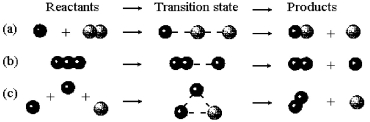 -Which of the elementary reactions shown above has a molecularity of three?
 (Multiple Choice)
4.7/5 (78)
(78) Nitrogen dioxide decomposes at 300°C via a second-order process to produce nitrogen monoxide and oxygen according to the following chemical equation. 2 NO2(g)→ 2 NO(g)+ O2(g).
A sample of NO2(g)is initially placed in a 2.50-L reaction vessel at 300°C.If the half-life and the rate constant at 300°C are 11 seconds and 0.54 M-1 s-1,respectively,how many moles of NO2 were in the original sample?
(Multiple Choice)
4.9/5 (80)
(80) What is the rate law for the elementary reaction shown below? 2 HI → H2 + I2
(Multiple Choice)
4.8/5 (83)
(83) The hydrolysis of tert-butyl chloride is given in the reaction below: (CH3)3CCl(aq)+ H2O(l)→ (CH3)3COH(aq)+ H+(aq)+ Cl-(aq)
If the rate law is: Rate = k[(CH3)3CCl],what is the order of the reaction with respect to water?
(Multiple Choice)
4.8/5 (78)
(78) According to kinetic molecular theory,which of the following will decrease the rate of reaction?
(Multiple Choice)
4.9/5 (79)
(79) Molecular hydrogen can be made from methane gas by the reaction below.How is the rate of disappearance of CH4 related to the rate of appearance of H2? -  = ?
CH4 (g)+ H2O (l)→ CO (g)+ 3H2 (g)
= ?
CH4 (g)+ H2O (l)→ CO (g)+ 3H2 (g) (Multiple Choice)
4.7/5 (69)
(69) The second-order reaction,2 Mn(CO)5 → Mn2(CO)10 has a rate constant equal to 3.0 × 10⁹ M-1s-1 at 25°C.If the initial concentration of Mn(CO)5 is 1.0 × 10⁻⁵ M,how long will it take for 90.% of the reactant to disappear?
(Multiple Choice)
4.8/5 (96)
(96) The half life of the reaction shown below is found not to depend on the concentration of H2O2(aq). 2 H2O2(aq)→ 2 H2O(l)+ O2(g)
What is the order of this reaction?
(Multiple Choice)
4.9/5 (84)
(84) The aquation of tris(1,10-phenanthroline)iron(II)in acid solution takes place according to the equation: Fe(phen)32+ + 3 H3O+ + 3 H2O → Fe(H2O)62+ + 3 phenH+
If the activation energy,Ea,is 126 kJ/mol and the rate constant at 30°C is 9.8 × 10⁻³ min-1,what is the frequency factor,A?
(Multiple Choice)
4.7/5 (94)
(94) At an elevated temperature the decomposition of a gaseous oxide,AO2 occurs with a rate constant,k = 0.54 M-1s-1.If the half-life of this reaction is 926 seconds when [AO2] = 2.0 × 10⁻³ M and 462 seconds when [AO2] = 4.0 × 10⁻³ M,this reaction is ________ order.
(Short Answer)
4.9/5 (77)
(77) The following set of data was obtained by the method of initial rates for the reaction: BrO3-(aq)+ 5 Br-(aq)+ 6 H+(aq)→ 3 Br2(aq)+ 3 H2O(l).
Calculate the initial rate when BrO3- is 0.30 M,Br- is 0.050 M,and H+ is 0.15 M. 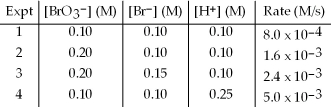
(Multiple Choice)
4.9/5 (80)
(80) When the temperature of a gas whose activation energy is 55 kJ/mol is increased from 300 K to 320 K,the fraction of collisions with sufficient energy to react
(Multiple Choice)
4.7/5 (69)
(69) The following reaction is first order,C2H6 → 2 CH3.If the rate constant is equal to 5.5 × 10⁻⁴ s-1 at 1000 K,how long will it take for 0.35 mol of C2H6 in a 1.00 L container to decrease to 0.25 mol in the same container?
(Multiple Choice)
4.9/5 (87)
(87) 
Filters
- Essay(0)
- Multiple Choice(0)
- Short Answer(0)
- True False(0)
- Matching(0)