



 Chat with AI
Exam 13: Chemical Kinetics

Exam 1: Chemical Tools: Experimentation and Measurement154 Questions
Exam 2: Atoms, molecules, and Ions275 Questions
Exam 3: Mass Relationships in Chemical Reactions159 Questions
Exam 4: Reactions in Aqueous Solutions211 Questions
Exam 5: Periodicity and the Electronic Structure of Atoms168 Questions
Exam 6: Ionic Compounds: Periodic Trends and Bonding138 Questions
Exam 7: Covalent Bonding and Electron-Dot Structures92 Questions
Exam 8: Covalent Compounds: Bonding Theories and Molecular Structure205 Questions
Exam 9: Thermochemistry: Chemical Energy170 Questions
Exam 10: Gases: Their Properties and Behavior188 Questions
Exam 11: Liquids, solids, and Phase Changes141 Questions
Exam 12: Solutions and Their Properties198 Questions
Exam 13: Chemical Kinetics190 Questions
Exam 14: Chemical Equilibrium171 Questions
Exam 15: Aqueous Equilibria: Acids and Bases231 Questions
Exam 16: Applications of Aqueous Equilibria201 Questions
Exam 17: Thermodynamics: Entropy, free Energy, and Equilibrium150 Questions
Exam 18: Electrochemistry212 Questions
Exam 19: Nuclear Chemistry176 Questions
Exam 20: Transition Elements and Coordination Chemistry190 Questions
Exam 21: Metals and Solid-State Materials154 Questions
Exam 22: The Main-Group Elements294 Questions
Exam 23: Connections to Organic and Biological Chemistry290 Questions
Select questions type


The isomerization reaction,CH3NC → CH3CN,is first order and the rate constant is equal to 0.46 s-1 at 600 K.What is the concentration of CH3NC after 0.20 minutes if the initial concentration is 0.40 M?
(Multiple Choice)
5.0/5  (85)
(85) A reaction has a rate constant,k = 1.2 × 10⁻¹² s-1 at 273 K and k = 5.1 × 10⁻⁷ s-1 at 373 K has an activation energy,Ea = ________ kJ/mol.
(Short Answer)
4.9/5 (78)
(78) Iodide and hypochlorite ion react in aqueous solution according to the reaction below: I- + OCl- → OI- + Cl-
If the concentration of OH- in the solution is doubled,the rate of the reaction is halved.What is the order of the reaction with respect to OH-?
(Multiple Choice)
4.8/5 (77)
(77) The decomposition of dinitrogen pentoxide is described by the chemical equation 2 N2O5(g)→ 4 NO2(g)+ O2(g)
If the rate of appearance of O2 is equal to 2.40 mol/min at a particular moment,what is the rate of disappearance of N2O5 at that moment?
(Multiple Choice)
4.9/5 (82)
(82) The reaction below is first order in H2 and second order in NO.What is the rate law for this reaction? 2 H2(g)+ 2 NO(g)→ N2(g)+ 2 H2O(g)
(Multiple Choice)
4.9/5 (81)
(81) The reaction for the decomposition of dinitrogen monoxide gas to form an oxygen radical is:  .If the activation energy is 250 kJ/mol and the frequency factor is 8.0 × 10¹¹ s-1,what is the rate constant for the first-order reaction at 1000 K?
 (Multiple Choice)
4.7/5 (77)
(77) The first-order isomerization reaction: cyclopropane → propene,has a rate constant of 1.10 × 10⁻⁴ s-1 at 470°C and 5.70 × 10⁻⁴ s-1 at 500°C.What is the activation energy,Ea,for the reaction?
(Multiple Choice)
4.8/5 (86)
(86) The decomposition of dinitrogen pentoxide is described by the chemical equation 2 N2O5(g)→ 4 NO2(g)+ O2(g)
If the rate of disappearance of N2O5 is equal to 1.40 mol/min at a particular moment,what is the rate of appearance of NO2 at that moment?
(Multiple Choice)
4.9/5 (67)
(67) Given the following hypothetical reaction: 2 E(g)+ F(g)+ G(g)→ products.If the rate law is: Rate = k[E]2[F]-1,what is the overall order of reaction?
(Multiple Choice)
4.9/5 (86)
(86) The reaction below is first order in H2 and one-half order in Br2.The rate law for this reaction is ________.
H2(g)+ Br2(g)→ 2 HBr(g)
(Essay)
4.9/5 (81)
(81) A gaseous compound,C,undergoes catalytic decomposition at an initial rate of 0.45 M/s when [C]o = 3.0 × 10⁻³ M and 0.45 M/s when [C]o = 9.0 × 10⁻³ M.Therefore,this is a ________ order reaction.
(Short Answer)
4.8/5 (74)
(74) For the reaction shown below,what is the relationship between the rate of formation of Br2 and the rate of reaction of ClO2- over the same time period? ClO2-(aq)+ 4 Br-(aq)+ 4 H+(aq)→ Cl-(aq)+ 2 Br2(aq)+2 H2O(l)
(Multiple Choice)
4.9/5 (88)
(88) Hydrogen iodide decomposes at 800 K via a second-order process to produce hydrogen and iodine according to the following chemical equation. 2HI(g)→ H2(g)+ I2(g)
At 800 K it takes 233 seconds for the initial concentration of HI to decrease from 5.75 × 10⁻² M to 2.50 × 10⁻² M.What is the rate constant for the reaction at this temperature?
(Multiple Choice)
4.9/5 (87)
(87) The following reaction is second order in A and first order in B: A + B → Products Rate = k[A]2[B]
What is the rate constant k of this reaction in vessel (b)relative to the rate constant k of this reaction in vessel (a)? Each vessel has the same volume.Shaded spheres represent A molecules,and unshaded spheres represent B molecules. 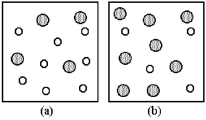
(Multiple Choice)
4.8/5 (82)
(82) The first-order reaction,2 N2O(g)→ 2 N2(g)+ O2(g),has a rate constant equal to 0.76 s-1 at 1000 K.How long will it take for the concentration of N2O to decrease to 6.0% of its initial concentration?
(Multiple Choice)
5.0/5 (90)
(90) Shown is a concentration versus time plot for a reaction involving gases A,B,and C. 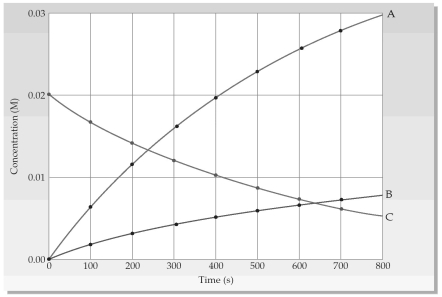 -Which equation best represents the reaction?
 (Multiple Choice)
4.7/5 (71)
(71) The reaction below is second order in ClO2 and first order in OH-.If the rate is expressed in M/s,the rate constant,k,has the units ________.
2 ClO2(aq)+ 2 OH-(aq)→ ClO3-(aq)+ ClO2-(aq)+ H2O(l)
(Short Answer)
4.8/5 (86)
(86) The first-order reaction,SO2Cl2 → SO2 + Cl2,has a half-life of 8.75 hours at 593 K.How long will it take for the concentration of SO2Cl2 to fall to 14.5% of its initial value?
(Multiple Choice)
4.8/5 (75)
(75) The following set of data was obtained by the method of initial rates for the reaction: 2 HgCl2(aq)+ C2O42-(aq)→ 2 Cl-(aq)+ 2 CO2(g)+ Hg2Cl2(s)
What is the value of the rate constant,k? 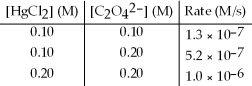
(Multiple Choice)
4.9/5 (75)
(75) For the first-order reaction,2 N2O(g)→ 2 N2(g)+ O2(g),what is the concentration of N2O after 3 half-lives if  mol of N2O is initially placed into a 1.00-L reaction vessel?
 (Multiple Choice)
4.8/5 (73)
(73) 
Filters
- Essay(0)
- Multiple Choice(0)
- Short Answer(0)
- True False(0)
- Matching(0)