



 Chat with AI
Exam 13: Chemical Kinetics

Exam 1: Chemical Tools: Experimentation and Measurement154 Questions
Exam 2: Atoms, molecules, and Ions275 Questions
Exam 3: Mass Relationships in Chemical Reactions159 Questions
Exam 4: Reactions in Aqueous Solutions211 Questions
Exam 5: Periodicity and the Electronic Structure of Atoms168 Questions
Exam 6: Ionic Compounds: Periodic Trends and Bonding138 Questions
Exam 7: Covalent Bonding and Electron-Dot Structures92 Questions
Exam 8: Covalent Compounds: Bonding Theories and Molecular Structure205 Questions
Exam 9: Thermochemistry: Chemical Energy170 Questions
Exam 10: Gases: Their Properties and Behavior188 Questions
Exam 11: Liquids, solids, and Phase Changes141 Questions
Exam 12: Solutions and Their Properties198 Questions
Exam 13: Chemical Kinetics190 Questions
Exam 14: Chemical Equilibrium171 Questions
Exam 15: Aqueous Equilibria: Acids and Bases231 Questions
Exam 16: Applications of Aqueous Equilibria201 Questions
Exam 17: Thermodynamics: Entropy, free Energy, and Equilibrium150 Questions
Exam 18: Electrochemistry212 Questions
Exam 19: Nuclear Chemistry176 Questions
Exam 20: Transition Elements and Coordination Chemistry190 Questions
Exam 21: Metals and Solid-State Materials154 Questions
Exam 22: The Main-Group Elements294 Questions
Exam 23: Connections to Organic and Biological Chemistry290 Questions
Select questions type


The decomposition of ozone in the stratosphere can occur by the following two-step mechanism: Br + O3 → BrO + O2
BrO + O → Br + O2
Which species is a catalyst in this mechanism?
(Multiple Choice)
4.7/5  (87)
(87) The following reaction is second order in A and first order in B: A + B → Products Rate = k[A]2[B]
What is the rate constant k of this reaction in vessel (b)relative to the rate constant k of this reaction in vessel (a)? Each vessel has the same volume.Shaded spheres represent A molecules,and unshaded spheres represent B molecules. 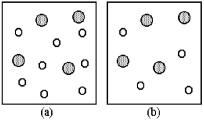
(Multiple Choice)
4.8/5 (69)
(69) Consider a reaction that occurs by the following mechanism:
A + BC → AC + B
AC + D → A + CD
The potential energy profile for this reaction is shown below. 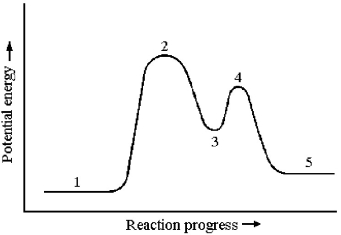 -Transition states occur at which reaction stages?
 (Multiple Choice)
5.0/5 (77)
(77) A gas molecule at 298 K and 1 atm pressure undergoes a collision with another gas molecule approximately every ________ seconds.
(Multiple Choice)
4.8/5 (92)
(92) Consider the first-order decomposition of A molecules (shaded spheres)in two vessels of equal volume.How will the rate of decomposition in vessel (a)be affected if the volume of the vessel is decreased by a factor of 2? 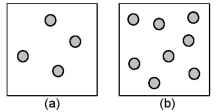
(Multiple Choice)
4.9/5 (86)
(86) A mechanism for a naturally occurring reaction that destroys ozone is: Step 1: O3(g)+ HO(g)→ HO2(g)+ O2(g)
Step 2: HO2(g)+ O(g)→ HO(g)+ O2(g)
Which species is an intermediate?
(Multiple Choice)
4.8/5 (80)
(80) Consider the first-order decomposition of A molecules (shaded spheres)in two vessels of equal volume.What is the half-life of decomposition in vessel (b)relative to the half-life of decomposition in vessel (a)? 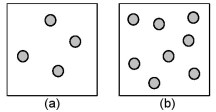
(Multiple Choice)
4.8/5 (69)
(69) The aquation of tris(1,10-phenanthroline)iron(II)in acid solution takes place according to the equation: Fe(phen)32+ + 3 H3O+ + 3 H2O → Fe(H2O)62+ + 3 phenH+
If the activation energy,Ea,is 126 kJ/mol and the rate constant at 30°C is 9.8 × 10⁻³ min-1,what is the rate constant at 40°C?
(Multiple Choice)
4.9/5 (74)
(74) The relative initial rates of the reaction A2 + B2 → products in vessels (a)-(d)are 1:1:4:4.Unshaded spheres represent A2 molecules,and shaded spheres represent B2 molecules present at the beginning of the reaction.  -What is the overall order of reaction?
 (Multiple Choice)
4.9/5 (87)
(87) Which statement is true for the general rate law: Rate = k[A]m[B]n?
(Multiple Choice)
5.0/5 (82)
(82) For the hypothetical second order reaction: A → products,the general rate law is: rate = k[A]2.How long is the third half-life of the reaction if [A]0 is 0.080 M and the first half-life is 22 minutes?
(Multiple Choice)
5.0/5 (90)
(90) What is the overall reaction order for the reaction that has the rate law: Rate = k[H2][NO]2?
(Multiple Choice)
4.8/5 (77)
(77) The following set of data was obtained by the method of initial rates for the reaction: 2 HgCl2(aq)+ C2O42-(aq)→ 2 Cl-(aq)+ 2 CO2(g)+ Hg2Cl2(s)
What is the rate law for the reaction? 
(Multiple Choice)
4.8/5 (83)
(83) A plot of 1/[BrO-] vs time is linear for the reaction: 3 BrO-(aq)→ BrO3-(aq)+ 2 Br-(aq)
What is the order of the reaction with respect to the hypobromite ion,BrO-?
(Multiple Choice)
4.7/5 (83)
(83) Using the method of initial rates for the reaction A → B,if the initial concentration of A is doubled and the rate of reaction quadruples,what is the order of reaction with respect to A?
(Multiple Choice)
4.9/5 (78)
(78) The decomposition of dinitrogen pentoxide is described by the chemical equation 2 N2O5(g)→ 4 NO2(g)+ O2(g)
If the rate of disappearance of N2O5 is equal to 1.40 mol/min at a particular moment,what is the rate of appearance of NO2 at that moment?
(Multiple Choice)
4.8/5 (80)
(80) The following pictures represent the progress of a reaction in which two A molecules combine to give a more complex molecule A2,2A → A2. 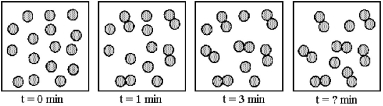 -What is the time required to achieve the molecular mixture in drawing (d)?
 (Multiple Choice)
4.8/5 (78)
(78) An aqueous reaction occurs by a two-step mechanism,shown below.
Step 1: A2X2 + Y → A2X + XY
Step 2: A2X2 + XY → A2X + X2 + Y
In this reaction the intermediate is ________,and the catalyst is ________.
(Short Answer)
4.7/5 (86)
(86) The aquation of tris(1,10-phenanthroline)iron(II)in acid solution takes place according to the equation: Fe(phen)32+ + 3 H3O+ + 3 H2O → Fe(H2O)62+ + 3 phenH+
If the activation energy,Ea,is 126 kJ/mol and the rate constant at 30°C is 9.8 × 10⁻³ min-1,what is the rate constant at 50°C?
(Multiple Choice)
4.9/5 (91)
(91) 
Filters
- Essay(0)
- Multiple Choice(0)
- Short Answer(0)
- True False(0)
- Matching(0)