



 Chat with AI
Exam 13: Chemical Kinetics

Exam 1: Chemical Tools: Experimentation and Measurement154 Questions
Exam 2: Atoms, molecules, and Ions275 Questions
Exam 3: Mass Relationships in Chemical Reactions159 Questions
Exam 4: Reactions in Aqueous Solutions211 Questions
Exam 5: Periodicity and the Electronic Structure of Atoms168 Questions
Exam 6: Ionic Compounds: Periodic Trends and Bonding138 Questions
Exam 7: Covalent Bonding and Electron-Dot Structures92 Questions
Exam 8: Covalent Compounds: Bonding Theories and Molecular Structure205 Questions
Exam 9: Thermochemistry: Chemical Energy170 Questions
Exam 10: Gases: Their Properties and Behavior188 Questions
Exam 11: Liquids, solids, and Phase Changes141 Questions
Exam 12: Solutions and Their Properties198 Questions
Exam 13: Chemical Kinetics190 Questions
Exam 14: Chemical Equilibrium171 Questions
Exam 15: Aqueous Equilibria: Acids and Bases231 Questions
Exam 16: Applications of Aqueous Equilibria201 Questions
Exam 17: Thermodynamics: Entropy, free Energy, and Equilibrium150 Questions
Exam 18: Electrochemistry212 Questions
Exam 19: Nuclear Chemistry176 Questions
Exam 20: Transition Elements and Coordination Chemistry190 Questions
Exam 21: Metals and Solid-State Materials154 Questions
Exam 22: The Main-Group Elements294 Questions
Exam 23: Connections to Organic and Biological Chemistry290 Questions
Select questions type


The decomposition of dinitrogen pentoxide is described by the chemical equation 2 N2O5(g)→ 4 NO2(g)+ O2(g)
If the rate of appearance of O2 is equal to 2.80 mol/min at a particular moment,what is the rate of disappearance of N2O5 at that moment?
(Multiple Choice)
4.8/5  (79)
(79) The decomposition of dinitrogen pentoxide is described by the chemical equation 2 N2O5(g)→ 4 NO2(g)+ O2(g)
If the rate of appearance of NO2 is equal to 0.560 mol/min at a particular moment,what is the rate of appearance of O2 at that moment?
(Multiple Choice)
4.9/5 (79)
(79) A concentration-time study of the gas phase reaction 2 A3 → 3 A2 produced the data in the table below. Time (s)[A3] (M)[A2] (M)
0 4.00 × 10⁻⁴ 0
10 2.00 × 10⁻⁴ 3.00 × 10⁻⁴
20 1.00 × 10⁻⁴ 4.50 × 10⁻⁴
30 5.00 × 10⁻⁵ ?
What is the concentration of A2 after 30 seconds?
(Multiple Choice)
4.9/5 (79)
(79) For the reaction shown below,if the rate of formation of O2 is 6.5 × 10⁻⁶ M/s,the rate of decomposition of N2O5 over the same time interval is ________.
2 N2O5(g)→ 4 NO2(g)+ O2(g)
(Short Answer)
4.8/5 (87)
(87) The following reaction is second order in A and first order in B: A + B → Products Rate = k[A]2[B]
What is the initial rate of this reaction in vessel (b)relative to the initial rate of this reaction in vessel (a)? Each vessel has the same volume.Shaded spheres represent A molecules,and unshaded spheres represent B molecules present at the beginning of the reaction. 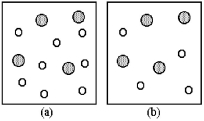
(Multiple Choice)
4.9/5 (79)
(79) For a particular first-order reaction,it takes 48 minutes for the concentration of the reactant to decrease to 25% of its initial value.What is the value for rate constant (in s-1)for the reaction?
(Multiple Choice)
4.8/5 (73)
(73) Consider the first-order decomposition of A molecules (shaded spheres)in two vessels of equal volume.What is the half-life of decomposition in vessel (b)relative to the half-life of decomposition in vessel (a)? 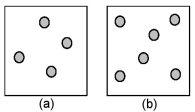
(Multiple Choice)
4.9/5 (77)
(77) For the zeroth-order reaction: A → products,what will happen to the rate of reaction if the concentration of A is tripled?
(Multiple Choice)
4.7/5 (84)
(84) 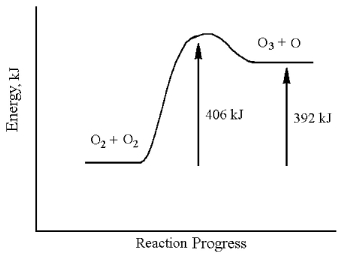 -What is the activation energy for the destruction of ozone?
 (Multiple Choice)
4.9/5 (64)
(64) Consider a reaction that occurs by the following one-step mechanism:
A2 + B2 → 2 AB
The potential energy profile for this reaction is shown below.  -The energy of reaction,ΔE,is given by the difference in energy between which two reaction stages?
 (Multiple Choice)
4.9/5 (85)
(85) Consider the first-order reaction A → B in which A molecules (shaded spheres)are converted to B molecules (unshaded spheres). 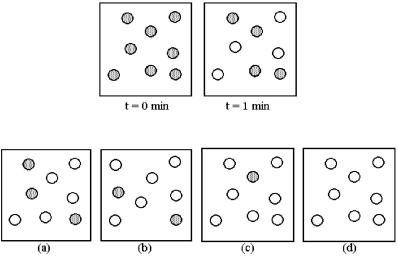 -Which drawing (a)-(d)represents the reaction mixture at t = 3 minutes?
 (Multiple Choice)
4.8/5 (83)
(83) What is the overall reaction order for the reaction that has the rate law: Rate = k[Cl ]2[N2]?
(Multiple Choice)
4.8/5 (87)
(87) The reaction that occurs in a Breathalyzer,a device used to determine the alcohol level in a person's bloodstream,is given below.If the rate of appearance of Cr2(SO4)3 is 1.24 mol/min at a particular moment,what is the rate of disappearance of C2H6O at that moment? 2 K2Cr2O7 + 8 H2SO4 + 3 C2H6O → 2 Cr2(SO4)3 + 2 K2SO4 + 11 H2O
(Multiple Choice)
5.0/5 (89)
(89) Chlorine reacts with chloroform according to the reaction given below: Cl2 + CHCl3 → CCl4 + HCl
When the initial concentration of Cl2 is doubled the reaction rate increases by a factor of 1.41.What is the order of the reaction with respect to Cl2?
(Multiple Choice)
4.8/5 (70)
(70) The following reaction is first order in A and first order in B: A + B → Products Rate = k[A][B]
What is the rate constant k of this reaction in vessel (b)relative to the rate constant k of this reaction in vessel (a)? Each vessel has the same volume.Shaded spheres represent A molecules,and unshaded spheres represent B molecules. 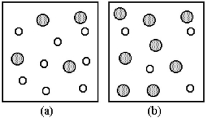
(Multiple Choice)
4.8/5 (102)
(102) The following pictures represent the progress of a reaction in which two A molecules combine to give a more complex molecule A2,2A → A2. 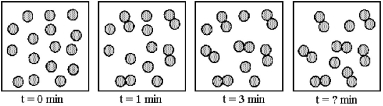 -What is the order of reaction with respect to A?
 (Multiple Choice)
4.9/5 (79)
(79) A mechanism for a naturally occurring reaction that destroys ozone is: Step 1: O3(g)+ HO(g)→ HO2(g)+ O2(g)
Step 2: HO2(g)+ O(g)→ HO(g)+ O2(g)
Which species is a catalyst?
(Multiple Choice)
4.8/5 (76)
(76) Platinum in the catalytic converter of an automobile catalyzes the conversion of CO to CO2 is an example of a ________ (heterogeneous,homogeneous)catalyst.
(Short Answer)
4.8/5 (75)
(75) Hydrogen peroxide decomposes to water and oxygen according to the reaction below: 2 H2O2(aq)→ 2 H2O(l)+ O2(g)
In the presence of large excesses of I- ion,the following set of data is obtained.What is the average rate of disappearance of H2O2(aq)in M/s in the first 45.0 seconds of the reaction if 1.00 L of H2O2 reacts at 25°C and 1.00 atm pressure? 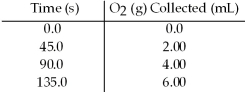
(Multiple Choice)
4.7/5 (65)
(65) 
Filters
- Essay(0)
- Multiple Choice(0)
- Short Answer(0)
- True False(0)
- Matching(0)