



 Chat with AI
Exam 13: Chemical Kinetics

Exam 1: Chemical Tools: Experimentation and Measurement154 Questions
Exam 2: Atoms, molecules, and Ions275 Questions
Exam 3: Mass Relationships in Chemical Reactions159 Questions
Exam 4: Reactions in Aqueous Solutions211 Questions
Exam 5: Periodicity and the Electronic Structure of Atoms168 Questions
Exam 6: Ionic Compounds: Periodic Trends and Bonding138 Questions
Exam 7: Covalent Bonding and Electron-Dot Structures92 Questions
Exam 8: Covalent Compounds: Bonding Theories and Molecular Structure205 Questions
Exam 9: Thermochemistry: Chemical Energy170 Questions
Exam 10: Gases: Their Properties and Behavior188 Questions
Exam 11: Liquids, solids, and Phase Changes141 Questions
Exam 12: Solutions and Their Properties198 Questions
Exam 13: Chemical Kinetics190 Questions
Exam 14: Chemical Equilibrium171 Questions
Exam 15: Aqueous Equilibria: Acids and Bases231 Questions
Exam 16: Applications of Aqueous Equilibria201 Questions
Exam 17: Thermodynamics: Entropy, free Energy, and Equilibrium150 Questions
Exam 18: Electrochemistry212 Questions
Exam 19: Nuclear Chemistry176 Questions
Exam 20: Transition Elements and Coordination Chemistry190 Questions
Exam 21: Metals and Solid-State Materials154 Questions
Exam 22: The Main-Group Elements294 Questions
Exam 23: Connections to Organic and Biological Chemistry290 Questions
Select questions type


The following reaction is first order: C2H6 → 2 CH3.If the rate constant is equal to 5.5 × 10⁻⁴ s-1 at 1000 K,how long will it take for 0.35 mol of C2H6 in a 1.00 L container to decrease to 0.10 mol in the same container?
(Multiple Choice)
4.7/5  (75)
(75) When the concentration of A is doubled,the rate for the reaction: 2 A + B → 2 C quadruples. When the concentration of B is doubled the rate remains the same.Which mechanism below is consistent with the experimental observations?
(Multiple Choice)
4.8/5 (75)
(75) The isomerization reaction,CH3NC → CH3CN,is first order and the rate constant is equal to 0.46 s-1 at 600 K.What is the concentration of CH3NC after 0.20 minutes if the initial concentration is 0.10 M?
(Multiple Choice)
4.7/5 (77)
(77) Hydrogen iodide decomposes at 800 K via a second-order process to produce hydrogen and iodine according to the following chemical equation. 2 HI(g)→ H2(g)+ I2(g)
At 800 K it takes 142 seconds for the initial concentration of HI to decrease from 6.75 × 10⁻² M to 3.50 × 10⁻² M.What is the rate constant for the reaction at this temperature?
(Multiple Choice)
4.8/5 (74)
(74) What fraction of collisions will have sufficient energy to react for a gas whose activation energy is 68 kJ/mol at 25°C?
(Multiple Choice)
4.8/5 (87)
(87) Which general rate law below corresponds to an elementary bimolecular reaction?
(Multiple Choice)
4.9/5 (71)
(71) Nitrogen dioxide decomposes at 300°C via a second-order process to produce nitrogen monoxide and oxygen according to the following chemical equation. 2 NO2(g)→ 2 NO(g)+ O2(g).
A sample of NO2(g)is initially placed in a 2.50-L reaction vessel at 300°C.If the half-life and the rate constant at 300°C are 44 seconds and 0.54 M-1 s-1,respectively,how many moles of NO2 were in the original sample?
(Multiple Choice)
4.8/5 (79)
(79) A reaction has the rate law Rate = k[NO]2[H2].If the concentration of NO is reduced by 1/3,the rate of reaction will be ________ (increased,decreased)by ________.
(Short Answer)
4.8/5 (75)
(75) The fraction of collisions with sufficient energy to react is equal to
(Multiple Choice)
4.9/5 (85)
(85) If the units for rate are M s-1,what are the units for the rate constant,k,if the overall order of the reaction is five?
(Multiple Choice)
5.0/5 (75)
(75) A catalyst increases the rate of a reaction by providing a different reaction pathway that
(Multiple Choice)
4.8/5 (83)
(83) The first-order isomerization reaction: cyclopropane → propene,has a rate constant of 1.10 × 10⁻⁴ s -1 at 470°C and an activation energy of 264 kJ/mol.What is the temperature of the reaction when the rate constant is equal to 4.36 × 10⁻³ s-1?
(Multiple Choice)
4.9/5 (81)
(81) A reaction with an activation energy,Ea = 51.2 kJ/mol will proceed ________ times faster when the temperature is raised from 20 °C to 30 °C.
(Short Answer)
5.0/5 (78)
(78) For the first-order reaction,2 N2O(g)→ 2 N2(g)+ O2(g),what is the concentration of N2O after 3 half-lives if 0.15 mol of N2O is initially placed into in a 1.00-L reaction vessel?
(Multiple Choice)
4.8/5 (70)
(70) A reaction has the rate law Rate = k[NO]2[H2].If the concentration of NO is reduced by half and the concentration of H2 is quadrupled,the rate of reaction will ________ (increase,decrease,not change).
(Short Answer)
4.8/5 (76)
(76) The rate-determining step in a reaction is shown below.The molecularity of this reaction is ________.
NO2(g)+ NO2(g)→ NO(g)+ NO3(g)
(Short Answer)
4.9/5 (75)
(75) The following reaction is first order in A and first order in B: A + B → Products Rate = k[A][B]
What is the initial rate of this reaction in vessel (b)relative to the initial rate of this reaction in vessel (a)? Each vessel has the same volume.Shaded spheres represent A molecules,and unshaded spheres represent B molecules present at the beginning of the reaction. 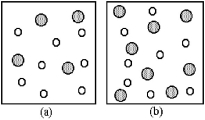
(Multiple Choice)
4.8/5 (74)
(74) A three-step mechanism has been suggested for the formation of carbonyl chloride: Step 1: Cl2→ 2 Cl (fast,equilibrium)
Step 2: Cl + CO → COCl (fast,equilibrium)
Step 3: COCl + Cl2 → COCl2 + Cl (slow)
What is the molecularity of the rate-determining step?
(Multiple Choice)
4.9/5 (79)
(79) The data below were collected for the following reaction: 2 NO2 (g)+ F2 (g)2 NO2F (g)  What is the expression for the rate law of the reaction?
 (Multiple Choice)
4.8/5 (81)
(81) The aquation of tris(1,10-phenanthroline)iron(II)in acid solution takes place according to the equation: Fe(phen)32+ + 3 H3O+ + 3 H2O → Fe(H2O)62+ + 3 phenH+
If the activation energy is 126 kJ/mol and frequency factor is 8.62 × 10¹⁷ s-1,at what temperature is the rate constant equal to 3.63 × 10⁻³ s-1 for the first-order reaction?
(Multiple Choice)
4.8/5 (84)
(84) 
Filters
- Essay(0)
- Multiple Choice(0)
- Short Answer(0)
- True False(0)
- Matching(0)