



 Chat with AI
Exam 13: Chemical Kinetics

Exam 1: Chemical Tools: Experimentation and Measurement154 Questions
Exam 2: Atoms, molecules, and Ions275 Questions
Exam 3: Mass Relationships in Chemical Reactions159 Questions
Exam 4: Reactions in Aqueous Solutions211 Questions
Exam 5: Periodicity and the Electronic Structure of Atoms168 Questions
Exam 6: Ionic Compounds: Periodic Trends and Bonding138 Questions
Exam 7: Covalent Bonding and Electron-Dot Structures92 Questions
Exam 8: Covalent Compounds: Bonding Theories and Molecular Structure205 Questions
Exam 9: Thermochemistry: Chemical Energy170 Questions
Exam 10: Gases: Their Properties and Behavior188 Questions
Exam 11: Liquids, solids, and Phase Changes141 Questions
Exam 12: Solutions and Their Properties198 Questions
Exam 13: Chemical Kinetics190 Questions
Exam 14: Chemical Equilibrium171 Questions
Exam 15: Aqueous Equilibria: Acids and Bases231 Questions
Exam 16: Applications of Aqueous Equilibria201 Questions
Exam 17: Thermodynamics: Entropy, free Energy, and Equilibrium150 Questions
Exam 18: Electrochemistry212 Questions
Exam 19: Nuclear Chemistry176 Questions
Exam 20: Transition Elements and Coordination Chemistry190 Questions
Exam 21: Metals and Solid-State Materials154 Questions
Exam 22: The Main-Group Elements294 Questions
Exam 23: Connections to Organic and Biological Chemistry290 Questions
Select questions type


The reaction that occurs in a Breathalyzer,a device used to determine the alcohol level in a person's bloodstream,is given below.If the rate of appearance of Cr2(SO4)3 is 1.24 mol/min at a particular moment,what is the rate of disappearance of C2H6O at that moment? 
(Multiple Choice)
4.9/5  (83)
(83) The first-order reaction,SO2Cl2 → SO2 + Cl2,has a rate constant equal to 2.20 × 10⁻⁵ s-1 at 593 K.What percentage of the initial amount SO2Cl2 will remain after 3.00 hours?
(Multiple Choice)
5.0/5 (80)
(80) The decomposition of hydrogen peroxide occurs according to the equation
2 H2O2(aq)→ 2 H2O(l)+ O2(g)
A concentration-time study of this reaction produces a straight line when ln[H2O2] is plotted versus time.Therefore,this is a ________ order reaction.
(Short Answer)
4.9/5 (75)
(75) An aqueous reaction occurs by a two-step mechanism,shown below. Step 1: A2X2 + Y → A2X + XY
Step 2: A2X2 + XY → A2X + X2 + Y
What is the catalyst in this reaction?
(Multiple Choice)
4.9/5 (77)
(77) The following set of data was obtained by the method of initial rates for the reaction: (H3C)3CBr + OH- → (H3C)3COH + Br-
What is the order of reaction with respect to ion,OH-? 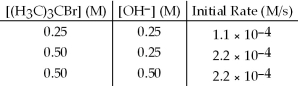
(Multiple Choice)
4.8/5 (91)
(91) The reaction: 2 HI → H2 + I2,is second order and the rate constant at 800 K is 9.70 × 10⁻² M-1 s-1.How long will it take for 8.00 × 10⁻² mol/L of HI to decrease to one-fourth of its initial concentration?
(Multiple Choice)
4.8/5 (75)
(75) The second-order reaction 2 Mn(CO)5 → Mn2(CO)10,has a rate constant equal to 3.0 × 10⁹ M-1 s-1 at 25°C.If the initial concentration of Mn(CO)5 is 5.0 × 10⁻⁵ M,how long will it take for 90.% of the reactant to disappear?
(Multiple Choice)
4.9/5 (74)
(74) For the reaction shown below,what is the order of reaction with respect to Br? ClO2-(aq)+ 4 Br-(aq)+ 4 H+(aq)→ Cl-(aq)+ 2 Br2(aq)+2 H2O(l)
(Multiple Choice)
4.9/5 (81)
(81) Which part of the Arrhenius equation contains a term which measures the number of molecules that have the correct orientation for reaction?
(Multiple Choice)
5.0/5 (73)
(73) The decomposition of hydrogen peroxide is given by the following reaction: 2 H2O2(aq)→ 2 H2O(l)+ O2(g)
In the presence of KI the reaction is thought to occur by the following mechanism:
Step 1: H2O2 + I- → H2O + IO-
Step 2: IO- + H2O2 → H2O + O2 + I-
What is the role of I- in this mechanism?
(Multiple Choice)
4.8/5 (89)
(89) The reaction below is second order in ClO2 and first order in OH-.When the concentration of ClO2 is 0.020 M and the concentration of OH- is 0.10 M,the initial rate of reaction is 8.00 × 10⁻⁴ M/s.What is the rate constant,k,for this reaction?
2 ClO2(aq)+ 2 OH-(aq)→ ClO3-(aq)+ ClO2-(aq)+ H2O(l)
(Short Answer)
5.0/5 (66)
(66) Acetaldehyde decomposes at 750 K: CH3CHO → CO + CH4.The reaction is first order in acetaldehyde and the half-life of the reaction is found to be 530 seconds.What is the rate constant for the reaction at this temperature?
(Multiple Choice)
4.9/5 (80)
(80) Consider a reaction that occurs by the following one-step mechanism:
A2 + B2 → 2 AB
The potential energy profile for this reaction is shown below.  -What is the species present at reaction stage 2?
 (Multiple Choice)
4.9/5 (79)
(79) Consider the first-order decomposition of A molecules (shaded spheres)in two vessels of equal volume.How will the half-life of decomposition in vessel (a)be affected if the volume of the vessel is decreased by a factor of 2? 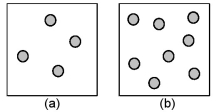
(Multiple Choice)
4.7/5 (81)
(81) Which of the following statements are true about reaction mechanisms? I.A rate law can be written from the molecularity of the slowest elementary step.
II.The final rate law can include intermediates.
III.The rate of the reaction is dependent on the fastest step in the mechanism.
IV.A mechanism can never be proven to be the correct pathway for a reaction.
(Multiple Choice)
4.9/5 (76)
(76) Which statement below regarding the half-life of a zeroth-order reaction is true?
(Multiple Choice)
4.8/5 (78)
(78) A gaseous reaction occurs by a two-step mechanism,shown below. Step 1: AX +Y2 ⇌ AXY2 fast
Step 2: AXY2 + AX → 2 AXY slow
Including concentration of only reactants and products,what is the rate law for this reaction?
(Multiple Choice)
4.8/5 (83)
(83) The decomposition of ammonia to nitrogen and hydrogen on a tungsten filament at 800°C is independent of the concentration of ammonia at high pressures of ammonia.What is the order of the reaction with respect to ammonia?
(Multiple Choice)
4.7/5 (64)
(64) The following set of data was obtained by the method of initial rates for the reaction: S2O82-(aq)+ 3 I-(aq)→ 2 SO42-(aq)+ I3-(aq)
What is the rate law for the reaction? 
(Multiple Choice)
4.9/5 (76)
(76) The relative initial rates of the reaction A2 + B2 → products in vessels (a)-(d)are 1:1:4:4.Unshaded spheres represent A2 molecules,and shaded spheres represent B2 molecules present at the beginning of the reaction.  -What is the order of reaction with respect to B2?
 (Multiple Choice)
4.9/5 (76)
(76) 
Filters
- Essay(0)
- Multiple Choice(0)
- Short Answer(0)
- True False(0)
- Matching(0)