



 Chat with AI
Exam 17: Thermodynamics: Entropy, free Energy, and Equilibrium

Exam 1: Chemical Tools: Experimentation and Measurement154 Questions
Exam 2: Atoms, molecules, and Ions275 Questions
Exam 3: Mass Relationships in Chemical Reactions159 Questions
Exam 4: Reactions in Aqueous Solutions211 Questions
Exam 5: Periodicity and the Electronic Structure of Atoms168 Questions
Exam 6: Ionic Compounds: Periodic Trends and Bonding138 Questions
Exam 7: Covalent Bonding and Electron-Dot Structures92 Questions
Exam 8: Covalent Compounds: Bonding Theories and Molecular Structure205 Questions
Exam 9: Thermochemistry: Chemical Energy170 Questions
Exam 10: Gases: Their Properties and Behavior188 Questions
Exam 11: Liquids, solids, and Phase Changes141 Questions
Exam 12: Solutions and Their Properties198 Questions
Exam 13: Chemical Kinetics190 Questions
Exam 14: Chemical Equilibrium171 Questions
Exam 15: Aqueous Equilibria: Acids and Bases231 Questions
Exam 16: Applications of Aqueous Equilibria201 Questions
Exam 17: Thermodynamics: Entropy, free Energy, and Equilibrium150 Questions
Exam 18: Electrochemistry212 Questions
Exam 19: Nuclear Chemistry176 Questions
Exam 20: Transition Elements and Coordination Chemistry190 Questions
Exam 21: Metals and Solid-State Materials154 Questions
Exam 22: The Main-Group Elements294 Questions
Exam 23: Connections to Organic and Biological Chemistry290 Questions
Select questions type


The reaction 2 H2(g)+ O2(g)→ 2 H2O(g)is spontaneous at 25°C.The addition of a catalyst will ________ (decrease,increase,not change)the rate of reaction and ________ (decrease,increase,not change)the spontaneity of the reaction.

Free
(Short Answer)
4.9/5  (84)
(84) Correct Answer: Verified
increase,not change
Which of the following processes are spontaneous? I.dissolving more solute in an unsaturated solution
II.dissolving more solute in a saturated solution
III.dissolving more solute in a supersaturated solution
Free
(Multiple Choice)
4.7/5 (78)
(78) Correct Answer:Verified
VerifiedB
A reaction has ΔG° = + 21.5 kJ/mol,ΔH° = + 25.0 kJ/mol,and ΔS° = + 15.0 J/mol∙K can become spontaneous at a temperature of ________ K.
Free
(Short Answer)
4.9/5 (87)
(87) Correct Answer:Verified
Verified1670
Which equation can be used to determine ΔGform for C2H5OH from its elemental parts.Be sure that the reaction is balanced. 
(Multiple Choice)
4.8/5 (86)
(86) For any thermodynamic function Y,ΔY° for a reaction refers to the change in Y for the process in which
(Multiple Choice)
5.0/5 (70)
(70) For the reaction N2(g)+ O2(g)→ 2NO(g),ΔH° = 180.4 kJ/mol and ΔS° = 24.9 J/K.Is there a temperature at which the spontaneity of this reaction be changed,either from spontaneous to nonspontaneous or nonspontaneous to spontaneous? If so,estimate the temperature.
(Essay)
4.7/5 (86)
(86) The standard free energy for a reaction is ΔG° = -33.0 kJ.At 25°C the equilibrium constant for this reaction,Kp = ________.
(Short Answer)
4.8/5 (86)
(86) Which of the following statements must be true for the entropy of a pure solid to be zero? I.The temperature must be 0 K.
II.The solid must be crystalline,not amorphous.
III.The solid must be perfectly ordered.
IV.The solid must be an element.
(Multiple Choice)
4.8/5 (91)
(91) For the reaction 3 C2H2(g)→ C6H6(l)at 25°C,the standard enthalpy change is -631 kJ and the standard entropy change is -430 J/K.Calculate the standard free energy change at 25°C?
(Multiple Choice)
4.9/5 (68)
(68) Which of the following is a criterion for spontaneity that holds for any process?
(Multiple Choice)
5.0/5 (87)
(87) In figure (1)below oxygen molecules,represented by unshaded spheres,and chlorine molecules,represented by shaded spheres,are in separate compartments.Figure (2)shows the equilibrium state of the system after the stopcock separating the two compartments is opened.Assuming the oxygen and the chlorine behave as ideal gases,what are the signs (+,-,or 0)of ΔH,ΔS,and ΔG for this process? 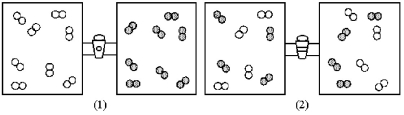
(Multiple Choice)
4.9/5 (70)
(70) For the reaction below ΔG° = +33.0 kJ,ΔH° = +92.2 kJ,and ΔS° = +198.7 J/K.Estimate the temperature at which this reaction becomes spontaneous. 2 NH3(g)→ N2(g)+ 3 H2(g)
(Multiple Choice)
4.8/5 (85)
(85) Which of the following are unstable with respect to their constituent elements at 25°C? 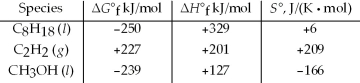
(Multiple Choice)
4.8/5 (81)
(81) At 25°C,ΔH° = 1.895 kJ and ΔS° = -3.363 J/K for the transition C(graphite)→ C(diamond)
Based on these data,
(Multiple Choice)
4.8/5 (75)
(75) 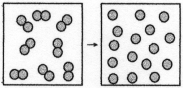 -The figure above represents the nonspontaneous reaction O2(g)→ 2O(g).What are the signs (+ or -)of ΔH,ΔS,and ΔG for this process?
 (Multiple Choice)
4.7/5 (78)
(78) Standard molar entropies,S°,in J/Kmol,are given below each reactant and product in the reaction shown below.The standard entropy of reaction,ΔS°,for this reaction is ________ J/K.
S(s,rhombic)+ O2(g)→ SO2(g)
31.8 205.0 248.1
(Short Answer)
4.8/5 (83)
(83) The Boltzmann formula is S = k ln W.A perfect crystal has a molar entropy of 0 at absolute zero because
(Multiple Choice)
4.9/5 (77)
(77) For the evaporation of water during perspiration on a hot,dry day,
(Multiple Choice)
4.8/5 (65)
(65) 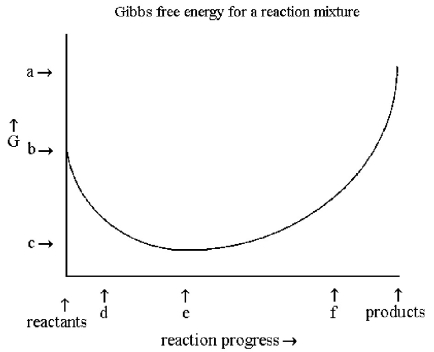 -According to the diagram above,

Filters
- Essay(0)
- Multiple Choice(0)
- Short Answer(0)
- True False(0)
- Matching(0)