



 Chat with AI
Exam 17: Thermodynamics: Entropy, free Energy, and Equilibrium

Exam 1: Chemical Tools: Experimentation and Measurement154 Questions
Exam 2: Atoms, molecules, and Ions275 Questions
Exam 3: Mass Relationships in Chemical Reactions159 Questions
Exam 4: Reactions in Aqueous Solutions211 Questions
Exam 5: Periodicity and the Electronic Structure of Atoms168 Questions
Exam 6: Ionic Compounds: Periodic Trends and Bonding138 Questions
Exam 7: Covalent Bonding and Electron-Dot Structures92 Questions
Exam 8: Covalent Compounds: Bonding Theories and Molecular Structure205 Questions
Exam 9: Thermochemistry: Chemical Energy170 Questions
Exam 10: Gases: Their Properties and Behavior188 Questions
Exam 11: Liquids, solids, and Phase Changes141 Questions
Exam 12: Solutions and Their Properties198 Questions
Exam 13: Chemical Kinetics190 Questions
Exam 14: Chemical Equilibrium171 Questions
Exam 15: Aqueous Equilibria: Acids and Bases231 Questions
Exam 16: Applications of Aqueous Equilibria201 Questions
Exam 17: Thermodynamics: Entropy, free Energy, and Equilibrium150 Questions
Exam 18: Electrochemistry212 Questions
Exam 19: Nuclear Chemistry176 Questions
Exam 20: Transition Elements and Coordination Chemistry190 Questions
Exam 21: Metals and Solid-State Materials154 Questions
Exam 22: The Main-Group Elements294 Questions
Exam 23: Connections to Organic and Biological Chemistry290 Questions
Select questions type


For the reaction N2(g)+ 2 O2(g)→ 2 NO2(g),ΔG° = 102.6 kJ.At 25°C the equilibrium constant Kp = ________.
(Short Answer)
4.9/5  (94)
(94) What is the relationship between ΔG,Qp,and Kp for a reaction involving gases?
(Multiple Choice)
4.8/5 (78)
(78) Which of the following processes is non-spontaneous at standard temperature and pressure?
(Multiple Choice)
4.7/5 (85)
(85) The figure represents the spontaneous evaporation of nitrogen in which liquid nitrogen,N2(l),becomes gaseous nitrogen,N2(g): N2(l)→ N2(g).What are the signs (+ or -)of ΔH,ΔS,and ΔG for this process? 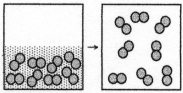
(Multiple Choice)
4.8/5 (82)
(82) If the entropy of a collection of molecules in 5000 boxes is 1.76 × 10⁻²⁰ J/K,how many molecules are there?
(Short Answer)
5.0/5 (80)
(80) The reaction A(g)→ B(g)is spontaneous under standard conditions.Which of the following statements must be true? I.The reaction B(g)→ A(g)is nonspontaneous under standard conditions.
II.A(g)will be completely converted to B(g)if sufficient time is allowed.
III.A(g)will be completely converted to B(g)rapidly.
(Multiple Choice)
4.9/5 (78)
(78) At 25°C,ΔG°f is -620 kJ/mol for SiCl4(g)and -592 kJ/mol for MgCl2(s).Calculate ΔG° for the reaction,SiCl4(g)+ 2 Mg(s)→ 2 MgCl2(s)+ Si(s)and determine if the reaction is spontaneous at 25°C if the pressure of SiCl4(g)is 1 atm.
(Multiple Choice)
4.8/5 (81)
(81) Consider the reaction 2A(g)⇌ A2(g).The following pictures represent two possible initial states and the equilibrium state of the system.  -What are the signs (+ or -)of ΔH,ΔS,and ΔG when the system spontaneously goes from initial state 1 to the equilibrium state?
 (Multiple Choice)
4.8/5 (75)
(75) Standard molar entropies,S°,in J/K∙mol,are given below each reactant and product in the reaction shown below.The standard entropy of reaction,ΔS°,for this reaction is ________ J/K.
CH4(g)+ 2 O2(g)→ CO2(g)+ 2 H2O(l)
186.2 205.0 213.6 69.9
(Short Answer)
4.9/5 (93)
(93) What is the entropy change associated with the expansion of one mole of an ideal gas from an initial volume of V to a final volume of 2.50V at constant temperature?
(Multiple Choice)
4.9/5 (85)
(85) For the reaction 3 C2H2(g)→ C6H6(l)at 25°C,the standard enthalpy change is -631 kJ and the standard entropy change is -430 J/K.Calculate the standard free energy change at 25°C.
(Multiple Choice)
4.9/5 (81)
(81) Solid NaHCO3 is heated to 90°C.At equilibrium the total pressure of the gases produced is 0.545 atm.Calculate ΔG° at 90°C for the reaction 2 NaHCO3(s)⇌ Na2CO3(s)+ H2O(g)+ CO2(g).
(Multiple Choice)
4.9/5 (70)
(70) By what factor does the entropy increase for a collection of 100 molecules from a system of 1 × 10⁵ boxes to 1 × 10⁶ boxes?
(Short Answer)
4.9/5 (74)
(74) The reaction 2 H2O(g)+ CO2(g)→ CH4(g)+ 2 CO2(g)is nonspontaneous at 25°C.The addition of a catalyst will ________ (decrease,increase,not change)the rate of reaction and ________ (decrease,increase,not change)the spontaneity of the reaction.
(Short Answer)
4.8/5 (87)
(87) Calculate ΔS° for the formation of three moles of solid sodium bromide from the elements at 25°C. 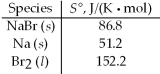
(Multiple Choice)
4.8/5 (84)
(84) Consider the following gas-phase reaction of A2 (shaded spheres)and B2 (unshaded spheres):
A2(g)+ B2(g)⇌ 2 AB(g)ΔG ° = +25 kJ 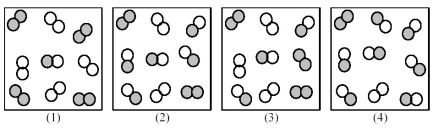 -Which of the above reaction mixtures has the least spontaneous forward reaction?
 (Multiple Choice)
4.8/5 (79)
(79) 
Filters
- Essay(0)
- Multiple Choice(0)
- Short Answer(0)
- True False(0)
- Matching(0)