



 Chat with AI
Exam 17: Thermodynamics: Entropy, free Energy, and Equilibrium

Exam 1: Chemical Tools: Experimentation and Measurement154 Questions
Exam 2: Atoms, molecules, and Ions275 Questions
Exam 3: Mass Relationships in Chemical Reactions159 Questions
Exam 4: Reactions in Aqueous Solutions211 Questions
Exam 5: Periodicity and the Electronic Structure of Atoms168 Questions
Exam 6: Ionic Compounds: Periodic Trends and Bonding138 Questions
Exam 7: Covalent Bonding and Electron-Dot Structures92 Questions
Exam 8: Covalent Compounds: Bonding Theories and Molecular Structure205 Questions
Exam 9: Thermochemistry: Chemical Energy170 Questions
Exam 10: Gases: Their Properties and Behavior188 Questions
Exam 11: Liquids, solids, and Phase Changes141 Questions
Exam 12: Solutions and Their Properties198 Questions
Exam 13: Chemical Kinetics190 Questions
Exam 14: Chemical Equilibrium171 Questions
Exam 15: Aqueous Equilibria: Acids and Bases231 Questions
Exam 16: Applications of Aqueous Equilibria201 Questions
Exam 17: Thermodynamics: Entropy, free Energy, and Equilibrium150 Questions
Exam 18: Electrochemistry212 Questions
Exam 19: Nuclear Chemistry176 Questions
Exam 20: Transition Elements and Coordination Chemistry190 Questions
Exam 21: Metals and Solid-State Materials154 Questions
Exam 22: The Main-Group Elements294 Questions
Exam 23: Connections to Organic and Biological Chemistry290 Questions
Select questions type


Under which of the following conditions would one mole of Ne have the highest entropy,S?
(Multiple Choice)
4.9/5  (80)
(80) Which one of the following has the lowest standard molar entropy,S°,at 25°C?
(Multiple Choice)
4.9/5 (69)
(69) Which statement is true about the formation of CaCO3(s)from CaO(s)and CO2(g)at 1.00 atm? CaO(s)+ CO2(g)→ CaCO3(s) ΔH° = -178.7 kJ and ΔS° = -150.4 J/K
(Multiple Choice)
4.9/5 (76)
(76) The solubility of manganese(II)fluoride in water is 6.6 g/mL at 40°C and 4.8 g/L at 100°C.Based on these data,what is the sign of ΔH° and ΔS° for the process below? MnF2(s)⇌ Mn2+(aq)+ 2 F-(aq)
(Multiple Choice)
4.9/5 (74)
(74) 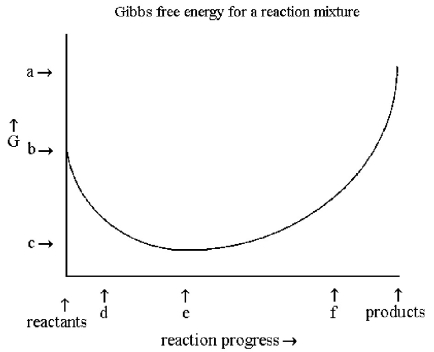 -According to the diagram above,
The synthesis of ethanol from ethylene and water proceeds using the following reaction. C2H4(g)+ H2O(l)C2H5OH(l)ΔGºrxn = -116.6 kJ/mol
Determine the Gibbs free energy if the pressure of the vessel is 325 atm at 570 K.
(Multiple Choice)
4.8/5 (76)
(76) Which statement is true concerning the standard states of F2(g)and C12H22O11(aq)?
(Multiple Choice)
4.9/5 (90)
(90) The entropy change associated with the expansion of one mole of an ideal gas from an initial volume of Vi to a final volume of Vf at constant temperature is given by the equation,ΔS = R ln (Vf/Vi).What is the entropy change associated with the expansion of five moles of an ideal gas from an initial volume of Vi to a final volume of Vf at constant temperature?
(Multiple Choice)
4.9/5 (89)
(89) For the following reaction find Kp at 25°C and indicate whether Kp should increase or decrease as the temperature rises. NH4HS(s)⇌ H2S(g)+ NH3(g)ΔH° = 83.47 kJ and ΔG° = 17.5 kJ at 25°C.
(Multiple Choice)
4.8/5 (88)
(88) The following pictures represent three equilibrium mixtures for the interconversion of A,B,and C molecules (unshaded spheres)into X,Y,and Z molecules (shaded spheres),respectively.What is the sign of ΔG ° for each of the three reactions? 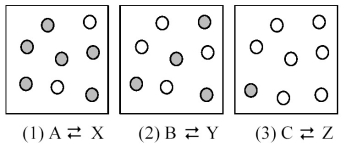
(Multiple Choice)
4.9/5 (81)
(81) Consider the reaction 2A(g)⇌ A2(g).The following pictures represent two possible initial states and the equilibrium state of the system.  -For initial state 1 what is the relationship between the reaction quotient,Qp,and the equilibrium constant,Kp?
 (Multiple Choice)
4.8/5 (84)
(84) The standard molar entropy for Br2(g)is 245.46 J/(mol ∙ K)at 25°C.Given that ΔS° = 104.58 J/K for the dissociation of one mole of Br2(g)into Br(g)at 25°C,find the standard molar entropy for Br(g)at 25°C.
(Multiple Choice)
4.9/5 (75)
(75) Standard molar entropies,S°,in J/Kmol,are given below each reactant and product in the reaction shown below.The standard entropy of reaction,ΔS°,for this reaction is ________ J/K.
2 SO2(g)+ O2(g)→ 2 SO3(g)
248.1 205.0 256.6
(Short Answer)
4.8/5 (66)
(66) For the process CaCO3(calcite)→ CaCO3(aragonite)ΔH° = -0.21 kJ,ΔS° = -4.2 J/K
Assuming that the surroundings can be considered a large heat reservoir at 25°C,calculate ΔSsurr and ΔStotal for the process at 25°C and 1 atm pressure.Is the process spontaneous at 25°C and 1 atm pressure?
(Multiple Choice)
4.7/5 (79)
(79) Which of the three laws of thermodynamics states the criterion for spontaneity?
(Multiple Choice)
5.0/5 (77)
(77) The sign (+ or -)of ΔH is ________ and the sign (+ or -)of ΔS is ________ for the evaporation of water.
(Short Answer)
5.0/5 (84)
(84) Without doing any calculations,determine whether the standard entropy change,ΔS° is positive or negative for each of the following reactions. reaction 1: S(s,rhombic)+ O2(g)→ SO2(g)
Reaction 2: 2 SO2(g)+ O2(g)→ 2 SO3(g)
(Multiple Choice)
4.8/5 (79)
(79) 
Filters
- Essay(0)
- Multiple Choice(0)
- Short Answer(0)
- True False(0)
- Matching(0)