



 Chat with AI
Exam 17: Thermodynamics: Entropy, free Energy, and Equilibrium

Exam 1: Chemical Tools: Experimentation and Measurement154 Questions
Exam 2: Atoms, molecules, and Ions275 Questions
Exam 3: Mass Relationships in Chemical Reactions159 Questions
Exam 4: Reactions in Aqueous Solutions211 Questions
Exam 5: Periodicity and the Electronic Structure of Atoms168 Questions
Exam 6: Ionic Compounds: Periodic Trends and Bonding138 Questions
Exam 7: Covalent Bonding and Electron-Dot Structures92 Questions
Exam 8: Covalent Compounds: Bonding Theories and Molecular Structure205 Questions
Exam 9: Thermochemistry: Chemical Energy170 Questions
Exam 10: Gases: Their Properties and Behavior188 Questions
Exam 11: Liquids, solids, and Phase Changes141 Questions
Exam 12: Solutions and Their Properties198 Questions
Exam 13: Chemical Kinetics190 Questions
Exam 14: Chemical Equilibrium171 Questions
Exam 15: Aqueous Equilibria: Acids and Bases231 Questions
Exam 16: Applications of Aqueous Equilibria201 Questions
Exam 17: Thermodynamics: Entropy, free Energy, and Equilibrium150 Questions
Exam 18: Electrochemistry212 Questions
Exam 19: Nuclear Chemistry176 Questions
Exam 20: Transition Elements and Coordination Chemistry190 Questions
Exam 21: Metals and Solid-State Materials154 Questions
Exam 22: The Main-Group Elements294 Questions
Exam 23: Connections to Organic and Biological Chemistry290 Questions
Select questions type


Which one of the following would be expected to have the lowest standard molar entropy,S°,at 25°C?
(Multiple Choice)
4.8/5  (79)
(79) At 25°C,ΔG° = -198 kJ for the reaction,NO(g)+ O3(g)⇌ NO2(g)+ O2(g). Calculate ΔG under the following conditions: 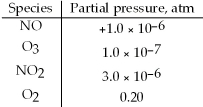
(Multiple Choice)
4.8/5 (87)
(87) A reaction has ΔH° = -60.9 kJ/mol and ΔS° = 266.6 J/K.Is this reaction spontaneous or nonspontaneous? At what temperature (if any)can the spontaneity be reversed?
(Multiple Choice)
4.8/5 (73)
(73) The most commonly used white pigment is titanium white,which is titanium(IV)oxide,TiO2.Titanium white can be formed from TiCl4 as shown in the reaction below.
TiCl4(l)+ 2 H2O(l)→ TiO2(s)+ 4 HCl(g)
If ΔH° = 61.9 kJ/mol and ΔS° = 405.4 J/K,what are ΔSsurr and ΔStotal for this reaction at 25°C?
(Short Answer)
4.8/5 (75)
(75) Predict the sign of ΔS of the system for both of the following. I.2 C(graphite)+ O2(g)→ 2 CO(g)
II.C4H10(g)→ C4H10(l)
(Multiple Choice)
4.7/5 (88)
(88) What is the entropy change associated with the expansion of one mole of an ideal gas from an initial volume of V to a final volume of V of 2.50V at constant temperature?
(Multiple Choice)
4.7/5 (81)
(81) The figure represents the spontaneous deposition of iodine in which iodine vapor,I2(g),becomes crystalline iodine solid I2(s): I2(g): → I2(s).What are the signs (+ or -)of ΔH,ΔS,and ΔG for this process? 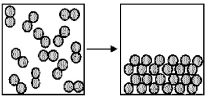
(Multiple Choice)
4.8/5 (77)
(77) For the reaction N2(g)+ 2 O2(g)→ 2 NO2(g),ΔH° = 66.4 kJ/mol and ΔS° = -121.5 J/K.Is there a temperature at which the spontaneity of this reaction be changed,either from spontaneous to nonspontaneous or nonspontaneous to spontaneous? If so,estimate the temperature.
(Essay)
4.8/5 (73)
(73) Predict the sign of ΔS for each of the following processes,which occur at constant temperature. I.The volume of 2.0 moles of O2(g)increases from 44 L to 52 L.
II.The pressure of 2.0 moles of O2(g)increases from 1.0 atm to 1.2 atm.
(Multiple Choice)
4.7/5 (75)
(75) 
Filters
- Essay(0)
- Multiple Choice(0)
- Short Answer(0)
- True False(0)
- Matching(0)