



 Chat with AI
Exam 9: Thermochemistry: Chemical Energy

Exam 1: Chemical Tools: Experimentation and Measurement154 Questions
Exam 2: Atoms, molecules, and Ions275 Questions
Exam 3: Mass Relationships in Chemical Reactions159 Questions
Exam 4: Reactions in Aqueous Solutions211 Questions
Exam 5: Periodicity and the Electronic Structure of Atoms168 Questions
Exam 6: Ionic Compounds: Periodic Trends and Bonding138 Questions
Exam 7: Covalent Bonding and Electron-Dot Structures92 Questions
Exam 8: Covalent Compounds: Bonding Theories and Molecular Structure205 Questions
Exam 9: Thermochemistry: Chemical Energy170 Questions
Exam 10: Gases: Their Properties and Behavior188 Questions
Exam 11: Liquids, solids, and Phase Changes141 Questions
Exam 12: Solutions and Their Properties198 Questions
Exam 13: Chemical Kinetics190 Questions
Exam 14: Chemical Equilibrium171 Questions
Exam 15: Aqueous Equilibria: Acids and Bases231 Questions
Exam 16: Applications of Aqueous Equilibria201 Questions
Exam 17: Thermodynamics: Entropy, free Energy, and Equilibrium150 Questions
Exam 18: Electrochemistry212 Questions
Exam 19: Nuclear Chemistry176 Questions
Exam 20: Transition Elements and Coordination Chemistry190 Questions
Exam 21: Metals and Solid-State Materials154 Questions
Exam 22: The Main-Group Elements294 Questions
Exam 23: Connections to Organic and Biological Chemistry290 Questions
Select questions type


If a reaction with a negative value of ΔS is nonspontaneous at constant temperature and pressure,

Free
(Multiple Choice)
4.9/5  (68)
(68) Correct Answer: Verified
C
The following drawing is a representation of a reaction for which ΔH° = +62 kJ.This reaction is likely to be 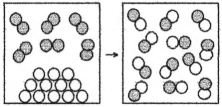
Free
(Multiple Choice)
4.9/5 (69)
(69) Correct Answer:Verified
VerifiedB
Imagine a reaction that results in a change in both volume and temperature,as shown in the diagram below.What is the sign of the work being done and the sign of the enthalpy change involved in this reaction? 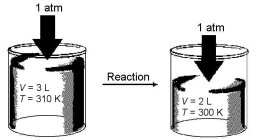
Free
(Multiple Choice)
5.0/5 (82)
(82) Correct Answer:Verified
VerifiedA
Given that ΔH°= -311 kJ for the hydrogenation of acetylene,C2H2: H-C  C-H(g)+ 2 H2(g)→ CH3-CH3(g)
And the following bond dissociation energies,estimate a value for the C-to-C triple bond dissociation energy.
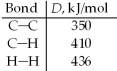
C-H(g)+ 2 H2(g)→ CH3-CH3(g)
And the following bond dissociation energies,estimate a value for the C-to-C triple bond dissociation energy. (Multiple Choice)
4.7/5 (63)
(63) Methanol can be produced from carbon monoxide and hydrogen with suitable catalysts: CO(g)+ 2 H2(g)→ CH3OH(l)at 25°C ΔH° = -128.1 kJ and ΔS° = -332 J/K
Find ΔG° at 25°C.
(Multiple Choice)
4.8/5 (74)
(74) The sign of ΔG for a reaction is ________ if the reaction is spontaneous,________ if the reaction is at equilibrium,and ________ if the reaction is nonspontaneous.
(Short Answer)
5.0/5 (62)
(62) Find ΔE° for the reaction below if the process is carried out at a constant pressure of 1.00 atm and ΔV (the volume change)= -24.5 L.(1 L ∙ atm = 101 J) 2 CO(g)+ O2 (g)→ 2 CO2(g)ΔH° = -566.kJ
(Multiple Choice)
4.9/5 (77)
(77) The heat of vaporization of water at 100°C is 40.66 kJ/mol.Calculate the quantity of heat that is absorbed/released when 7.00 g of steam condenses to liquid water at 100°C.
(Multiple Choice)
4.8/5 (81)
(81) An ideal gas expands into a vacuum (external pressure = 0)without gaining or losing heat.For this expansion
(Multiple Choice)
4.8/5 (65)
(65) When 20.00 moles of H2(g)reacts with 10.00 mol of O2(g)to form 20.00 mol of H2O(l)at 25°C and a constant pressure of 1.00 atm.If 1366 kJ of heat are released during this reaction,and PΔV is equal to -74.00 kJ,then
(Multiple Choice)
4.8/5 (86)
(86) Heat of formation for CO is -110.5 KJ/mol and the heat of formation for MgO is -602 KJ/mol.Which of the following statements is true?
(Multiple Choice)
4.7/5 (75)
(75) When 50.0 mL of 0.400 M Ca(NO3)2 is added to 50.0 mL of 0.800 M NaF,CaF2 precipitates,as shown in the net ionic equation below.The initial temperature of both solutions is 30.00°C.Assuming that the reaction goes to completion,and that the resulting solution has a mass of 100.00 g and a specific heat of 4.18 J/(g ∙ °C),calculate the final temperature of the solution. Ca2+(aq)+ 2 F-(aq)→ CaF2(s)ΔH° = -11.5 kJ
(Multiple Choice)
4.8/5 (81)
(81) Which combination always results in a reaction being spontaneous?
(Multiple Choice)
4.8/5 (91)
(91) In which case is the work done on the system always positive?
(Multiple Choice)
4.8/5 (78)
(78) The specific heat of copper is 0.385 J/(g ∙ °C).If 34.2 g of copper,initially at 25°C,absorbs 7.880 kJ,what will be the final temperature of the copper?
(Multiple Choice)
4.8/5 (78)
(78) It takes 11.2 kJ of energy to raise the temperature of 145 g of benzene from 22.0°C to 67.0°C.What is the specific heat of benzene?
(Multiple Choice)
4.9/5 (78)
(78) The following drawing is a representation of a reaction of the type A → B,where different shaded spheres represent different molecular structures.For this reaction ΔH° = +45 kJ.This reaction is likely to be 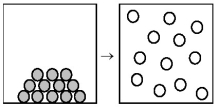
(Multiple Choice)
4.9/5 (68)
(68) 10.0 g of a metal,initially at 25°C,are placed into 10.0 g of water,initially at 100°C.Which metal will have the highest final temperature? Shown after each metal is its specific heat in J/(g∙°C).
(Multiple Choice)
4.8/5 (87)
(87) When 6.000 moles of H2(g)reacts with 3.000 mol of O2(g)to form 6.000 mol of H2O(l)at 25°C and a constant pressure of 1.00 atm.If 409.8 kJ of heat are released during this reaction,and PΔV is equal to -22.20 kJ,then
(Multiple Choice)
4.8/5 (83)
(83) 
Filters
- Essay(0)
- Multiple Choice(0)
- Short Answer(0)
- True False(0)
- Matching(0)