



 Chat with AI
Exam 9: Thermochemistry: Chemical Energy

Exam 1: Chemical Tools: Experimentation and Measurement154 Questions
Exam 2: Atoms, molecules, and Ions275 Questions
Exam 3: Mass Relationships in Chemical Reactions159 Questions
Exam 4: Reactions in Aqueous Solutions211 Questions
Exam 5: Periodicity and the Electronic Structure of Atoms168 Questions
Exam 6: Ionic Compounds: Periodic Trends and Bonding138 Questions
Exam 7: Covalent Bonding and Electron-Dot Structures92 Questions
Exam 8: Covalent Compounds: Bonding Theories and Molecular Structure205 Questions
Exam 9: Thermochemistry: Chemical Energy170 Questions
Exam 10: Gases: Their Properties and Behavior188 Questions
Exam 11: Liquids, solids, and Phase Changes141 Questions
Exam 12: Solutions and Their Properties198 Questions
Exam 13: Chemical Kinetics190 Questions
Exam 14: Chemical Equilibrium171 Questions
Exam 15: Aqueous Equilibria: Acids and Bases231 Questions
Exam 16: Applications of Aqueous Equilibria201 Questions
Exam 17: Thermodynamics: Entropy, free Energy, and Equilibrium150 Questions
Exam 18: Electrochemistry212 Questions
Exam 19: Nuclear Chemistry176 Questions
Exam 20: Transition Elements and Coordination Chemistry190 Questions
Exam 21: Metals and Solid-State Materials154 Questions
Exam 22: The Main-Group Elements294 Questions
Exam 23: Connections to Organic and Biological Chemistry290 Questions
Select questions type


Reactant R reacts with reactant S in two steps to yield product Z. 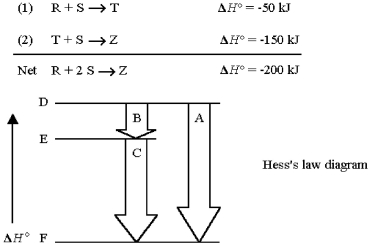 -Step (2)in the reaction is represented by
 (Multiple Choice)
4.9/5  (86)
(86) Under thermodynamic standard state conditions the element oxygen occurs as
(Multiple Choice)
4.9/5 (83)
(83) Which of the following states the first law of thermodynamics (conservation of energy)?
(Multiple Choice)
4.9/5 (78)
(78) Which of the following is not a type of energy or energy transfer?
(Multiple Choice)
4.9/5 (77)
(77) At 298 K the average kinetic energy is the same for H2,He,and N2.The gas with the highest average velocity is
(Multiple Choice)
4.8/5 (72)
(72) The enthalpy of fusion of naphthalene,C10H8,is 19.1 kJ/mol at 78.2°C,its melting point.Calculate the entropy of fusion at the melting point.
(Multiple Choice)
4.7/5 (75)
(75) The heat of vaporization of water at 100°C is 40.66 kJ/mol.Calculate the quantity of heat that is absorbed/released when 20.00 g of steam condenses to liquid water at 100°C.
(Multiple Choice)
4.8/5 (64)
(64) Heat transferred in a chemical reaction or physical change is expressed as ΔE when the heat is transferred under constant ________ and is expressed as ΔH when heat is transferred under constant ________ conditions.
(Short Answer)
4.7/5 (80)
(80) Reactant R reacts with reactant S in two steps to yield product Z.
-Step (1)in the reaction is represented by
-Step (1)in the reaction is represented by (Multiple Choice)
4.8/5 (77)
(77) Kinetic energy increases with increasing ________ and increasing ________.
(Short Answer)
4.7/5 (78)
(78) How much heat is absorbed/released when 20.00 g of NH3(g)reacts in the presence of excess  (g)to produce NO(g)and H2O(l)according to the following chemical equation? 4 NH3(g)+ 5 O2(g)→ 4 NO(g)+ 6 H2O(l)ΔH° = 1168 kJ
 (Multiple Choice)
4.8/5 (67)
(67) What are the signs of ΔH,ΔS,and ΔG for the following spontaneous change? 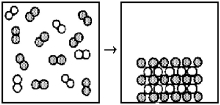
(Multiple Choice)
4.9/5 (69)
(69) If an endothermic reaction is spontaneous at constant temperature and pressure,
(Multiple Choice)
4.9/5 (65)
(65) Which thermodynamic function is most related to disorder and probability?
(Multiple Choice)
4.7/5 (94)
(94) 
Filters
- Essay(0)
- Multiple Choice(0)
- Short Answer(0)
- True False(0)
- Matching(0)