



 Chat with AI
Exam 9: Thermochemistry: Chemical Energy

Exam 1: Chemical Tools: Experimentation and Measurement154 Questions
Exam 2: Atoms, molecules, and Ions275 Questions
Exam 3: Mass Relationships in Chemical Reactions159 Questions
Exam 4: Reactions in Aqueous Solutions211 Questions
Exam 5: Periodicity and the Electronic Structure of Atoms168 Questions
Exam 6: Ionic Compounds: Periodic Trends and Bonding138 Questions
Exam 7: Covalent Bonding and Electron-Dot Structures92 Questions
Exam 8: Covalent Compounds: Bonding Theories and Molecular Structure205 Questions
Exam 9: Thermochemistry: Chemical Energy170 Questions
Exam 10: Gases: Their Properties and Behavior188 Questions
Exam 11: Liquids, solids, and Phase Changes141 Questions
Exam 12: Solutions and Their Properties198 Questions
Exam 13: Chemical Kinetics190 Questions
Exam 14: Chemical Equilibrium171 Questions
Exam 15: Aqueous Equilibria: Acids and Bases231 Questions
Exam 16: Applications of Aqueous Equilibria201 Questions
Exam 17: Thermodynamics: Entropy, free Energy, and Equilibrium150 Questions
Exam 18: Electrochemistry212 Questions
Exam 19: Nuclear Chemistry176 Questions
Exam 20: Transition Elements and Coordination Chemistry190 Questions
Exam 21: Metals and Solid-State Materials154 Questions
Exam 22: The Main-Group Elements294 Questions
Exam 23: Connections to Organic and Biological Chemistry290 Questions
Select questions type


For a system at constant pressure,19,400 calories of heat are released.This quantity of heat is equivalent to
(Multiple Choice)
4.9/5  (83)
(83) Most chemical reactions are carried out in one of two ways: I.in an open vessel at constant atmospheric pressure
II.in a closed vessel
Which is true?
(Multiple Choice)
4.7/5 (77)
(77) Calculate ΔG° for the reaction below and tell whether it is spontaneous or nonspontaneous under standard conditions at 25°C. 2 S (s)+ 3 O2 (g)+ 2 H2O (l)→ 2 H2SO4 (l)ΔH° = -1056 kJ/mol
ΔS° = -505 J/mol
(Multiple Choice)
4.9/5 (75)
(75) Ethyl alcohol is produced by the fermentation of glucose,C6H12O6. C6H12O6(s)→ 2 C2H5OH(l)+ 2 CO2(g)ΔH° = -69.1 kJ
Given that the enthalpy of formation is -277.7 kJ/mol for C2H5OH(l)and -393.5 kJ/mol for CO2(g),find the enthalpy of formation for C6H12O6.
(Multiple Choice)
5.0/5 (76)
(76) What are the signs of ΔH,ΔS,and ΔG for the following spontaneous change? 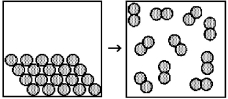
(Multiple Choice)
4.8/5 (73)
(73) A process is carried out at constant pressure.Given that ΔE is positive and ΔH is negative,
(Multiple Choice)
4.8/5 (75)
(75) At a given temperature and pressure,which of the following would be expected to have the greatest molar entropy?
(Multiple Choice)
4.7/5 (68)
(68) Energy can be classified as either ________ energy (energy of motion)or ________ energy (stored energy).
(Short Answer)
4.7/5 (74)
(74) The following drawing is a representation of a reaction of the type A → B,where different shaded spheres represent different molecular structures.For this reaction ΔH° = -30 kJ.This reaction is likely to be 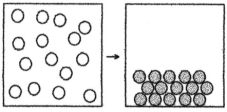
(Multiple Choice)
4.9/5 (88)
(88) A reaction is performed in a water bath initially at 28°C which decreases to 10°C by the end of the reaction.For this reaction the sign of heat transfer is ________,and the reaction is classified as ________.
(Short Answer)
4.8/5 (77)
(77) When 0.700 g of anthracene,C14H10,is combusted in a bomb calorimeter that has a water jacket containing 500.g of water,the temperature of the water increases by 13.27°C.Assuming that the specific heat of water is 4.18 J/(g ∙ °C),and that the heat absorption by the calorimeter is negligible,estimate the enthalpy of combustion per mole of anthracene.
(Multiple Choice)
4.8/5 (89)
(89) For the expansion of an ideal gas into a vacuum at constant temperature,ΔH = 0.What can be said about ΔE and ΔS?
(Multiple Choice)
4.8/5 (86)
(86) In the reaction below,is energy released or absorbed by the system? What is the sign of the energy change,E?
432 kJ + A + 2B → 3C
(Short Answer)
4.9/5 (80)
(80) Which is expected to have the largest carbon-oxygen bond dissociation energy?
(Multiple Choice)
4.8/5 (77)
(77) Given: S (s)+ O2 (g)→ SO2 (g)ΔH° = -296.1 kJ 2 SO3 (g)→ 2 SO2 (g)+ O2 (g)ΔH° = 198.2 kJ
Find ΔH° for : 2 S(s)+ 3 O2(g)→ 2 SO3(g)
(Multiple Choice)
4.9/5 (88)
(88) The specific heat of copper is 0.385 J/(g ∙ °C).If 34.2 g of copper,initially at 21.0°C,absorbs 4.689 kJ,what will be the final temperature of the copper?
(Multiple Choice)
4.8/5 (65)
(65) When 10.0 mol of benzene is vaporized at a constant pressure of 1.00 atm and at its normal boiling point of 80.1°C,339 kJ are absorbed and PΔV for the vaporization process is equal to 29.0 kJ,then
(Multiple Choice)
4.9/5 (87)
(87) The enthalpy of fusion,or heat of fusion (ΔHfusion),of water is positive and corresponds to which physical change?
(Multiple Choice)
4.7/5 (79)
(79) 
Filters
- Essay(0)
- Multiple Choice(0)
- Short Answer(0)
- True False(0)
- Matching(0)