



 Chat with AI
Exam 9: Thermochemistry: Chemical Energy

Exam 1: Chemical Tools: Experimentation and Measurement154 Questions
Exam 2: Atoms, molecules, and Ions275 Questions
Exam 3: Mass Relationships in Chemical Reactions159 Questions
Exam 4: Reactions in Aqueous Solutions211 Questions
Exam 5: Periodicity and the Electronic Structure of Atoms168 Questions
Exam 6: Ionic Compounds: Periodic Trends and Bonding138 Questions
Exam 7: Covalent Bonding and Electron-Dot Structures92 Questions
Exam 8: Covalent Compounds: Bonding Theories and Molecular Structure205 Questions
Exam 9: Thermochemistry: Chemical Energy170 Questions
Exam 10: Gases: Their Properties and Behavior188 Questions
Exam 11: Liquids, solids, and Phase Changes141 Questions
Exam 12: Solutions and Their Properties198 Questions
Exam 13: Chemical Kinetics190 Questions
Exam 14: Chemical Equilibrium171 Questions
Exam 15: Aqueous Equilibria: Acids and Bases231 Questions
Exam 16: Applications of Aqueous Equilibria201 Questions
Exam 17: Thermodynamics: Entropy, free Energy, and Equilibrium150 Questions
Exam 18: Electrochemistry212 Questions
Exam 19: Nuclear Chemistry176 Questions
Exam 20: Transition Elements and Coordination Chemistry190 Questions
Exam 21: Metals and Solid-State Materials154 Questions
Exam 22: The Main-Group Elements294 Questions
Exam 23: Connections to Organic and Biological Chemistry290 Questions
Select questions type


Which of CH4(g),C2H2(g),and CH3OH(l)provides the most energy per gram upon combustion and which provides the least? CH4(g)+ 2 O2(g)→ CO2(g)+ 2 H2O(l)ΔH° = -890 kJ
2 C2H2(g)+ 5 O2(g)→ 4 CO2(g)+ 2 H2O(l)ΔH° = -2599 kJ
2 CH3OH(l)+ 3 O2(g)→ 2 CO2(g)+ 4 H2O(l)ΔH° = -1453 kJ
(Multiple Choice)
4.9/5  (75)
(75) Which is expected to have the lowest specific heat capacity at 25°C?
(Multiple Choice)
4.9/5 (75)
(75) For the of freezing liquid butane at a given temperature and pressure,
(Multiple Choice)
4.8/5 (73)
(73) For a process at constant pressure,24,800 calories of heat are released.This quantity of heat is equivalent to
(Multiple Choice)
4.7/5 (87)
(87) Calculate Gibb's free energy and determine if the event is spontaneous or non-spontaneous for ΔH = 42 Jand ΔS = -111 J/K at 400 K.
(Multiple Choice)
4.8/5 (72)
(72) Which of the following can be interpreted as a measure of randomness?
(Multiple Choice)
4.9/5 (86)
(86) Determine the sign of ΔS° for each of the following: I.C6H6(s)→ C6H6(l)
II.2 SO2(g)+ O2(g)→ 2 SO3(g)
(Multiple Choice)
4.8/5 (89)
(89) Heat transfer measured in a coffee-cup calorimeter at constant pressure is a measure of ________,but heat transfer measured in a bomb calorimeter at constant volume is a measure of ________.
(Short Answer)
4.8/5 (93)
(93) The following drawing is a representation of a reaction for which ΔH° = -22 kJ.This reaction is likely to be 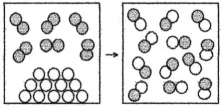
(Multiple Choice)
5.0/5 (69)
(69) Which equation represents the reaction whose ΔH,represents the standard enthalpy of formation of CHCl3(l)at 25°C? (i.e. ,for which is ΔH = ΔH°f of CHCl3)
(Multiple Choice)
4.9/5 (79)
(79) The following drawing is a representation of the exothermic reaction in which ozone forms dioxygen. 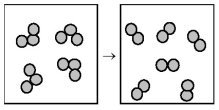 -What are the signs of ΔH and ΔS for this reaction?
 (Multiple Choice)
4.8/5 (86)
(86) At 25°C the heat of fusion of aluminum is 10.6 kJ/mol and the heat of sublimation is 326.4 kJ/mol.What is the heat of vaporization of aluminum at 25°C?
(Multiple Choice)
4.8/5 (74)
(74) Because the number of moles of gas are increasing from 6 to 7 in the reaction shown below,at constant pressure ΔE is predicted to be slightly ________ negative than ΔH.
C3H8(g)+ 5 O2(g)→ 3 CO2(g)+ 4 H2O(g)
(Short Answer)
5.0/5 (86)
(86) Find ΔH° for the reaction C3H8(g)+ 5 O2(g)→ 3 CO2(g)+ 4 H2O(l). ΔH° = -2046 kJ for the reaction: C3H8(g)+ 5 O2(g)→ 3 CO2(g)+ 4 H2O(g)
The heat of vaporization of water is 44.0 kJ/mol.Note that H2O is a liquid in the first reaction and a gas in the second.
(Multiple Choice)
5.0/5 (85)
(85) Imagine a reaction that results in a change in both volume and temperature,as shown in the diagram below.What is the sign of the work being done,and what is the sign of the enthalpy change involved in this reaction? 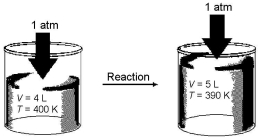
(Multiple Choice)
4.8/5 (69)
(69) Calculate the total quantity of heat required to convert 25.0 g of liquid CCl4(l)from 45.0°C to gaseous CCl4 76.8°C (the normal boiling point for CCl4)? The specific heat of CCl4(l)is  its heat of fusion is
 and its heat of vaporization is

its heat of fusion is and its heat of vaporization is (Multiple Choice)
4.8/5 (78)
(78) The sign of ΔS° for reaction below is expected to be ________.
2 H2(g)+ O2(g)→ 2 H2O(g)
(Short Answer)
4.9/5 (81)
(81) The heat of combustion per mole for acetylene,C2H2(g),is -1299.5 kJ/mol.Assuming that the combustion products are CO2(g)and H2O(l),and given that the enthalpy of formation is -393.5 kJ/mol for CO2(g)and -285.8 kJ/mol for H2O(l),find the enthalpy of formation of C2H2(g).
(Multiple Choice)
4.9/5 (73)
(73) 
Filters
- Essay(0)
- Multiple Choice(0)
- Short Answer(0)
- True False(0)
- Matching(0)