



 Chat with AI
Exam 9: Thermochemistry: Chemical Energy

Exam 1: Chemical Tools: Experimentation and Measurement154 Questions
Exam 2: Atoms, molecules, and Ions275 Questions
Exam 3: Mass Relationships in Chemical Reactions159 Questions
Exam 4: Reactions in Aqueous Solutions211 Questions
Exam 5: Periodicity and the Electronic Structure of Atoms168 Questions
Exam 6: Ionic Compounds: Periodic Trends and Bonding138 Questions
Exam 7: Covalent Bonding and Electron-Dot Structures92 Questions
Exam 8: Covalent Compounds: Bonding Theories and Molecular Structure205 Questions
Exam 9: Thermochemistry: Chemical Energy170 Questions
Exam 10: Gases: Their Properties and Behavior188 Questions
Exam 11: Liquids, solids, and Phase Changes141 Questions
Exam 12: Solutions and Their Properties198 Questions
Exam 13: Chemical Kinetics190 Questions
Exam 14: Chemical Equilibrium171 Questions
Exam 15: Aqueous Equilibria: Acids and Bases231 Questions
Exam 16: Applications of Aqueous Equilibria201 Questions
Exam 17: Thermodynamics: Entropy, free Energy, and Equilibrium150 Questions
Exam 18: Electrochemistry212 Questions
Exam 19: Nuclear Chemistry176 Questions
Exam 20: Transition Elements and Coordination Chemistry190 Questions
Exam 21: Metals and Solid-State Materials154 Questions
Exam 22: The Main-Group Elements294 Questions
Exam 23: Connections to Organic and Biological Chemistry290 Questions
Select questions type


Imagine a reaction that results in a change in both volume and temperature,as shown in the diagram below.What is the sign of the work being done,and what is the sign of the enthalpy change involved in this reaction? 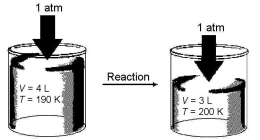
(Multiple Choice)
4.9/5  (80)
(80) At 253 K the sign of ΔG for the physical change shown below is ________.
H2O(s)→ H2O(l)
(Short Answer)
4.8/5 (85)
(85) Calculate the work,w,gained or lost by the system when a gas expands from 15 L to 35 L against a constant external pressure of 1.5 atm.1 L ∙ atm = 101 J
(Multiple Choice)
4.8/5 (69)
(69) In the lab,you mix two solutions (each originally at the same temperature)and the temperature of the resulting solution decreases.Which of the following is true?
(Multiple Choice)
5.0/5 (69)
(69) Use the given average bond dissociation energies,D,to estimate ΔH for the reaction of methane,CH4(g),with fluorine according to the equation: CH4(g)+ 2 F2(g)→ CF4(g)+ 2 H2(g) 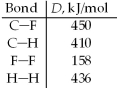
(Multiple Choice)
4.9/5 (70)
(70) When 1.820 g of anthracene,C14H10,is combusted in a bomb calorimeter that has a water jacket containing 500.0 g of water,the temperature of the water increases by 34.52°C.Assuming that the specific heat of water is 4.18 J/(g ∙ °C),and that the heat absorption by the calorimeter is negligible,estimate the enthalpy of combustion per mole of anthracene.
(Multiple Choice)
4.8/5 (85)
(85) In the reaction shown below,________ kJ of heat are released per mole of carbon dioxide(g)that is produced.
C3H8(g)+ 5 O2(g)→ 3 CO2(g)+ 4 H2O(g)ΔH = -2045 kJ
(Short Answer)
4.7/5 (88)
(88) Find ΔH for C3H8 (g)+ 6 H2O (g)→ 3 CO2 (g)+ 10 H2 given C3H8 (g)+ 3 H2O (g)→ 3 CO (g)+ 7 H2 (g)ΔH = 499 kJ
CO (g)+ H2O (g)→ CO2 (g)+ H2 (g)ΔH = -41 kJ
(Multiple Choice)
4.8/5 (68)
(68) For the reaction I2(g)→ I2(s),ΔH° = -62.4 kJ at 25°C.Based on these data,at 25°C
(Multiple Choice)
4.9/5 (86)
(86) Consider the conversion of white tin to gray tin: Sn(white)→ Sn(gray)ΔH° = -2.09 kJ ΔS° = -7.41 J/K
Based on these data,
(Multiple Choice)
4.8/5 (73)
(73) How much heat is absorbed when 20.00 g of C(s)reacts in the presence of excess SO2(g)to produce CS2(l)and CO(g)according to the following chemical equation? 5 C(s)+ 2 SO2(g)→ CS2(l)+ 4 CO(g)ΔH° = +239.9 kJ
(Multiple Choice)
4.8/5 (71)
(71) The values of ΔH°f for the three states of benzene are approximately -22 kcal/mol,-11 kcal/mol,and  Which is the value for solid benzene?
 (Multiple Choice)
4.8/5 (79)
(79) 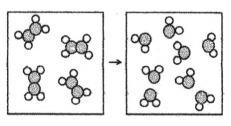 -The reaction represented in the above drawing is likely to be
 (Multiple Choice)
4.8/5 (72)
(72) Which is expected to have the most negative standard enthalpy of formation?
(Multiple Choice)
4.7/5 (79)
(79) A spontaneous reaction has a ________ value of ΔG and is favored by a ________ value of ΔH and a ________ value of ΔS.
(Short Answer)
4.8/5 (81)
(81) For which should the standard heat of formation ΔH°f,be zero at 25°C?
(Multiple Choice)
4.8/5 (71)
(71) When 5.50 g of Ba(s)is added to 100.00 g of water in a container open to the atmosphere,the reaction shown below occurs and the temperature of the resulting solution rises from 22.00°C to 61.16°C.If the specific heat of the solution is 4.18 J/(g ∙ °C),calculate  for the reaction,as written. Ba(s)+ 2 H2O(l)→ Ba(OH)2(aq)+ H2(g)
 = ?
for the reaction,as written. Ba(s)+ 2 H2O(l)→ Ba(OH)2(aq)+ H2(g) = ? (Multiple Choice)
4.9/5 (81)
(81) Sodium metal reacts with water to produce hydrogen gas and sodium hydroxide according to the chemical equation shown below.When 0.0500 mol of Na is added to 100.00 g of water,the temperature of the resulting solution rises from 25.00°C to 46.23°C.If the specific heat of the solution is 4.18 J/(g ∙ °C),calculate ΔH for the reaction,as written. 2 Na(s)+ 2 H2O(l)→ 2 NaOH(aq)+ H2(g)ΔH = ?
(Multiple Choice)
4.9/5 (95)
(95) 
Filters
- Essay(0)
- Multiple Choice(0)
- Short Answer(0)
- True False(0)
- Matching(0)