



 Chat with AI
Exam 11: Liquids, solids, and Phase Changes

Exam 1: Chemical Tools: Experimentation and Measurement154 Questions
Exam 2: Atoms, molecules, and Ions275 Questions
Exam 3: Mass Relationships in Chemical Reactions159 Questions
Exam 4: Reactions in Aqueous Solutions211 Questions
Exam 5: Periodicity and the Electronic Structure of Atoms168 Questions
Exam 6: Ionic Compounds: Periodic Trends and Bonding138 Questions
Exam 7: Covalent Bonding and Electron-Dot Structures92 Questions
Exam 8: Covalent Compounds: Bonding Theories and Molecular Structure205 Questions
Exam 9: Thermochemistry: Chemical Energy170 Questions
Exam 10: Gases: Their Properties and Behavior188 Questions
Exam 11: Liquids, solids, and Phase Changes141 Questions
Exam 12: Solutions and Their Properties198 Questions
Exam 13: Chemical Kinetics190 Questions
Exam 14: Chemical Equilibrium171 Questions
Exam 15: Aqueous Equilibria: Acids and Bases231 Questions
Exam 16: Applications of Aqueous Equilibria201 Questions
Exam 17: Thermodynamics: Entropy, free Energy, and Equilibrium150 Questions
Exam 18: Electrochemistry212 Questions
Exam 19: Nuclear Chemistry176 Questions
Exam 20: Transition Elements and Coordination Chemistry190 Questions
Exam 21: Metals and Solid-State Materials154 Questions
Exam 22: The Main-Group Elements294 Questions
Exam 23: Connections to Organic and Biological Chemistry290 Questions
Select questions type


The two most efficiently packed unit cells have the hexagonal closest-packed and the ________ the atomic arrangements.

Free
(Short Answer)
4.7/5  (78)
(78) Correct Answer: Verified
cubic closest-packed
A compound having A ions on each corner and B ions on each face of a cubic unit cell has the empirical formula ________.
Free
(Short Answer)
4.9/5 (79)
(79) Correct Answer:Verified
VerifiedAB3
Which of the following compounds has the highest boiling point?
Free
(Multiple Choice)
4.9/5 (63)
(63) Correct Answer:Verified
VerifiedA
A crystalline solid of unknown origin forms an aqueous solution that conducts an electrical current.The solid has a high melting point and shatters when struck with a hammer.The solid is likely to be
(Multiple Choice)
4.9/5 (78)
(78) The magnitude of the heats of vaporization,fusion and sublimation of a substance reflect the
(Multiple Choice)
4.9/5 (78)
(78) The phase diagram of a substance is shown below. 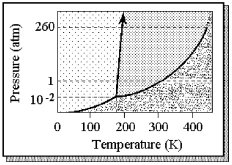 -The approximate normal melting point of this substance is
 (Multiple Choice)
4.8/5 (89)
(89) The temperature and pressure at which all three phases can coexist in equilibrium is
(Multiple Choice)
4.8/5 (85)
(85) How many atoms are in one face-centered cubic unit cell of a metal?
(Multiple Choice)
4.7/5 (67)
(67) .  -If figure (1)represents the vapor pressure of water at 25°C,which figure represents the vapor pressure of water at 45°C?
 (Multiple Choice)
4.8/5 (80)
(80) How much heat is released when 95.0 g of steam at 100.0°C is cooled to ice at -15.0°C? The enthalpy of vaporization of water is 40.67 kJ/mol,the enthalpy of fusion for water is 6.01 kJ/mol,the molar heat capacity of liquid water is 75.4 J/(mol ∙ °C),and the molar heat capacity of ice is 36.4 J/(mol ∙ °C).
(Multiple Choice)
4.8/5 (71)
(71) Consider a compound that undergoes sublimation at 125°C and a pressure of one atm.Which of the following could be a heating curve appropriate for heating the compound from 100°C to 150°C? 
(Multiple Choice)
4.9/5 (94)
(94) Use the diagram below to answer the following questions.  -Melting occurs along the
 (Multiple Choice)
4.9/5 (87)
(87)  -If figure (1)represents the vapor pressure of water at 25°C,which figure represents the vapor pressure of ethanol,CH3CH2OH at 25°C?
 (Multiple Choice)
4.7/5 (79)
(79) The phase change H2(g)→ H2(s)is called ________,and the enthalpy change,ΔH,for this phase change has a ________ sign.
(Short Answer)
5.0/5 (73)
(73) First-order diffraction of X-rays with d = 154.2 pm at an angle of 32.5° is caused by layers of atoms in a crystalline solid with a spacing of ________ pm.
(Short Answer)
4.8/5 (78)
(78) Of C2H5OH and C3H5(OH)3 the one expected to have the higher viscosity is ________,and the one expected to have the higher surface tension is ________.
(Essay)
4.8/5 (82)
(82) Ethyl chloride,C2H5Cl,is used as a local anesthetic.It works by cooling tissue as it vaporizes;its heat of vaporization is 26.4 kJ/mol.How much heat could be removed by 10.0 g of ethyl chloride?
(Multiple Choice)
4.8/5 (73)
(73) 
Filters
- Essay(0)
- Multiple Choice(0)
- Short Answer(0)
- True False(0)
- Matching(0)