



 Chat with AI
Exam 13: Chemical Kinetics

Exam 1: Chemical Tools: Experimentation and Measurement154 Questions
Exam 2: Atoms, molecules, and Ions275 Questions
Exam 3: Mass Relationships in Chemical Reactions159 Questions
Exam 4: Reactions in Aqueous Solutions211 Questions
Exam 5: Periodicity and the Electronic Structure of Atoms168 Questions
Exam 6: Ionic Compounds: Periodic Trends and Bonding138 Questions
Exam 7: Covalent Bonding and Electron-Dot Structures92 Questions
Exam 8: Covalent Compounds: Bonding Theories and Molecular Structure205 Questions
Exam 9: Thermochemistry: Chemical Energy170 Questions
Exam 10: Gases: Their Properties and Behavior188 Questions
Exam 11: Liquids, solids, and Phase Changes141 Questions
Exam 12: Solutions and Their Properties198 Questions
Exam 13: Chemical Kinetics190 Questions
Exam 14: Chemical Equilibrium171 Questions
Exam 15: Aqueous Equilibria: Acids and Bases231 Questions
Exam 16: Applications of Aqueous Equilibria201 Questions
Exam 17: Thermodynamics: Entropy, free Energy, and Equilibrium150 Questions
Exam 18: Electrochemistry212 Questions
Exam 19: Nuclear Chemistry176 Questions
Exam 20: Transition Elements and Coordination Chemistry190 Questions
Exam 21: Metals and Solid-State Materials154 Questions
Exam 22: The Main-Group Elements294 Questions
Exam 23: Connections to Organic and Biological Chemistry290 Questions
Select questions type


Methanol can be produced by the following reaction: CO(g)+ 2 H2(g)→ CH3OH(g).
How is the rate of disappearance of hydrogen gas related to the rate of appearance of methanol?
-  = ?
= ? (Multiple Choice)
4.9/5  (68)
(68) The decomposition of ozone in the stratosphere can occur by the following two-step mechanism: Step 1: Br + O3 → BrO + O2
Step 2: BrO + O → Br + O2
Which species is an intermediate in this mechanism?
(Multiple Choice)
4.8/5 (84)
(84) A concentration-time study of the gas phase reaction 2 A3 → 3 A2 produced the data in the table below. Time (s)[A3] (M)[A2] (M)
0 4.00 × 10⁻⁴ 0
10 2.00 × 10⁻⁴ 3.00 × 10⁻⁴
20 1.00 × 10⁻⁴ 4.50 × 10⁻⁴
30 5.00 × 10⁻⁵ ?
What is the average rate of formation of A2 in the time interval 20-30 seconds?
(Multiple Choice)
4.9/5 (82)
(82) For the zeroth-order reaction: C → products,-Δ[C]/Δt = k,which of the following graphs would be expected to give a straight line?
(Multiple Choice)
4.9/5 (75)
(75) At 55° the decomposition of N2O5 is first order,having a rate constant,k = 1.7 × 10⁻³ s-1.If the initial concentration of N2O5 is 6.4 × 10⁻³ M,the number of half-lives that are required for the N2O5 concentration to fall to 2.0 × 10⁻⁴ M is ________,and the amount of time required is ________ minutes.
(Short Answer)
4.9/5 (71)
(71) A reaction is second order in NO and first order in O2 has a rate constant,k = 1.4 × 10⁴ M-2s-1.What is the initial rate of reaction when the concentrations of NO and O2 are 0.015 M and 0.030 M,respectively?
(Short Answer)
4.9/5 (73)
(73) A common rule in organic chemistry is that increasing the temperature of a reaction at room temperature by 10°C doubles the rate.Calculate Ea for a reaction that follows this rule.Assume room temperature is 25°C.
(Multiple Choice)
4.7/5 (87)
(87) Consider the first-order reaction A → B in which A molecules (shaded spheres)are converted to B molecules (unshaded spheres). 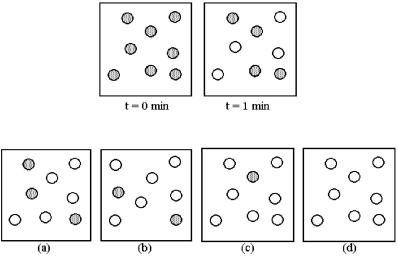 -Which drawing (a)-(d)represents the reaction mixture at t = 2 minutes?
 (Multiple Choice)
4.8/5 (75)
(75) Which term describes the measure of the decrease in the concentration of a product per unit time?
(Multiple Choice)
4.8/5 (77)
(77) 
Filters
- Essay(0)
- Multiple Choice(0)
- Short Answer(0)
- True False(0)
- Matching(0)