



 Chat with AI
Exam 19: Nuclear Chemistry

Exam 1: Chemical Tools: Experimentation and Measurement154 Questions
Exam 2: Atoms, molecules, and Ions275 Questions
Exam 3: Mass Relationships in Chemical Reactions159 Questions
Exam 4: Reactions in Aqueous Solutions211 Questions
Exam 5: Periodicity and the Electronic Structure of Atoms168 Questions
Exam 6: Ionic Compounds: Periodic Trends and Bonding138 Questions
Exam 7: Covalent Bonding and Electron-Dot Structures92 Questions
Exam 8: Covalent Compounds: Bonding Theories and Molecular Structure205 Questions
Exam 9: Thermochemistry: Chemical Energy170 Questions
Exam 10: Gases: Their Properties and Behavior188 Questions
Exam 11: Liquids, solids, and Phase Changes141 Questions
Exam 12: Solutions and Their Properties198 Questions
Exam 13: Chemical Kinetics190 Questions
Exam 14: Chemical Equilibrium171 Questions
Exam 15: Aqueous Equilibria: Acids and Bases231 Questions
Exam 16: Applications of Aqueous Equilibria201 Questions
Exam 17: Thermodynamics: Entropy, free Energy, and Equilibrium150 Questions
Exam 18: Electrochemistry212 Questions
Exam 19: Nuclear Chemistry176 Questions
Exam 20: Transition Elements and Coordination Chemistry190 Questions
Exam 21: Metals and Solid-State Materials154 Questions
Exam 22: The Main-Group Elements294 Questions
Exam 23: Connections to Organic and Biological Chemistry290 Questions
Select questions type


 U2+ nucleus is
 Fe2+ is

What is needed to balance the nuclear fusion reaction below?
2  H →
 H + ?
H → H + ? (Essay)
4.8/5  (77)
(77) Tell the type of decay process occurring in the following nuclear reaction. 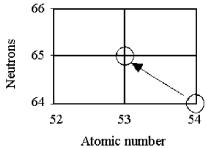
(Multiple Choice)
4.9/5 (83)
(83) Neptunium-239 has a half-life of 2.35 days.How many days must elapse for a sample of 239Np to decay to 3.00% of its original quantity?
(Multiple Choice)
4.9/5 (76)
(76) Which of the following elements would be expected to be particularly stable?
(Multiple Choice)
4.9/5 (73)
(73) When more than 3000 known nuclides are plotted on a neutron/proton grid,they make up a group called
(Multiple Choice)
4.8/5 (70)
(70) Which one of the following combinations of neutrons/protons results in the lowest number of nonradioactive (stable)isotopes?
(Multiple Choice)
4.7/5 (77)
(77) A radioisotope has a neutron/proton ratio which is too low.Which of the following processes will not occur for such a nucleus?
(Multiple Choice)
4.9/5 (81)
(81) 201Tl is used in myocardial perfusion imaging.It undergoes beta decay with a half-life of 73 hours generating 80 keV X-rays.A typical dose is 2.5 mCi which is equal to ________ Bq.
(Short Answer)
4.9/5 (76)
(76) Energy is ________ (released,required)in the transmutation reaction shown below.The atomic masses are 40Ar (39.9624),1H (1.0078),40K (39.9640),1n (1.0087).  Ar +
 H →
 Kr +
 n
Ar + H → Kr + n (Short Answer)
4.9/5 (68)
(68)  -What kind of decay process is occurring in the decay of isotope D to isotope E in the figure shown above?
 (Multiple Choice)
4.9/5 (72)
(72) If the age of the Earth is 4.5 billion years and the half-life of 40K is 1.26 billion years,what percent of the Earth's original amount of 40K remains today?
(Multiple Choice)
4.9/5 (77)
(77) The sum of the masses of the protons and neutrons in a given nucleus minus the mass of that nucleus is always
(Multiple Choice)
4.7/5 (77)
(77) The decay curve shown below approximates the decay of iodine-123.What is the approximate half-life of iodine-123? 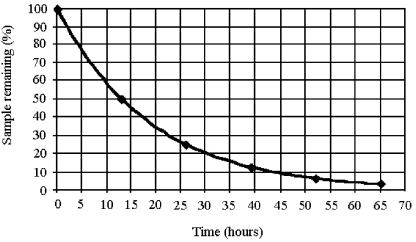
(Multiple Choice)
4.7/5 (70)
(70) Carbon-14,which is present in all living tissue,radioactively decays via a first-order process.A one-gram sample of wood taken from a living tree gives a rate for carbon-14 decay of 13.6 counts per minute.If the half-life for carbon-14 is 5715 years,how old is a wood sample that gives a rate for carbon-14 decay of 3.9 counts per minute?
(Multiple Choice)
4.8/5 (77)
(77) Which nuclide below is most likely to decay by electron capture?
(Multiple Choice)
4.9/5 (83)
(83) The two reactions shown below are classified as (1)nuclear ________ and (2)nuclear ________.
(1)  n +
 U →
 Ba +
 Kr + 3
 n
(2)
 H +
 H →
 He
n + U → Ba + Kr + 3 n
(2) H + H → He (Short Answer)
4.8/5 (86)
(86) 
Filters
- Essay(0)
- Multiple Choice(0)
- Short Answer(0)
- True False(0)
- Matching(0)