



 Chat with AI
Exam 13: Chemical Kinetics

Exam 1: Chemistry: the Study of Change168 Questions
Exam 2: Atoms, Molecules, and Ions156 Questions
Exam 3: Mass Relationships in Chemical Reactions194 Questions
Exam 4: Reactions in Aqueous Solutions186 Questions
Exam 5: Gases121 Questions
Exam 6: Thermochemistry118 Questions
Exam 7: Quantum Theory and the Electronic Structure of Atoms136 Questions
Exam 8: Periodic Relationships Among the Elements144 Questions
Exam 9: Chemical Bonding I: Basic Concepts137 Questions
Exam 10: Chemical Bonding Ii: Molecular Geometry and Hybridization of Atomic Orbitals147 Questions
Exam 11: Intermolecular Forces and Liquids and Solids149 Questions
Exam 12: Physical Properties of Solutions122 Questions
Exam 13: Chemical Kinetics130 Questions
Exam 14: Chemical Equilibrium109 Questions
Exam 15: Acids and Bases178 Questions
Exam 16: Acid-Base Equilibria and Solubility Equilibria131 Questions
Exam 17: Entropy Free Energy and Equilibrium128 Questions
Exam 18: Electrochemistry154 Questions
Exam 19: Nuclear Chemistry133 Questions
Exam 20: Chemistry in the Atmosphere50 Questions
Exam 21: Metallurgy and the Chemistry of Metals63 Questions
Exam 22: Nonmetallic Elements and Their Compounds52 Questions
Exam 23: Transition Metal Chemistry and Coordination Compounds92 Questions
Exam 24: Organic Chemistry67 Questions
Exam 25: Synthetic and Natural Organic Polymers50 Questions
Select questions type


With respect to the figure below, which choice correctly identifies all the numbered positions? 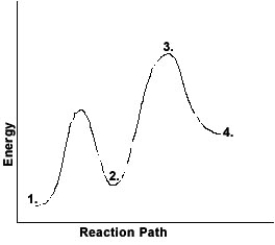
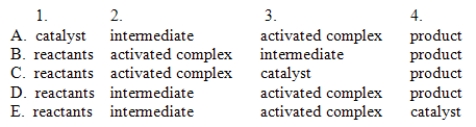
(Multiple Choice)
4.9/5  (81)
(81) Chlorine dioxide reacts in basic water to form chlorite and chlorate according to the following chemical equation:
2ClO2(aq)+ 2OH-(aq) ClO2-(aq)+ ClO3-(aq)+ H2O(l)
A kinetic study of this reaction under a certain set of conditions yielded the data below. 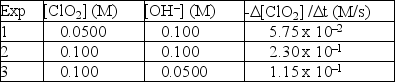 Which one of the following is the rate law for this reaction?
 (Multiple Choice)
4.9/5 (85)
(85) Concerning the rate law, Rate = k[A][B], what are appropriate units for the rate constant k?
(Multiple Choice)
4.9/5 (88)
(88) The isomerization of cyclopropane follows first order kinetics.The rate constant at 700 K is 6.20 × 10⁻⁴ min-1, and the half-life at 760 K is 29.0 min.Calculate the activation energy for this reaction.
(Multiple Choice)
4.8/5 (69)
(69) Aspirin, C9H8O4, slowly decomposes at room temperature by reacting with water in the atmosphere to produce acetic acid, HC2H3O2, and 2-hydroxybenzoic acid, C7H6O3 (this is why old bottles of aspirin often smell like vinegar):
C9H8O4 + H2O HC2H3O2 + C7H6O3
Concentration and rate data for this reaction are given below. 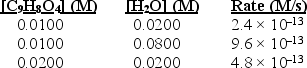 Write the rate law for this reaction and calculate k (be sure to include the correct units).
 (Essay)
5.0/5 (86)
(86) For the reaction X + Y Z, the reaction rate is found to depend only upon the concentration of X.A plot of 1/X verses time gives a straight line.
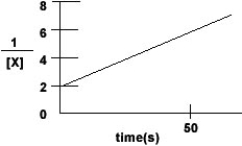 What is the rate law for this reaction?
 (Multiple Choice)
4.8/5 (68)
(68) When the concentrations of reactant molecules are increased, the rate of reaction increases.The best explanation for this phenomenon is that as the reactant concentration increases,
(Multiple Choice)
4.8/5 (84)
(84) A certain first-order reaction A B is 25% complete in 42 min at 25°C.What is the half-life of the reaction?
(Multiple Choice)
4.9/5 (88)
(88) The graphs below all refer to the same reaction.What is the order of this reaction? 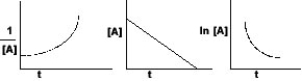
(Multiple Choice)
4.8/5 (63)
(63) Nitric acid is formed by the gas-phase hydrolysis of N2O5.Draw an energy profile curve for the reaction N2O5 + H2O 2HNO3 given that Ea(forward)= 15 kJ and Ea(reverse)= 51 kJ/mol.Label the activation energies of the forward and reverse reactions and label H for the reaction.
(Essay)
4.8/5 (87)
(87) 
Filters
- Essay(0)
- Multiple Choice(0)
- Short Answer(0)
- True False(0)
- Matching(0)