



 Chat with AI
Exam 13: Chemical Kinetics

Exam 1: Chemistry: the Study of Change168 Questions
Exam 2: Atoms, Molecules, and Ions156 Questions
Exam 3: Mass Relationships in Chemical Reactions194 Questions
Exam 4: Reactions in Aqueous Solutions186 Questions
Exam 5: Gases121 Questions
Exam 6: Thermochemistry118 Questions
Exam 7: Quantum Theory and the Electronic Structure of Atoms136 Questions
Exam 8: Periodic Relationships Among the Elements144 Questions
Exam 9: Chemical Bonding I: Basic Concepts137 Questions
Exam 10: Chemical Bonding Ii: Molecular Geometry and Hybridization of Atomic Orbitals147 Questions
Exam 11: Intermolecular Forces and Liquids and Solids149 Questions
Exam 12: Physical Properties of Solutions122 Questions
Exam 13: Chemical Kinetics130 Questions
Exam 14: Chemical Equilibrium109 Questions
Exam 15: Acids and Bases178 Questions
Exam 16: Acid-Base Equilibria and Solubility Equilibria131 Questions
Exam 17: Entropy Free Energy and Equilibrium128 Questions
Exam 18: Electrochemistry154 Questions
Exam 19: Nuclear Chemistry133 Questions
Exam 20: Chemistry in the Atmosphere50 Questions
Exam 21: Metallurgy and the Chemistry of Metals63 Questions
Exam 22: Nonmetallic Elements and Their Compounds52 Questions
Exam 23: Transition Metal Chemistry and Coordination Compounds92 Questions
Exam 24: Organic Chemistry67 Questions
Exam 25: Synthetic and Natural Organic Polymers50 Questions
Select questions type


Substitute natural gas can be synthesized by passing carbon monoxide and hydrogen over Ni or Co at 400°C. 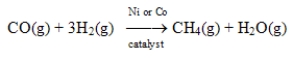 This process is an example of homogeneous catalysis.
 (True/False)
4.8/5  (85)
(85) The reaction A + 2B products has the rate law, rate = k[A][B]3.If the concentration of B is doubled while that of A is unchanged, by what factor will the rate of reaction increase?
(Multiple Choice)
4.7/5 (60)
(60) The gas phase reaction of nitrogen dioxide and carbon monoxide was found experimentally to be second-order with respect to NO2, and zero-order with respect to CO below 25°C. NO2 + CO NO + CO2
Which one of the following mechanisms is consistent with the observed reaction order?
(Multiple Choice)
4.8/5 (85)
(85) When acetaldehyde at a pressure of 364 mmHg is introduced into an evacuated 500.mL flask at 518°C, the half-life for the second-order decomposition process, CH3CHO CH4 + CO, is 410.s.What will the total pressure in the flask be after 1.00 hour?
(Multiple Choice)
4.8/5 (86)
(86) A nuclear stress test utilizes a gamma-emitting radioisotope such as thallium-201 to follow the flow of blood through the heart - first at rest, and then under stress.The first-order rate constant for the decay of thallium-201 is 9.5 x 10⁻³ hr-1.Calculate how long it takes for the amount of thallium-201 to fall to 5.0% of its original value.
(Short Answer)
4.9/5 (83)
(83) An increase in the temperature of the reactants causes an increase in the rate of reaction.The best explanation for this behavior is that as the temperature increases,
(Multiple Choice)
4.9/5 (71)
(71) The reaction A + 2B products has been found to have the rate law, rate = k[A] [B]2.While holding the concentration of A constant, the concentration of B is increased from x to 3x.Predict by what factor the rate of reaction increases.
(Multiple Choice)
4.8/5 (71)
(71) It is possible for the following overall reaction to consist of a one step mechanism:
2A products
(True/False)
4.9/5 (83)
(83) The rate constant for the first-order decomposition of C4H8 at 500°C is 9.2 × 10⁻³ s-1.How long will it take for 10.0% of a 0.100 M sample of C4H8 to decompose at 500°C?
(Short Answer)
4.8/5 (78)
(78) In general, to calculate the activation energy for an elementary step given the rate constants at two different temperatures, which equation should be used?
(Multiple Choice)
4.8/5 (67)
(67) The thermal decomposition of acetaldehyde, CH3CHO CH4 + CO, is a second-order reaction.The following data were obtained at 518°C.
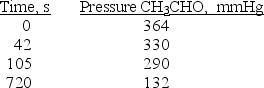 Calculate the rate constant for the decomposition of acetaldehyde from the above data.
 (Multiple Choice)
4.9/5 (88)
(88) The rate determining step must be the first step of a reaction mechanism in all cases.
(True/False)
4.9/5 (83)
(83) A reaction was experimentally determined to follow the rate law, Rate = k[A] where k = 0.15 s-1.Starting with [A]o = 0.225M, how many seconds will it take for [A]t = 0.0350M
(Multiple Choice)
4.8/5 (73)
(73) The first-order decomposition, A products, has a rate constant of 0.150 s-1.Starting with [A]o = 0.350 M, how much time is required for [A]t = 0.125 M?
(Multiple Choice)
4.7/5 (75)
(75) At 700 K, the rate constant for the following reaction is 6.2 × 10⁻⁴ min-1.  How many minutes are required for 20% of a sample of cyclopropane to isomerize to propene?
 (Multiple Choice)
4.9/5 (76)
(76) At a certain temperature, the data below were collected for the reaction below.
2ICl + H2 I2 + 2HCl.
Determine the rate constant for the reaction. 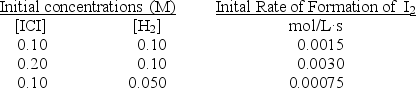
(Short Answer)
4.9/5 (78)
(78) For the overall chemical reaction shown below, which one of the following statements can be rightly assumed? 2H2S(g)+ O2(g)\9\rarr\) 2S(s)+ 2H2O(l)
(Multiple Choice)
4.9/5 (81)
(81) Nitrous oxide (N2O)decomposes at 600°C according to the balanced equation 2N2O(g) 2N2(g)+ O2(g)
A reaction mechanism involving three steps is shown below.Identify all of the catalysts in the following mechanism.
Cl2(g) 2Cl(g)
N2O(g)+ Cl(g) N2(g)+ ClO(g)(occurs twice)
ClO(g)+ ClO(g) Cl2(g)+ O2(g)
(Multiple Choice)
5.0/5 (71)
(71) The reaction C4H10 C2H6 + C2H4 has an activation energy (Ea)of 350 kJ/mol, and the Ea of the reverse reaction is 260 kJ/mol.Estimate H, in kJ/mol, for the reaction as written above.
(Multiple Choice)
4.9/5 (94)
(94) For the reaction BrO3- + 5Br-+ 6H+ 3Br2 + 3H2O at a particular time, - [BrO3-]/ t = 1.5 × 10⁻² M/s.What is - [Br-]/ t at the same instant?
(Multiple Choice)
4.8/5 (74)
(74) 
Filters
- Essay(0)
- Multiple Choice(0)
- Short Answer(0)
- True False(0)
- Matching(0)