



 Chat with AI
Exam 13: Chemical Kinetics

Exam 1: Chemistry: the Study of Change168 Questions
Exam 2: Atoms, Molecules, and Ions156 Questions
Exam 3: Mass Relationships in Chemical Reactions194 Questions
Exam 4: Reactions in Aqueous Solutions186 Questions
Exam 5: Gases121 Questions
Exam 6: Thermochemistry118 Questions
Exam 7: Quantum Theory and the Electronic Structure of Atoms136 Questions
Exam 8: Periodic Relationships Among the Elements144 Questions
Exam 9: Chemical Bonding I: Basic Concepts137 Questions
Exam 10: Chemical Bonding Ii: Molecular Geometry and Hybridization of Atomic Orbitals147 Questions
Exam 11: Intermolecular Forces and Liquids and Solids149 Questions
Exam 12: Physical Properties of Solutions122 Questions
Exam 13: Chemical Kinetics130 Questions
Exam 14: Chemical Equilibrium109 Questions
Exam 15: Acids and Bases178 Questions
Exam 16: Acid-Base Equilibria and Solubility Equilibria131 Questions
Exam 17: Entropy Free Energy and Equilibrium128 Questions
Exam 18: Electrochemistry154 Questions
Exam 19: Nuclear Chemistry133 Questions
Exam 20: Chemistry in the Atmosphere50 Questions
Exam 21: Metallurgy and the Chemistry of Metals63 Questions
Exam 22: Nonmetallic Elements and Their Compounds52 Questions
Exam 23: Transition Metal Chemistry and Coordination Compounds92 Questions
Exam 24: Organic Chemistry67 Questions
Exam 25: Synthetic and Natural Organic Polymers50 Questions
Select questions type


The data below were determined for the reaction shown below.
S2O82- + 3I - (aq) 0 2SO42- + I3-
 The rate law for this reaction must be:
 (Multiple Choice)
4.8/5  (76)
(76) The Arrhenius equation is k = Ae-Ea/RT.The slope of a plot of ln k vs.1/T is equal to
(Multiple Choice)
4.8/5 (87)
(87) The isomerization of cyclopropane to propene follows first-order kinetics.  At 700 K, the rate constant for this reaction is 6.2 × 10⁻⁴ min-1.How many minutes are required for 10.0% of a sample of cyclopropane to isomerize to propene?
 (Multiple Choice)
4.7/5 (86)
(86) The following reaction in aqueous solution was found to be first order in [OH-], first order in [C2H5Br], and inverse first order in Br-.
C2H5Br + OH- C2H5OH + Br-
Which one of the following mechanisms is consistent with the observed reaction order?
(Multiple Choice)
4.7/5 (78)
(78) In general, to calculate the rate constant for a second order reaction with respect to A, given an initial and final concentration as well as the time required for this change, which equation should be used?
(Multiple Choice)
4.9/5 (80)
(80) Use the table of data shown below to calculate the average rate of the reaction A B between 10 s and 20 s. 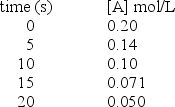
(Short Answer)
4.8/5 (88)
(88) The first-order decomposition of SO2Cl2 to sulfur dioxide gas and chlorine gas at 320°C has a half-life of 8.75 hr.If 600.mmHg of pure SO2Cl2 is placed in a 5.00-L flask at 320°C, how long does it take for the total pressure in the flask to rise to 1.000 atm?
(Multiple Choice)
4.8/5 (81)
(81) Which one of the following changes would alter the rate constant (k)for the reaction 2A + B products?
(Multiple Choice)
4.8/5 (75)
(75) For the hypothetical reaction A + 3B 2C, the rate of appearance of C given by ( [C]/ t)may also be expressed as
(Multiple Choice)
4.7/5 (66)
(66) The first-order decomposition of phosphene to phosphorus and hydrogen, shown below, 4PH3(g) P4(g)+ 6H2(g)
Has a half-life of 35.0 s at 680°C.Starting with 520 mmHg of pure phosphene in an 8.00-L flask at 680°C, how long will it take for the total pressure in the flask to rise to 1.000 atm?
(Multiple Choice)
4.8/5 (91)
(91) The reaction 2NO2(g) 2NO(g)+ O2(g)is suspected to be second order in NO2.Which of the following kinetic plots would be the most useful to confirm whether or not the reaction is second order?
(Multiple Choice)
4.7/5 (82)
(82) The reaction 2A products is second order with respect to A.If the concentration of A drops from 1.05 M to 0.815 M in a time of 15.0 min, what is the rate constant for this reaction (the same time units may be used)?
(Essay)
4.7/5 (76)
(76) For the following reaction, P(C6H14)/ t was found to be -6.2 × 10⁻³ atm/s. C6H14(g) C6H6(g)+ 4H2(g)
Determine P(H2)/ t for this reaction at the same time.
(Multiple Choice)
5.0/5 (76)
(76) What is the rate law that corresponds to the data shown for the reaction 2A + B C? 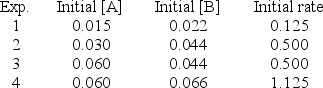
(Short Answer)
4.9/5 (81)
(81) The activation energy for the following first-order reaction is 102 kJ/mol. N2O5(g) 2NO2(g)+ 1/2O2(g)
The value of the rate constant (k)is 1.35 × 10⁻⁴ s-1 at 35°C.What is the value of k at 0°C?
(Multiple Choice)
4.8/5 (88)
(88) At 25°C the rate constant for the first-order decomposition of a pesticide solution is 6.40 × 10⁻³ min-1.If the starting concentration of pesticide is 0.0314 M, what concentration will remain after 62.0 min at 25°C?
(Multiple Choice)
4.7/5 (77)
(77) A city's water supply is contaminated with a toxin at a concentration of 0.63 mg/L.Fortunately, this toxin decomposes to a safe mixture of products by first-order kinetics with a rate constant of 0.27 day-1.How long will it take for half of the toxin to decompose?
(Multiple Choice)
4.9/5 (86)
(86) The rate law predicted by the following two-step mechanism is rate = k[A][B]. 
(True/False)
4.7/5 (89)
(89) 
Filters
- Essay(0)
- Multiple Choice(0)
- Short Answer(0)
- True False(0)
- Matching(0)