



 Chat with AI
Exam 17: Entropy Free Energy and Equilibrium

Exam 1: Chemistry: the Study of Change168 Questions
Exam 2: Atoms, Molecules, and Ions156 Questions
Exam 3: Mass Relationships in Chemical Reactions194 Questions
Exam 4: Reactions in Aqueous Solutions186 Questions
Exam 5: Gases121 Questions
Exam 6: Thermochemistry118 Questions
Exam 7: Quantum Theory and the Electronic Structure of Atoms136 Questions
Exam 8: Periodic Relationships Among the Elements144 Questions
Exam 9: Chemical Bonding I: Basic Concepts137 Questions
Exam 10: Chemical Bonding Ii: Molecular Geometry and Hybridization of Atomic Orbitals147 Questions
Exam 11: Intermolecular Forces and Liquids and Solids149 Questions
Exam 12: Physical Properties of Solutions122 Questions
Exam 13: Chemical Kinetics130 Questions
Exam 14: Chemical Equilibrium109 Questions
Exam 15: Acids and Bases178 Questions
Exam 16: Acid-Base Equilibria and Solubility Equilibria131 Questions
Exam 17: Entropy Free Energy and Equilibrium128 Questions
Exam 18: Electrochemistry154 Questions
Exam 19: Nuclear Chemistry133 Questions
Exam 20: Chemistry in the Atmosphere50 Questions
Exam 21: Metallurgy and the Chemistry of Metals63 Questions
Exam 22: Nonmetallic Elements and Their Compounds52 Questions
Exam 23: Transition Metal Chemistry and Coordination Compounds92 Questions
Exam 24: Organic Chemistry67 Questions
Exam 25: Synthetic and Natural Organic Polymers50 Questions
Select questions type


Which of these species has the highest entropy (S°)at 25°C?

Free
(Multiple Choice)
4.8/5  (90)
(90) Correct Answer: Verified
B
The heat of vaporization of water is 2.27 kJ/g.What is Svap per mole at the normal boiling point?
Free
(Short Answer)
4.8/5 (77)
(77) Correct Answer:Verified
Verified110.J/K·mol
Find the temperature at which the reaction N2O4(g)  2NO2(g)will be in equilibrium when both gases are present at partial pressures of 1.00 atm.

2NO2(g)will be in equilibrium when both gases are present at partial pressures of 1.00 atm. Free
(Multiple Choice)
4.9/5 (82)
(82) Correct Answer:Verified
VerifiedC
Arrange these compounds in order of increasing standard molar entropy at 25°C: C3H8(g), C2H4(g), ZnS(s), and H2O(l).
(Multiple Choice)
4.9/5 (90)
(90) Which of the following processes would be accompanied by an increase in entropy?
(Multiple Choice)
4.8/5 (81)
(81) Determine the equilibrium constant Kp at 25°C for the reaction N2(g)+ 3H2(g)  2NH3(g)
[ G°f (NH3(g))= -16.6 kJ/mol].
2NH3(g)
[ G°f (NH3(g))= -16.6 kJ/mol]. (Multiple Choice)
4.9/5 (80)
(80) Which of these species would you expect to have the highest standard entropy (S°)?
(Multiple Choice)
4.9/5 (72)
(72) The element oxygen was prepared by Joseph Priestley in 1774 by heating mercury(II)oxide: HgO(s) Hg(l)+ 1/2O2(g), H° = 90.84 kJ/mol.
Estimate the temperature at which this reaction will become spontaneous under standard state conditions.
S°(Hg)= 76.02 J/K·mol
S°(O2)= 205.0 J/K·mol
S°(HgO)= 70.29 J/K·mol
(Multiple Choice)
5.0/5 (85)
(85) Which of the following is consistent with a spontaneous endothermic reaction?
(Multiple Choice)
4.8/5 (82)
(82) For a certain reaction, G° = 87 kJ/mol, H° = 100 kJ/mol at STP.At what temperature, in K, is the reaction in equilibrium, assuming that S° and H° are temperature-independent?
(Short Answer)
4.9/5 (84)
(84) Assuming S° and H° do not vary with temperature, at what temperature will the reaction shown below become spontaneous?
C(s)+ H2O(g) H2(g)+ CO(s)( S° = 133.6 J/K·mol; H° = 131.3 kJ/mol)
(Short Answer)
4.8/5 (67)
(67) Ozone (O3)in the atmosphere can reaction with nitric oxide (NO): O3(g)+ NO(g) NO2(g)+ O2(g).
Calculate the G° for this reaction at 25°C.( H° = -199 kJ/mol, S° = -4.1 J/K·mol)
(Multiple Choice)
4.7/5 (88)
(88) Aluminum forms a layer of aluminum oxide when exposed to air which protects the bulk metal from further corrosion. 4Al(s)+ 3O2(g) 2Al2O3(s)
Calculate G° for this reaction, given that G°f of aluminum oxide is -1576.4 kJ/mol.
(Multiple Choice)
5.0/5 (82)
(82) For the reaction CuS(s)+ H2(g)  H2S(g)+ Cu(s),
G°f (CuS)= -53.6 kJ/mol
G°f (H2S)= -33.6 kJ/mol
H°f (CuS)= -53.1 kJ/mol
H°f (H2S)= -20.6 kJ/mol
Calculate the value of the equilibrium constant (Kp)at 798 K and 1 atm pressure.
H2S(g)+ Cu(s),
G°f (CuS)= -53.6 kJ/mol
G°f (H2S)= -33.6 kJ/mol
H°f (CuS)= -53.1 kJ/mol
H°f (H2S)= -20.6 kJ/mol
Calculate the value of the equilibrium constant (Kp)at 798 K and 1 atm pressure. (Short Answer)
4.8/5 (73)
(73) Is the reaction SiO2(s)+ Pb(s) PbO2(s)+ Si(s)spontaneous?
G°f (PbO2)= -217 kJ/mol
G°f (SiO2)= -856 kJ/mol
(Short Answer)
4.8/5 (92)
(92) For the reaction CuS(s)+ H2(g)  H2S(g)+ Cu(s),
G°f (CuS)= -53.6 kJ/mol
G°f (H2S)= -33.6 kJ/mol
H°f (CuS)= -53.1 kJ/mol
H°f (H2S)= - 20.6 kJ/mol
Will this reaction proceed spontaneously at 298 K and 1 atm pressure?
H2S(g)+ Cu(s),
G°f (CuS)= -53.6 kJ/mol
G°f (H2S)= -33.6 kJ/mol
H°f (CuS)= -53.1 kJ/mol
H°f (H2S)= - 20.6 kJ/mol
Will this reaction proceed spontaneously at 298 K and 1 atm pressure? (Short Answer)
4.9/5 (75)
(75) For the reaction 2C(graphite)+ H2(g) C2H2(g), G°= +209.2 kJ/mol at 25°C.If P(H2)= 100.atm, and P(C2H2)= 0.10 atm, calculate G for this reaction.
(Multiple Choice)
4.7/5 (65)
(65) Determine the equilibrium constant (Kp)at 25°C for the reaction

(Multiple Choice)
4.9/5 (90)
(90) Using the thermodynamic data provided below, calculate Ksp for Mg(OH)2(s)at 25°. 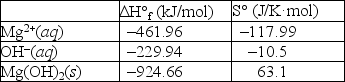
(Essay)
4.8/5 (88)
(88) Calculate S° for the reaction SO2(s)+ NO2(g) SO3(g)+ NO(g). 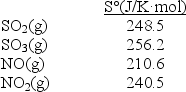
(Multiple Choice)
4.7/5 (78)
(78) 
Filters
- Essay(0)
- Multiple Choice(0)
- Short Answer(0)
- True False(0)
- Matching(0)