



 Chat with AI
Exam 19: Nuclear Chemistry

Exam 1: Chemistry: the Study of Change168 Questions
Exam 2: Atoms, Molecules, and Ions156 Questions
Exam 3: Mass Relationships in Chemical Reactions194 Questions
Exam 4: Reactions in Aqueous Solutions186 Questions
Exam 5: Gases121 Questions
Exam 6: Thermochemistry118 Questions
Exam 7: Quantum Theory and the Electronic Structure of Atoms136 Questions
Exam 8: Periodic Relationships Among the Elements144 Questions
Exam 9: Chemical Bonding I: Basic Concepts137 Questions
Exam 10: Chemical Bonding Ii: Molecular Geometry and Hybridization of Atomic Orbitals147 Questions
Exam 11: Intermolecular Forces and Liquids and Solids149 Questions
Exam 12: Physical Properties of Solutions122 Questions
Exam 13: Chemical Kinetics130 Questions
Exam 14: Chemical Equilibrium109 Questions
Exam 15: Acids and Bases178 Questions
Exam 16: Acid-Base Equilibria and Solubility Equilibria131 Questions
Exam 17: Entropy Free Energy and Equilibrium128 Questions
Exam 18: Electrochemistry154 Questions
Exam 19: Nuclear Chemistry133 Questions
Exam 20: Chemistry in the Atmosphere50 Questions
Exam 21: Metallurgy and the Chemistry of Metals63 Questions
Exam 22: Nonmetallic Elements and Their Compounds52 Questions
Exam 23: Transition Metal Chemistry and Coordination Compounds92 Questions
Exam 24: Organic Chemistry67 Questions
Exam 25: Synthetic and Natural Organic Polymers50 Questions
Select questions type


 .


What would the atom ratio of 206Pb to 238U be in a uranium mineral from a rock that is 1.0 × 10⁹ years old? t1/2(238U)= 4.5 × 10⁹ yr.

Free
(Multiple Choice)
4.8/5  (82)
(82) Correct Answer: Verified
B
Consider the following decay series: 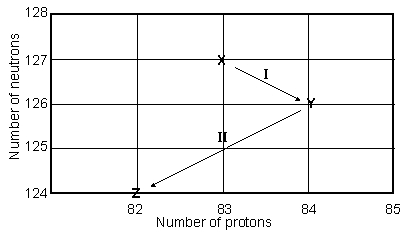 What type of nuclear process occurs at the transformation labeled II?
Free
(Multiple Choice)
4.9/5 (75)
(75) Correct Answer:Verified
VerifiedA
A balanced nuclear equation representing the beta emission of iodine-131 is which of the following?
(Multiple Choice)
4.8/5 (78)
(78) The energy equivalent of a mass defect of - 0.1620 amu is which of the following?
(Multiple Choice)
4.9/5 (83)
(83) What fraction of radioactive atoms remains in a sample after five half-lives?
(Multiple Choice)
4.8/5 (84)
(84) Consider the following decay series: 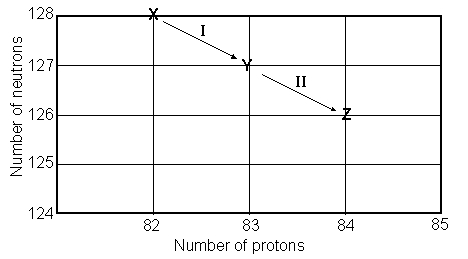 What is the complete element symbol for the product labeled Y?
 (Multiple Choice)
4.7/5 (77)
(77) The alpha particles emitted by radon-222 have an energy of 8.8 × 10⁻¹³ J.If a 200.g Pb brick absorbs 1.0 × 10¹⁰ alpha particles from radon decay, what dose in rads will the brick absorb?
(Short Answer)
4.8/5 (78)
(78) 
The only stable isotope of aluminum is aluminum-27.What type of radioactive decay should be expected from  Al?
Al? (Multiple Choice)
4.9/5 (71)
(71) Find the nuclear binding energy of potassium-40 (atomic mass = 39.9632591 amu)in units of joules per nucleon.[Data: neutron mass = 1.674928 × 10⁻²⁴ g; proton mass = 1.672623 × 10⁻²⁴g; electron mass = 9.109387 × 10⁻²⁸ g; NA = 6.0221367 × 10²³ /mol; c = 2.99792458 × 10⁸ m/s]
(Multiple Choice)
4.8/5 (72)
(72) 
The isotope of iodine with mass number 128 undergoes beta decay with a half-life of 25.00 minutes.How long will it take for 93.75% of a sample of pure 128 I to decay?
(Short Answer)
4.7/5 (92)
(92) Consider the following decay series: 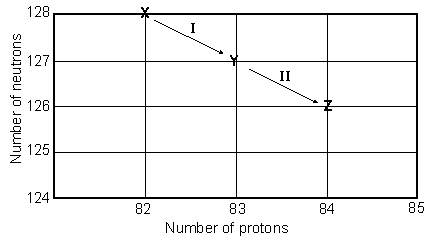 What type of nuclear process occurs at the transformation labeled II?
 (Multiple Choice)
5.0/5 (82)
(82) 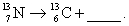
The heaviest known isotope of hydrogen is called tritium,  .It decays by beta emission, and has a half-life of 12.3 years.What fraction of a tritium sample will remain after 5.20 years?
 (Multiple Choice)
4.9/5 (77)
(77) What fraction of radioactive atoms remains in a sample after six half-lives?
(Multiple Choice)
4.8/5 (66)
(66) 
Filters
- Essay(0)
- Multiple Choice(0)
- Short Answer(0)
- True False(0)
- Matching(0)