



 Chat with AI
Exam 19: Nuclear Chemistry

Exam 1: Chemistry: the Study of Change168 Questions
Exam 2: Atoms, Molecules, and Ions156 Questions
Exam 3: Mass Relationships in Chemical Reactions194 Questions
Exam 4: Reactions in Aqueous Solutions186 Questions
Exam 5: Gases121 Questions
Exam 6: Thermochemistry118 Questions
Exam 7: Quantum Theory and the Electronic Structure of Atoms136 Questions
Exam 8: Periodic Relationships Among the Elements144 Questions
Exam 9: Chemical Bonding I: Basic Concepts137 Questions
Exam 10: Chemical Bonding Ii: Molecular Geometry and Hybridization of Atomic Orbitals147 Questions
Exam 11: Intermolecular Forces and Liquids and Solids149 Questions
Exam 12: Physical Properties of Solutions122 Questions
Exam 13: Chemical Kinetics130 Questions
Exam 14: Chemical Equilibrium109 Questions
Exam 15: Acids and Bases178 Questions
Exam 16: Acid-Base Equilibria and Solubility Equilibria131 Questions
Exam 17: Entropy Free Energy and Equilibrium128 Questions
Exam 18: Electrochemistry154 Questions
Exam 19: Nuclear Chemistry133 Questions
Exam 20: Chemistry in the Atmosphere50 Questions
Exam 21: Metallurgy and the Chemistry of Metals63 Questions
Exam 22: Nonmetallic Elements and Their Compounds52 Questions
Exam 23: Transition Metal Chemistry and Coordination Compounds92 Questions
Exam 24: Organic Chemistry67 Questions
Exam 25: Synthetic and Natural Organic Polymers50 Questions
Select questions type


If 12% of a certain radioisotope decays in 5.2 years, what is the half-life of this isotope?
(Multiple Choice)
4.8/5  (73)
(73) 
Which of the following represents a rule for balancing a nuclear equation? I.The total number of protons plus neutrons in the products and reactants must be the same
II.The total number of each type of element in the products and reactants must be the same
III.The total number of nuclear charges in the products and reactants must be the same
IV.The total number of each type of elementary particle in the products and reactants must be the same
(Multiple Choice)
4.9/5 (66)
(66) Consider the following decay series: 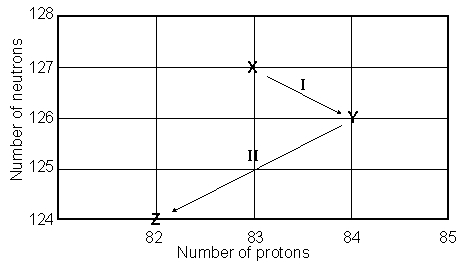 What is the symbol for the product labeled as Y?
 (Multiple Choice)
4.9/5 (93)
(93) A sample of a radioisotope shows an activity of 999 disintegrations per minute due to beta decay.If after 1.10 years the activity is 952 disintegrations per minute, what is the half-life of this radioisotope?
(Multiple Choice)
4.7/5 (93)
(93) Consider the following decay series: 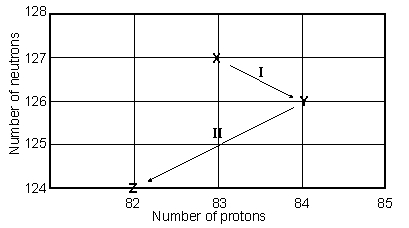 What type of nuclear process occurs at the transformation labeled I?
 (Multiple Choice)
4.8/5 (68)
(68) When atoms of beryllium-9 are bombarded with alpha particles, neutrons are produced.What new isotope is also formed?  He +
 Be

 n + _____
He + Be n + _____ (Multiple Choice)
4.8/5 (75)
(75) List the number of protons, neutrons, and nucleons (protons + neutrons), in that order, for an isotope with the symbol: 
(Multiple Choice)
4.8/5 (75)
(75) A balanced nuclear equation representing the alpha emission of curium-242 is which of the following?
(Multiple Choice)
4.8/5 (82)
(82) Thorium-225 undergoes alpha decay.Write a balanced equation for this reaction.
(Essay)
4.8/5 (92)
(92) The energy equivalent of a mass defect of - 0.1710 amu is which of the following?
(Multiple Choice)
4.9/5 (80)
(80) What role does cadmium metal (Cd)play in a nuclear reactor?
(Multiple Choice)
4.9/5 (67)
(67) A plot of the number of neutrons versus the number of protons in various isotopes produces a "belt of stability." Isotopes below the belt of stability (i.e., with a smaller neutron-to-proton ratio)decay by beta particle emission.
(True/False)
4.7/5 (82)
(82) Consider the following decay series: 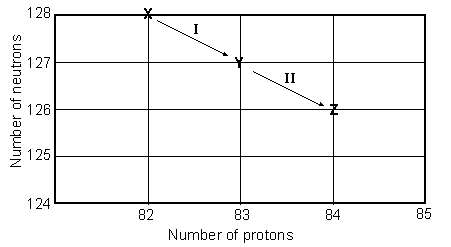 What is the symbol for the product labeled as Z?
 (Multiple Choice)
4.7/5 (91)
(91) Which isotope, when bombarded with nitrogen-15, yields the artificial isotope dubnium-260 plus 4 neutrons?
(Multiple Choice)
4.8/5 (94)
(94) How old is a bottle of wine if the tritium (3H)content is 25% that of a new wine? The half-life of tritium is 12.5 years.
(Multiple Choice)
5.0/5 (87)
(87) Strontium-90 has a half-life of 28.8 years.How much strontium-90 was present initially, if after 144 years 10.0 g remain?
(Short Answer)
4.8/5 (65)
(65) Compare nuclear reactions with chemical reactions in terms of the conservation of mass.
(Essay)
4.7/5 (78)
(78) In passing through matter, alpha particles lose energy chiefly by causing
(Multiple Choice)
4.9/5 (74)
(74) 
Filters
- Essay(0)
- Multiple Choice(0)
- Short Answer(0)
- True False(0)
- Matching(0)