



 Chat with AI
Exam 23: Transition Metal Chemistry and Coordination Compounds

Exam 1: Chemistry: the Study of Change168 Questions
Exam 2: Atoms, Molecules, and Ions156 Questions
Exam 3: Mass Relationships in Chemical Reactions194 Questions
Exam 4: Reactions in Aqueous Solutions186 Questions
Exam 5: Gases121 Questions
Exam 6: Thermochemistry118 Questions
Exam 7: Quantum Theory and the Electronic Structure of Atoms136 Questions
Exam 8: Periodic Relationships Among the Elements144 Questions
Exam 9: Chemical Bonding I: Basic Concepts137 Questions
Exam 10: Chemical Bonding Ii: Molecular Geometry and Hybridization of Atomic Orbitals147 Questions
Exam 11: Intermolecular Forces and Liquids and Solids149 Questions
Exam 12: Physical Properties of Solutions122 Questions
Exam 13: Chemical Kinetics130 Questions
Exam 14: Chemical Equilibrium109 Questions
Exam 15: Acids and Bases178 Questions
Exam 16: Acid-Base Equilibria and Solubility Equilibria131 Questions
Exam 17: Entropy Free Energy and Equilibrium128 Questions
Exam 18: Electrochemistry154 Questions
Exam 19: Nuclear Chemistry133 Questions
Exam 20: Chemistry in the Atmosphere50 Questions
Exam 21: Metallurgy and the Chemistry of Metals63 Questions
Exam 22: Nonmetallic Elements and Their Compounds52 Questions
Exam 23: Transition Metal Chemistry and Coordination Compounds92 Questions
Exam 24: Organic Chemistry67 Questions
Exam 25: Synthetic and Natural Organic Polymers50 Questions
Select questions type


In the coordination compound [Pt(NH3)2Cl2], the coordination number and oxidation number of the central atom are, respectively,

Free
(Multiple Choice)
4.8/5  (89)
(89) Correct Answer: Verified
D
The neutral monodentate ligand L forms the complex ion [CrL6]2+, and the magnetic properties of this complex correspond to 2 unpaired electrons.Is L a strong-field or weak-field ligand? Explain your reasoning.
Free
(Essay)
4.9/5 (94)
(94) Correct Answer:Verified
VerifiedL is a strong-field ligand.Reasoning (answers will vary): The oxidation state of chromium in this complex is +2, so there are four d electrons.For only two of these electrons to be unpaired, [CrL6]2+ must be a low-spin complex, so L must be a strong-field ligand.
What is the coordination number of silver in [Ag(NH3)2]Cl?
Free
(Short Answer)
4.9/5 (83)
(83) Correct Answer:Verified
Verified2
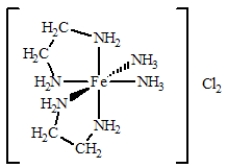
What is the oxidation number of Co in the complex Na[Co(H2O)2Cl4]?
(Short Answer)
4.9/5 (81)
(81) In the complex ion [ML6]n+, Mn+ has seven d electrons and L is a strong field ligand.According to crystal field theory, the magnetic properties of the complex ion correspond to how many unpaired electrons?
(Multiple Choice)
4.7/5 (85)
(85) Copper can be separated from iron in the ore chalcopyrite (CuFeS2)by heating the ore in the presence of oxygen to form copper(I)sulfide, iron(II)oxide, and sulfur dioxide.Write a balanced chemical equation for this process.
(Essay)
4.8/5 (87)
(87) The ion [Co(NH3)6]2+ is octahedral and high spin.This complex is
(Multiple Choice)
4.9/5 (80)
(80) Predict the number of unpaired electrons in the [CrCl6]4- ion.
(Short Answer)
4.9/5 (72)
(72) 
Filters
- Essay(0)
- Multiple Choice(0)
- Short Answer(0)
- True False(0)
- Matching(0)