



 Chat with AI
Exam 5: Gases

Exam 1: Chemistry: the Study of Change168 Questions
Exam 2: Atoms, Molecules, and Ions156 Questions
Exam 3: Mass Relationships in Chemical Reactions194 Questions
Exam 4: Reactions in Aqueous Solutions186 Questions
Exam 5: Gases121 Questions
Exam 6: Thermochemistry118 Questions
Exam 7: Quantum Theory and the Electronic Structure of Atoms136 Questions
Exam 8: Periodic Relationships Among the Elements144 Questions
Exam 9: Chemical Bonding I: Basic Concepts137 Questions
Exam 10: Chemical Bonding Ii: Molecular Geometry and Hybridization of Atomic Orbitals147 Questions
Exam 11: Intermolecular Forces and Liquids and Solids149 Questions
Exam 12: Physical Properties of Solutions122 Questions
Exam 13: Chemical Kinetics130 Questions
Exam 14: Chemical Equilibrium109 Questions
Exam 15: Acids and Bases178 Questions
Exam 16: Acid-Base Equilibria and Solubility Equilibria131 Questions
Exam 17: Entropy Free Energy and Equilibrium128 Questions
Exam 18: Electrochemistry154 Questions
Exam 19: Nuclear Chemistry133 Questions
Exam 20: Chemistry in the Atmosphere50 Questions
Exam 21: Metallurgy and the Chemistry of Metals63 Questions
Exam 22: Nonmetallic Elements and Their Compounds52 Questions
Exam 23: Transition Metal Chemistry and Coordination Compounds92 Questions
Exam 24: Organic Chemistry67 Questions
Exam 25: Synthetic and Natural Organic Polymers50 Questions
Select questions type


A sample of helium gas occupies 355mL at 23°C.If the container the He is in is expanded to 1.50 L at constant pressure, what is the final temperature for the He at this new volume?

Free
(Multiple Choice)
4.8/5  (89)
(89) Correct Answer: Verified
B
When active metals such as magnesium are immersed in acid solution, hydrogen gas is evolved.Calculate the volume of H2(g)at 30.1°C and 0.85 atm that can be formed when 275 mL of 0.725 M HCl solution reacts with excess Mg to give hydrogen gas and aqueous magnesium chloride.
Free
(Multiple Choice)
4.9/5 (83)
(83) Correct Answer:Verified
VerifiedC
The mole fraction of oxygen molecules in dry air is 0.2095.What volume of dry air at 1.00 atm and 25°C is required for burning 1.00 L of hexane (C6H14, density = 0.660 g/mL)completely, yielding carbon dioxide and water?
Free
(Multiple Choice)
4.8/5 (89)
(89) Correct Answer:Verified
VerifiedE
What volume of O2(g)at 810.mmHg pressure is required to react completely with a 4.50g sample of C(s)at 48°C? 2 C(s)+ O2(g) 2 CO(g)
(Multiple Choice)
4.8/5 (82)
(82) How many atoms of He gas are present in a 450 mL container at 35°C and 740 mmHg?
(Multiple Choice)
5.0/5 (83)
(83) Calculate the molar mass of a gaseous substance if 0.125 g of the gas occupies 93.3 mL at STP.
(Short Answer)
4.7/5 (90)
(90) What is standard temperature and standard pressure in units of °C and atm?
(Short Answer)
4.9/5 (66)
(66) Calculate the volume occupied by 56.5 g of argon gas at STP.
(Multiple Choice)
4.8/5 (84)
(84) A gas evolved during the fermentation of sugar was collected.After purification its volume was found to be 25.0 L at 22.5°C and 702 mmHg.How many moles of gas were collected?
(Multiple Choice)
4.9/5 (68)
(68) The following data describes an initial and final state for an ideal gas.Given that the amount of gas does not change in the process, what is the final pressure (atm)of the gas? 
(Short Answer)
4.8/5 (76)
(76) What is the molar mass of Freon-11 gas if its density is 6.13 g/L at STP?
(Multiple Choice)
4.7/5 (61)
(61) A sample of pure nitrogen has a temperature of 15 °C.What is the temperature of the nitrogen in units of Kelvin?
(Multiple Choice)
4.8/5 (75)
(75) What is the pressure (in atmospheres)of the sample of gas trapped in the open-tube mercury manometer shown below if atmospheric pressure is 735 mmHg and h = 8.3 cm? 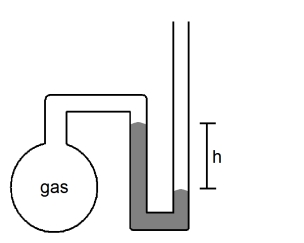
(Short Answer)
4.8/5 (82)
(82) Calculate the density, in g/L, of SF6 gas at 27°C and 0.500 atm pressure.
(Multiple Choice)
4.8/5 (79)
(79) Give five examples (list names)of compounds that exist as gases at room temperature and pressure.
(Essay)
5.0/5 (63)
(63) Gasoline (which can be considered to be octane, C8H18)burns in oxygen to produce carbon dioxide and water.What volume (L)of oxygen at STP is necessary to react with 1.0 gal of gasoline?
(The density of gasoline is 0.81 g/mL.1 gal = 3.78 L)
(Short Answer)
4.8/5 (86)
(86) What is the pressure of the gas trapped in the apparatus shown below when the atmospheric pressure is 720 mmHg? 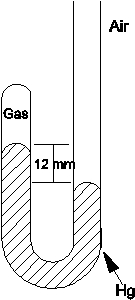
(Multiple Choice)
4.9/5 (91)
(91) 
Filters
- Essay(0)
- Multiple Choice(0)
- Short Answer(0)
- True False(0)
- Matching(0)