



 Chat with AI
Exam 5: Gases

Exam 1: Chemistry: the Study of Change168 Questions
Exam 2: Atoms, Molecules, and Ions156 Questions
Exam 3: Mass Relationships in Chemical Reactions194 Questions
Exam 4: Reactions in Aqueous Solutions186 Questions
Exam 5: Gases121 Questions
Exam 6: Thermochemistry118 Questions
Exam 7: Quantum Theory and the Electronic Structure of Atoms136 Questions
Exam 8: Periodic Relationships Among the Elements144 Questions
Exam 9: Chemical Bonding I: Basic Concepts137 Questions
Exam 10: Chemical Bonding Ii: Molecular Geometry and Hybridization of Atomic Orbitals147 Questions
Exam 11: Intermolecular Forces and Liquids and Solids149 Questions
Exam 12: Physical Properties of Solutions122 Questions
Exam 13: Chemical Kinetics130 Questions
Exam 14: Chemical Equilibrium109 Questions
Exam 15: Acids and Bases178 Questions
Exam 16: Acid-Base Equilibria and Solubility Equilibria131 Questions
Exam 17: Entropy Free Energy and Equilibrium128 Questions
Exam 18: Electrochemistry154 Questions
Exam 19: Nuclear Chemistry133 Questions
Exam 20: Chemistry in the Atmosphere50 Questions
Exam 21: Metallurgy and the Chemistry of Metals63 Questions
Exam 22: Nonmetallic Elements and Their Compounds52 Questions
Exam 23: Transition Metal Chemistry and Coordination Compounds92 Questions
Exam 24: Organic Chemistry67 Questions
Exam 25: Synthetic and Natural Organic Polymers50 Questions
Select questions type


A 792 mg sample of a gas containing only sulfur and oxygen occupies a volume of 372 mL at 54°C and 678 mmHg.Identify the gas in the sample.(R = 0.08206 L.atm/K.mol)
(Multiple Choice)
4.8/5  (71)
(71) What volume (L)of H2 is formed at STP when 6.0 g of Al is treated with excess NaOH?
2NaOH + 2Al + 6H2O 2NaAl(OH)4 + 3H2(g)
(Short Answer)
4.8/5 (95)
(95) At what temperature will a sample of nitrogen gas with a volume of 328 mL at 15°C and 748 mmHg occupy a volume of 0.898 L at a pressure of 642 mm Hg? Assume the amount of the nitrogen gas does not change.
(Multiple Choice)
4.9/5 (83)
(83) Gases are sold in large cylinders for laboratory use.What pressure, in atmospheres, will be exerted by 2,500 g of oxygen gas (O2)when stored at 22°C in a 40.0 L cylinder?
(Multiple Choice)
4.9/5 (72)
(72) What will happen to the height (h)of the mercury column in the manometer shown below if the stopcock is opened, given that the atmospheric pressure is 755 mmHg? 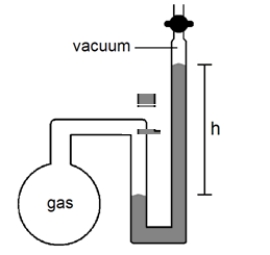
(Multiple Choice)
4.9/5 (68)
(68) The following data describes an initial and final state for an ideal gas.Given that the amount of gas does not change in the process, what is the final temperature (°C)of the gas? 
(Short Answer)
4.9/5 (88)
(88) What is the pressure of the sample of gas trapped in the open-tube mercury manometer shown below if atmospheric pressure is 736 mmHg and h = 9.2 cm? 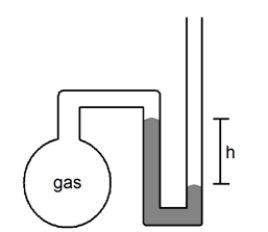
(Multiple Choice)
4.8/5 (62)
(62) What is the pressure (in atmospheres)of the sample of gas trapped in the closed-tube mercury manometer shown below if h = 23.6 cm? 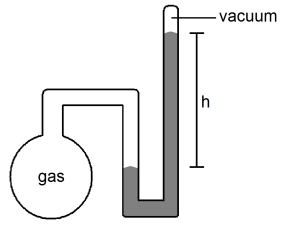
(Short Answer)
4.8/5 (69)
(69) What will happen to the height (h)of the column of mercury in the manometer shown below if the stopcock is opened? 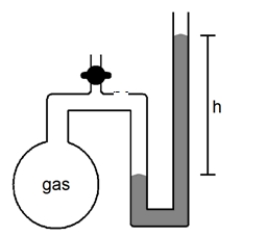
(Multiple Choice)
4.8/5 (83)
(83) If the pressure of a gas sample is quadrupled and the absolute temperature is doubled, by what factor does the volume of the sample change?
(Multiple Choice)
5.0/5 (69)
(69) How many liters of oxygen gas at 153°C and 0.820 atm can be produced by the decomposition of 22.4 g of solid KClO3? (The other decomposition product is solid potassium chloride.)
(Multiple Choice)
4.8/5 (80)
(80) A convenient way to produce very high purity oxygen in the laboratory is to decompose KMnO4(s)at high temperature according to the following chemical equation:
2KMnO4(s) K2MnO4(s)+ MnO2(s)+ O2(g)
If 2.50 L of O2(g)is needed at 1.00 atm and 20.°C, what mass (in grams)of KMnO4(s)should be decomposed? Assume the decomposition of KMnO4(s)goes to completion.
(Short Answer)
4.9/5 (91)
(91) A sample of a gas occupies 1.40 × 10³ mL at 25°C and 760 mmHg.What volume will it occupy at the same temperature and 380 mmHg?
(Multiple Choice)
4.8/5 (80)
(80) A small bubble rises from the bottom of a lake, where the temperature and pressure are 4°C and 3.0 atm, to the water's surface, where the temperature is 25°C and the pressure is 0.95 atm.Calculate the final volume of the bubble if its initial volume was 2.1 mL.
(Multiple Choice)
4.9/5 (84)
(84) Calculate the volume occupied by 35.2 g of methane gas (CH4)at 25°C and 1.0 atm.R = 0.08206 L.atm/K.mol.
(Multiple Choice)
4.8/5 (97)
(97) The temperature of a sample of argon gas in a 365 mL container at 740.mmHg and 25°C is lowered to 12°C.Assuming the volume of the container and the amount of gas is unchanged, calculate the new pressure of the argon.
(Multiple Choice)
4.8/5 (88)
(88) Calculate the number of moles of gas contained in a 10.0 L tank at 22°C and 105 atm.(R = 0.08206 L.atm/K*mol)
(Multiple Choice)
4.8/5 (81)
(81) The following data describes an initial and final state for an ideal gas.Given that the amount of gas does not change in the process, what was the initial volume (L)of the gas? 
(Short Answer)
4.7/5 (82)
(82) A 2.50-L flask contains a mixture of methane (CH4)and propane (C3H8)at a pressure of 1.45 atm and 20°C.When this gas mixture is then burned in excess oxygen, 8.60 g of carbon dioxide is formed.(The other product is water.)What is the mole fraction of methane in the original gas mixture?
(Multiple Choice)
5.0/5 (77)
(77) A spacecraft is filled with 0.500 atm of N2 and 0.500 atm of O2.Suppose a micrometeor strikes this spacecraft and puts a very small hole in it's side.Under these circumstances,
(Multiple Choice)
4.7/5 (77)
(77) 
Filters
- Essay(0)
- Multiple Choice(0)
- Short Answer(0)
- True False(0)
- Matching(0)