



 Chat with AI
Exam 13: Chemical Kinetics

Exam 1: Chemistry: the Study of Change168 Questions
Exam 2: Atoms, Molecules, and Ions156 Questions
Exam 3: Mass Relationships in Chemical Reactions194 Questions
Exam 4: Reactions in Aqueous Solutions186 Questions
Exam 5: Gases121 Questions
Exam 6: Thermochemistry118 Questions
Exam 7: Quantum Theory and the Electronic Structure of Atoms136 Questions
Exam 8: Periodic Relationships Among the Elements144 Questions
Exam 9: Chemical Bonding I: Basic Concepts137 Questions
Exam 10: Chemical Bonding Ii: Molecular Geometry and Hybridization of Atomic Orbitals147 Questions
Exam 11: Intermolecular Forces and Liquids and Solids149 Questions
Exam 12: Physical Properties of Solutions122 Questions
Exam 13: Chemical Kinetics130 Questions
Exam 14: Chemical Equilibrium109 Questions
Exam 15: Acids and Bases178 Questions
Exam 16: Acid-Base Equilibria and Solubility Equilibria131 Questions
Exam 17: Entropy Free Energy and Equilibrium128 Questions
Exam 18: Electrochemistry154 Questions
Exam 19: Nuclear Chemistry133 Questions
Exam 20: Chemistry in the Atmosphere50 Questions
Exam 21: Metallurgy and the Chemistry of Metals63 Questions
Exam 22: Nonmetallic Elements and Their Compounds52 Questions
Exam 23: Transition Metal Chemistry and Coordination Compounds92 Questions
Exam 24: Organic Chemistry67 Questions
Exam 25: Synthetic and Natural Organic Polymers50 Questions
Select questions type


In the reaction, 2N2O 2N2 + O2, oxygen and nitrogen gases are formed at the same rate (mol/L·s).

Free
(True/False)
4.9/5  (84)
(84) Correct Answer: Verified
False
For what order reaction does the half-life get longer as the initial concentration increases?
Free
(Multiple Choice)
4.8/5 (60)
(60) Correct Answer:Verified
VerifiedA
The rate constant of a first-order reaction, A products, can be determined from a graph of ln[A] versus t.
Free
(True/False)
4.8/5 (76)
(76) Correct Answer:Verified
VerifiedTrue
For the chemical reaction A B + C, a plot of [A]t versus time is found to give a straight line with a negative slope.What is the order of reaction with respect to A?
(Multiple Choice)
4.8/5 (71)
(71) Nitrogen pentoxide decomposes by a first-order process yielding N2O4 and oxygen.
2N2O5 2N2O4 + O2
At a given temperature, the half-life of N2O5 is 0.90 hr.What is the first-order rate constant for N2O5 decomposition?
(Short Answer)
4.8/5 (85)
(85) A certain reaction A products is second order with respect to A with a rate constant, k, 0.122 M-1min-1.Starting with [A]o = 1.01M, how many seconds will it take for A to reach a concentration of 0.750M?
(Multiple Choice)
4.9/5 (82)
(82) The reaction 2A + B products is second order with respect to A and zero-order with respect to B.Starting with 0.135 M of A, what is the concentration of A after 35 min if the rate constant is 0.11 M-1s-1?
(Short Answer)
4.8/5 (79)
(79) The activation energy for a certain reaction is 113 kJ/mol.By what factor (how many times)will the rate constant increase when the temperature is raised from 310 K to 325 K?
(Short Answer)
4.9/5 (87)
(87) For the first-order reaction, A products, if half of the initial concentration of A reacts in 20 min, then the remaining half will completely react in the next 20 min.
(True/False)
4.8/5 (86)
(86) Nitric oxide gas (NO)reacts with chlorine gas according to the chemical equation given below. NO +  Cl2 NOCl
The following initial rates of reaction have been measured for the given reagent concentrations.
 Which of the following is the rate law (rate equation)for this reaction?
Cl2 NOCl
The following initial rates of reaction have been measured for the given reagent concentrations. Which of the following is the rate law (rate equation)for this reaction? (Multiple Choice)
4.9/5 (91)
(91) The reaction A + 2B products was found to follow the rate law: rate = k[A]2[B].Predict by what factor the rate of reaction will increase when the concentration of A is doubled, the concentration of B is tripled, and the temperature remains constant.
(Multiple Choice)
4.8/5 (76)
(76) The activation energy of a certain uncatalyzed reaction is 64 kJ/mol.In the presence of a catalyst, the Ea is 55 kJ/mol.How many times faster is the catalyzed than the uncatalyzed reaction at 400°C? Assume that the frequency factor remains the same.
(Multiple Choice)
4.8/5 (88)
(88) A certain reaction, reaction A products, is first order with respect to A.Starting with [A] = 0.250M, it takes 45 min to reduce the concentration of A to 0.110M.What is its rate constant for this reaction?
(Multiple Choice)
4.9/5 (82)
(82) Hydrogen peroxide decomposes to water and oxygen gas, and the activation energy for this process is 42 kJ/mol.The hydrogen peroxide formed in biological processes is harmful to tissue, but the enzyme catalase catalyzes the decomposition of hydrogen peroxide by lowering the activation energy to 7.0 kJ/mol.Assuming the frequency factor is the same for both processes and independent of temperature, calculate the temperature required for the uncatalyzed decomposition to proceed at the same rate as the enzyme-catalyzed decomposition at 37°C (normal human body temperature).Is this a reasonable temperature for a biological organism?
(Short Answer)
4.9/5 (83)
(83) At a certain temperature, the data below were collected for the reaction below.
2ICl + H2 I2 + 2HCl.
Determine the rate law for the reaction. 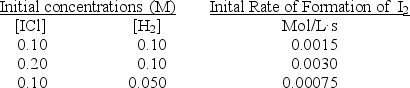
(Short Answer)
4.9/5 (81)
(81) The peroxodisulfate ion can oxidize iodide ions to iodine according to the balanced equation S2O82- + 2I - 2SO42- + I2.
The reaction is catalyzed by certain chemical species.Identify the catalyst in the following mechanism:
Step 1: Fe3+ + 2I - Fe2+ + I2
step 2: S2O82- + Fe2+ 2SO42- + Fe3+
(Multiple Choice)
4.8/5 (64)
(64) A reaction was experimentally determined to follow the rate law, Rate = k[A]2 where k = 0.456 s-1M-1.Starting with [A]o = 0.500 M, how many seconds will it take for [A]t = 0.250 M?
(Multiple Choice)
4.9/5 (97)
(97) The activation energy for the reaction CH3CO CH3 + CO is 71 kJ/mol.How many times greater is the rate constant for this reaction at 170°C than at 150°C?
(Multiple Choice)
4.9/5 (87)
(87) At a particular temperature the first-order gas-phase reaction 2N2O5 2N2O4 + O2 has a half-life for the disappearance of dinitrogen pentoxide of 3240 s.If 1.00 atm of N2O5 is introduced into an evacuated 5.00 L flask, what will be the total pressure of the gases in the flask after 1.50 hours?
(Multiple Choice)
4.9/5 (72)
(72) 
Filters
- Essay(0)
- Multiple Choice(0)
- Short Answer(0)
- True False(0)
- Matching(0)