



 Chat with AI
Exam 13: Chemical Kinetics

Exam 1: Chemistry: the Study of Change168 Questions
Exam 2: Atoms, Molecules, and Ions156 Questions
Exam 3: Mass Relationships in Chemical Reactions194 Questions
Exam 4: Reactions in Aqueous Solutions186 Questions
Exam 5: Gases121 Questions
Exam 6: Thermochemistry118 Questions
Exam 7: Quantum Theory and the Electronic Structure of Atoms136 Questions
Exam 8: Periodic Relationships Among the Elements144 Questions
Exam 9: Chemical Bonding I: Basic Concepts137 Questions
Exam 10: Chemical Bonding Ii: Molecular Geometry and Hybridization of Atomic Orbitals147 Questions
Exam 11: Intermolecular Forces and Liquids and Solids149 Questions
Exam 12: Physical Properties of Solutions122 Questions
Exam 13: Chemical Kinetics130 Questions
Exam 14: Chemical Equilibrium109 Questions
Exam 15: Acids and Bases178 Questions
Exam 16: Acid-Base Equilibria and Solubility Equilibria131 Questions
Exam 17: Entropy Free Energy and Equilibrium128 Questions
Exam 18: Electrochemistry154 Questions
Exam 19: Nuclear Chemistry133 Questions
Exam 20: Chemistry in the Atmosphere50 Questions
Exam 21: Metallurgy and the Chemistry of Metals63 Questions
Exam 22: Nonmetallic Elements and Their Compounds52 Questions
Exam 23: Transition Metal Chemistry and Coordination Compounds92 Questions
Exam 24: Organic Chemistry67 Questions
Exam 25: Synthetic and Natural Organic Polymers50 Questions
Select questions type


The rate constant for a certain first-order reaction is 0.40/min.What is the initial rate in mole/L·min, if the initial concentration of the compound involved is 0.50 mol/L?
(Short Answer)
4.9/5  (83)
(83) Use the following data to determine the rate law for the reaction shown below. 2NO + H2 N2O + H2O 
(Multiple Choice)
4.8/5 (72)
(72) The following mechanism has been suggested for the reaction:
H2O2 + 2H+ + 2I - I2 + 2H2O
 Identify the molecularity of the rate determining step
 (Multiple Choice)
4.9/5 (79)
(79) The activation energy for the following reaction is 60.kJ/mol.
Sn2+ + 2Co3+ Sn4+ + 2Co2+
By what factor (how many times)will the rate constant increase when the temperature is raised from 10°C to 28°C?
(Multiple Choice)
4.8/5 (95)
(95) The thermal decomposition of acetaldehyde, CH3CHO CH4 + CO, is a second-order reaction.The following data were obtained at 518°C.
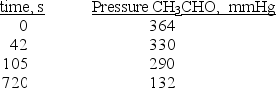 Based on the data given, what is the half-life for the disappearance of acetaldehyde?
 (Multiple Choice)
4.9/5 (87)
(87) For the reaction C6H14(g) C6H6(g)+ 4H2(g), P(H2)/ t was found to be 2.5 × 10⁻² atm/s, where P(H2)is the change in pressure of hydrogen.Determine P(C6H14)/ t for this reaction at the same time.
(Multiple Choice)
4.9/5 (83)
(83) Ammonium ion (NH4+)reacts with nitrite ion (NO2-)to yield nitrogen gas and liquid water.The following initial rates of reaction have been measured for the given reactant concentrations.  Which of the following is the rate law (rate equation)for this reaction?
 (Multiple Choice)
4.9/5 (77)
(77) For the reaction A + 3B 2C, the rate of disappearance of B given by ( [B]/ t)may also be expressed as
(Multiple Choice)
5.0/5 (95)
(95) If Ea for a certain biological reaction is 50.kJ/mol, by what factor (how many times)will the rate of this reaction increase when body temperature increases from 37°C (normal)to 40°C (fever)?
(Multiple Choice)
4.9/5 (77)
(77) At 25°C, by what factor is the reaction rate increased by a catalyst that reduces the activation energy of the reaction by 1.00 kJ/mol?
(Multiple Choice)
4.9/5 (65)
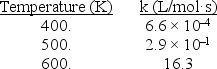
(65) What is the slope of an Arrhenius plot for the following reaction?
2NOCl 2NO + Cl2
(Multiple Choice)
4.9/5 (78)
(78) A city's water supply is contaminated with a toxin at a concentration of 0.63 mg/L.For the water to be safe for drinking, the concentration of this toxin must be below 1.5 x 10⁻³ mg/L.Fortunately, this toxin decomposes to a safe mixture of products by first-order kinetics with a rate constant of 0.27 day-1.How long will it take for the water to be safe to drink?
(Multiple Choice)
4.9/5 (72)
(72) Nitric acid is formed by the gas-phase hydrolysis of N2O5.For the reaction N2O5 + H2O 2HNO3, Ea(forward)= 15 kJ/mol and Ea(reverse)= 51 kJ/mol.Calculate Hrxn.
(Short Answer)
4.9/5 (67)
(67) Chlorine dioxide reacts in basic water to form chlorite and chlorate according to the following chemical equation: 2ClO2(aq)+ 2OH-(aq) ClO2-(aq)+ ClO3-(aq)+ H2O(l)
Under a certain set of conditions, the initial rate of disappearance of chlorine dioxide was determined to be 2.30 x 10⁻¹ M/s.What is the initial rate of appearance of chlorite ion under those same conditions?
(Multiple Choice)
4.8/5 (88)
(88) Concerning the rate law, Rate = k[A]2[B], what are appropriate units for the rate constant k?
(Multiple Choice)
4.8/5 (62)
(62) The following mechanism has been suggested for the reaction:
H2O2 + 2H+ + 2I - I2 + 2H2O
 Identify all intermediates included in this mechanism.
(Multiple Choice)
4.9/5 (86)
(86) For the reaction whose rate law is rate = k[X], a plot of which of the following is a straight line?
(Multiple Choice)
4.9/5 (75)
(75) The rate law for the reaction 2NO2 + O3 N2O5 + O2 is rate = k[NO2][O3].Which one of the following mechanisms is consistent with this rate law?
(Multiple Choice)
4.9/5 (84)
(84) 
Filters
- Essay(0)
- Multiple Choice(0)
- Short Answer(0)
- True False(0)
- Matching(0)