



 Chat with AI
Exam 21: Metallurgy and the Chemistry of Metals

Exam 1: Chemistry: the Study of Change168 Questions
Exam 2: Atoms, Molecules, and Ions156 Questions
Exam 3: Mass Relationships in Chemical Reactions194 Questions
Exam 4: Reactions in Aqueous Solutions186 Questions
Exam 5: Gases121 Questions
Exam 6: Thermochemistry118 Questions
Exam 7: Quantum Theory and the Electronic Structure of Atoms136 Questions
Exam 8: Periodic Relationships Among the Elements144 Questions
Exam 9: Chemical Bonding I: Basic Concepts137 Questions
Exam 10: Chemical Bonding Ii: Molecular Geometry and Hybridization of Atomic Orbitals147 Questions
Exam 11: Intermolecular Forces and Liquids and Solids149 Questions
Exam 12: Physical Properties of Solutions122 Questions
Exam 13: Chemical Kinetics130 Questions
Exam 14: Chemical Equilibrium109 Questions
Exam 15: Acids and Bases178 Questions
Exam 16: Acid-Base Equilibria and Solubility Equilibria131 Questions
Exam 17: Entropy Free Energy and Equilibrium128 Questions
Exam 18: Electrochemistry154 Questions
Exam 19: Nuclear Chemistry133 Questions
Exam 20: Chemistry in the Atmosphere50 Questions
Exam 21: Metallurgy and the Chemistry of Metals63 Questions
Exam 22: Nonmetallic Elements and Their Compounds52 Questions
Exam 23: Transition Metal Chemistry and Coordination Compounds92 Questions
Exam 24: Organic Chemistry67 Questions
Exam 25: Synthetic and Natural Organic Polymers50 Questions
Select questions type


Write the chemical formula of pyrite.

Free
(Short Answer)
4.9/5  (85)
(85) Correct Answer: Verified
FeS2
Which one of these metals would normally be obtained by electrolytic reduction?
Free
(Multiple Choice)
4.9/5 (75)
(75) Correct Answer:Verified
VerifiedA
How much energy (kJ)is released if 10.0g of Al(s)is reacted with excess Fe2O3(s)in the thermite reaction: 2Al(s)+ Fe2O3(s) Al2O3(s)+ 2Fe(l) H° = - 822.8 kJ/mol
Free
(Multiple Choice)
4.9/5 (81)
(81) Correct Answer:Verified
VerifiedD
The following reaction is used to produce titanium metal at high temperature.
TiCl4(g)+ 2Mg(l) Ti(s)+ 2MgCl2(l)
Which element is oxidized and which is reduced?
(Essay)
4.9/5 (78)
(78) The equilibrium 3Fe(s)+ C(s)  Fe3C(s)is established in a solid solution.For such a solution, one can write an equilibrium constant expression in the usual way except that the concentrations that refer to solids in the solid solution are included.Determine the equilibrium constant for the formation of cementite from iron and carbon at 680°C.(Given: for this reaction at 25°C, H° = 21 kJ/mol and S° = 20.4 J/mol·K)
 (Multiple Choice)
4.9/5 (79)
(79) How much energy (kJ)is released when 15.0g of Fe(l)is produced in the thermite reaction: 2Al(s)+ Fe2O3(s) Al2O3(s)+ 2Fe(l) H° = - 822.8 kJ/mol
(Multiple Choice)
4.9/5 (81)
(81) The naturally occurring form of a metal that is concentrated enough to allow economical recovery of the metal is know as
(Multiple Choice)
4.9/5 (87)
(87) Bauxite (Al2O3·2H2O)ore is the principal commercial source of aluminum metal.
(True/False)
4.9/5 (85)
(85) What is the total number of moles (n)of electrons exchanged between the oxidizing agent and the reducing agent in the reaction below to obtain chromium metal: Cr2O3(s)+ 2Al(s) 2Cr(l)+ Al2O3(s)
(Multiple Choice)
4.8/5 (85)
(85) Which of the following diagrams represents a semiconductor? 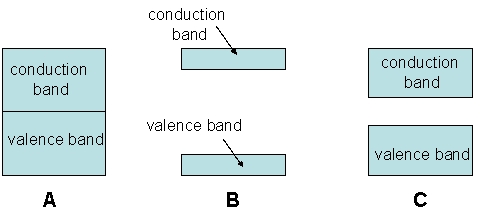
(Multiple Choice)
4.8/5 (80)
(80) Beryllium, the first element in Group 2A, is the most metallic element in the group.
(True/False)
4.8/5 (77)
(77) Which of these ions is most likely to substitute for Ca2+ in the human body?
(Multiple Choice)
4.7/5 (89)
(89) Which one of these elements has seawater as its commercial source?
(Multiple Choice)
4.8/5 (82)
(82) Potassium superoxide, KO2(s), is used in the breathing systems of biohazard suits.Write separate chemical equations showing how KO2(s)reacts with moisture and carbon dioxide in exhaled air to generate oxygen gas.
(Essay)
4.8/5 (89)
(89) For the reaction 3Fe(s)+ C(s)  Fe3C(s), H° = 21 kJ/mol and S° = 20.4 J/mol·K at 25°C.Estimate the minimum temperature above which the formation of cementite (Fe3C)is favored.
 (Multiple Choice)
4.9/5 (91)
(91) Write two balanced chemical equations for the burning of magnesium in air.
(Essay)
4.9/5 (91)
(91) 
Filters
- Essay(0)
- Multiple Choice(0)
- Short Answer(0)
- True False(0)
- Matching(0)