



 Chat with AI
Exam 13: Chemical Kinetics

Exam 1: Chemistry: the Study of Change168 Questions
Exam 2: Atoms, Molecules, and Ions156 Questions
Exam 3: Mass Relationships in Chemical Reactions194 Questions
Exam 4: Reactions in Aqueous Solutions186 Questions
Exam 5: Gases121 Questions
Exam 6: Thermochemistry118 Questions
Exam 7: Quantum Theory and the Electronic Structure of Atoms136 Questions
Exam 8: Periodic Relationships Among the Elements144 Questions
Exam 9: Chemical Bonding I: Basic Concepts137 Questions
Exam 10: Chemical Bonding Ii: Molecular Geometry and Hybridization of Atomic Orbitals147 Questions
Exam 11: Intermolecular Forces and Liquids and Solids149 Questions
Exam 12: Physical Properties of Solutions122 Questions
Exam 13: Chemical Kinetics130 Questions
Exam 14: Chemical Equilibrium109 Questions
Exam 15: Acids and Bases178 Questions
Exam 16: Acid-Base Equilibria and Solubility Equilibria131 Questions
Exam 17: Entropy Free Energy and Equilibrium128 Questions
Exam 18: Electrochemistry154 Questions
Exam 19: Nuclear Chemistry133 Questions
Exam 20: Chemistry in the Atmosphere50 Questions
Exam 21: Metallurgy and the Chemistry of Metals63 Questions
Exam 22: Nonmetallic Elements and Their Compounds52 Questions
Exam 23: Transition Metal Chemistry and Coordination Compounds92 Questions
Exam 24: Organic Chemistry67 Questions
Exam 25: Synthetic and Natural Organic Polymers50 Questions
Select questions type




It takes 42.0 min for the concentration of a reactant in a first-order reaction to drop from 0.45 M to 0.32 M at 25°C.How long will it take for the reaction to be 90% complete?
(Multiple Choice)
4.7/5  (95)
(95) The half life for a first order reaction is 45 min.What is the rate constant in units of s-1?
(Multiple Choice)
4.8/5 (83)
(83) Concerning the decomposition of A, A products, which of the following methods could be used to determine the order of the reaction with respect to A? I.Plot [A] vs time, ln[A] vs time, and 1/[A] vs time and identify which plot yields a straight line
II.Vary the concentration of A and note by what factor the rate changes
III.Identify if successive half lives of A double, halve, or stay constant
(Multiple Choice)
4.7/5 (93)
(93) The reaction A + 2B products was found to have the rate law, rate = k[A] [B]2.Predict by what factor the rate of reaction will increase when the concentration of A is doubled and the concentration of B is also doubled.
(Multiple Choice)
4.9/5 (81)
(81) The isomerization of cyclopropane to form propene is a first-order reaction.  At 760 K, 15% of a sample of cyclopropane changes to propene in 6.8 min.What is the half-life of cyclopropane at 760 K?
 (Multiple Choice)
4.8/5 (89)
(89) The following initial rate data apply to the reaction below. F2(g)+ 2Cl2O(g) 2FClO2(g)+ Cl2(g)
 Which of the following is the rate law (rate equation)for this reaction?
 (Multiple Choice)
4.9/5 (91)
(91) Given that Ea for a certain biological reaction is 48 kJ/mol and that the rate constant is 2.5 × 10⁻² s-1 at 15°C, what is the rate constant at 37°C?
(Multiple Choice)
4.8/5 (75)
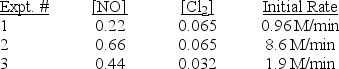
(75) Nitric oxide reacts with chlorine to form nitrosyl chloride, NOCl.Use the following data to determine the rate equation for the reaction.
NO + 1/2Cl2S1U1 NOCl
(Multiple Choice)
4.8/5 (82)
(82) For the chemical reaction system described by the diagram below, which statement is true? 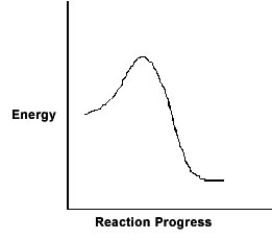 If the Ea for the forward reaction is 25 kJ/mol and the enthalpy of reaction is -95 kJ/mol, what is Ea for the reverse reaction?
 (Multiple Choice)
4.9/5 (80)
(80) A reaction is experimentally found to follow the rate law, Rate = k[A]2 where k = 0.355 M-1min-1.Starting with [A]o = 1.55 M, how many seconds will it take for [A]t = 0.150M
(Multiple Choice)
4.7/5 (69)
(69) The isomerization of methyl isocyanide, CH3NC CH3CN, follows first-order kinetics.The half-lives were found to be 161 min at 199°C and 12.5 min at 230°C.Calculate the activation energy for this reaction.
(Multiple Choice)
5.0/5 (79)
(79) For the following exothermic reaction, the rate law at 298 K is rate = k [H2][I2].
H2(g)+ I2(g) 2HI(g)
Predict the effect of each of the following changes on the initial rate of the reaction:
a.Addition of hydrogen gas at constant temperature and volume
b.Increase in volume of the reaction vessel at constant temperature
c.Addition of a catalyst
d.Increase in temperature
(Essay)
4.9/5 (71)
(71) For the reaction X2 + Y + Z XY + XZ, it is found that the rate equation is rate = k [X2][Y].Why does the concentration of Z have no effect on the rate?
(Multiple Choice)
4.8/5 (74)
(74) The following mechanism has been suggested for the reaction:
H2O2 + 2H+ + 2I - I2 + 2H2O
 Identify the rate law that is consistent with this mechanism
 (Multiple Choice)
4.8/5 (81)
(81) Benzoyl chloride, C6H5COCl, reacts with water to form benzoic acid, C6H5COOH, and hydrochloric acid.This first-order reaction is 25% complete after 26 s.How much longer would one have to wait in order to obtain 99% conversion of benzoyl chloride to benzoic acid?
(Multiple Choice)
4.8/5 (81)
(81) It is possible for the following overall reaction to consist of a one step mechanism:
2A + B + C products
(True/False)
4.9/5 (78)
(78) The oxidation of iodide ions by arsenic acid in acidic aqueous solution occurs according to the net reaction H3AsO4 + 3I - + 2 H3O + H3AsO3 + I3- + H2O.The experimental rate law for this reaction is
Rate = k [H3AsO4] [I-] [H3O+].
According to the rate law for the reaction, an increase in the concentration of hydronium ion has what effect on this reaction?
(Essay)
4.8/5 (62)
(62) At 30°C, by how much is a reaction's activation energy decreased by the addition of a catalyst if the catalyst triples the reaction rate?
(Multiple Choice)
4.9/5 (79)
(79) 
Filters
- Essay(0)
- Multiple Choice(0)
- Short Answer(0)
- True False(0)
- Matching(0)