



 Chat with AI
Exam 13: Chemical Kinetics

Exam 1: Chemistry: the Study of Change168 Questions
Exam 2: Atoms, Molecules, and Ions156 Questions
Exam 3: Mass Relationships in Chemical Reactions194 Questions
Exam 4: Reactions in Aqueous Solutions186 Questions
Exam 5: Gases121 Questions
Exam 6: Thermochemistry118 Questions
Exam 7: Quantum Theory and the Electronic Structure of Atoms136 Questions
Exam 8: Periodic Relationships Among the Elements144 Questions
Exam 9: Chemical Bonding I: Basic Concepts137 Questions
Exam 10: Chemical Bonding Ii: Molecular Geometry and Hybridization of Atomic Orbitals147 Questions
Exam 11: Intermolecular Forces and Liquids and Solids149 Questions
Exam 12: Physical Properties of Solutions122 Questions
Exam 13: Chemical Kinetics130 Questions
Exam 14: Chemical Equilibrium109 Questions
Exam 15: Acids and Bases178 Questions
Exam 16: Acid-Base Equilibria and Solubility Equilibria131 Questions
Exam 17: Entropy Free Energy and Equilibrium128 Questions
Exam 18: Electrochemistry154 Questions
Exam 19: Nuclear Chemistry133 Questions
Exam 20: Chemistry in the Atmosphere50 Questions
Exam 21: Metallurgy and the Chemistry of Metals63 Questions
Exam 22: Nonmetallic Elements and Their Compounds52 Questions
Exam 23: Transition Metal Chemistry and Coordination Compounds92 Questions
Exam 24: Organic Chemistry67 Questions
Exam 25: Synthetic and Natural Organic Polymers50 Questions
Select questions type


The rate determining step in the following mechanism is bimolecular 
(True/False)
4.9/5  (70)
(70) At a particular temperature the first-order gas-phase reaction N2O5 2NO2 + 1/2O2 has a half-life for the disappearance of dinitrogen pentoxide of 5130 s.Suppose 0.450 atm of N2O5 is introduced into an evacuated 2.00 L flask.What will be the total gas pressure inside the flask after 3.00 hours?
(Multiple Choice)
4.9/5 (75)
(75) For the first-order reaction 2N2O5 2N2O4 + O2 at a particular temperature, the half-life of N2O5 is 0.90 hr.What fraction of the initial concentration of N2O5 will remain after 2.4 hours?
(Short Answer)
4.8/5 (92)
(92) For the chemical reaction A C, a plot of 1/[A]t versus time was found to give a straight line with a positive slope.What is the order of reaction?
(Multiple Choice)
4.9/5 (69)
(69) Given the rate law for a reaction, rate = k[A][B]2, where rate is measured in units of M s-1, what are the units for the rate constant k?
(Short Answer)
4.9/5 (79)
(79) In general, to calculate the time required for a given initial concentration to decrease by 35% given the rate constant with units of 1/M-1s-1, which equation should be used?
(Multiple Choice)
4.9/5 (90)
(90) The isomerization of cyclopropane to form propene is a first-order reaction.  At 760 K, 85% of a sample of cyclopropane changes to propene in 79.0 min.Determine the rate constant for this reaction at 760 K.
 (Multiple Choice)
4.9/5 (87)
(87) For the chemical reaction system described by the diagram below, which statement is true? 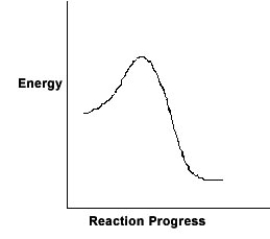
(Multiple Choice)
4.8/5 (60)
(60) In general, to calculate the rate constant for a first order decomposition reaction, A products, given the time needed to decrease the initial concentration by one half, which equation should be used?
(Multiple Choice)
4.9/5 (72)
(72) A certain reaction A products is second order with respect to A.If it takes 45 min to reduce the concentration of A from 0.350 M to 0.125 M, what is the rate constant for this reaction?
(Multiple Choice)
4.8/5 (82)
(82) The activation energy for the reaction O + O3 2O2 is 25 kJ/mol, and the enthalpy change is H = -388 kJ/mol.What is the activation energy for the decomposition of O2 by the reverse reaction?
(Multiple Choice)
5.0/5 (92)
(92) Given the rate law for a reaction, rate = k[A]2, where rate is measured in units of M min-1, what are the units for the rate constant k?
(Short Answer)
4.9/5 (84)
(84) Concerning the rate law, Rate = k[A]0, what are appropriate units for the rate constant k?
(Multiple Choice)
4.8/5 (89)
(89) The half life for a first order reaction is 27 min.How long will it take for 4 half lives to occur?
(Multiple Choice)
4.9/5 (96)
(96) An experimental drug, D, is known to decompose in the blood stream.Tripling the concentration of the drug increases the decomposition rate by a factor of nine.Write the rate law for decomposition of D and give the units of the rate constant.
(Essay)
4.7/5 (76)
(76) A reaction is experimentally found to follow the rate law, Rate = k[A]2 where k = 0.130 M-1min-1.Starting with [A]o = 2.50 M, how many seconds will it take for [A]t = 1.25 M
(Multiple Choice)
4.9/5 (96)
(96) Concerning the rate law, Rate = k[A][B][C], what are appropriate units for the rate constant k?
(Multiple Choice)
4.7/5 (81)
(81) At 25°C, the second-order reaction NOCl(g) NO(g)+ 1/2Cl2(g) is 50% complete after 5.82 hours when the initial concentration of NOCl is 4.46 mol/L.How long will it take for the reaction to be 75% complete?
(Multiple Choice)
4.9/5 (89)
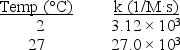
(89) Calculate the activation energy, in kJ/mol, for the redox reaction
Sn2+ + 2Co3+ Sn4+ + 2Co2+.
(Multiple Choice)
4.9/5 (72)
(72) 
Filters
- Essay(0)
- Multiple Choice(0)
- Short Answer(0)
- True False(0)
- Matching(0)