



 Chat with AI
Exam 5: Gases

Exam 1: Chemistry: the Study of Change168 Questions
Exam 2: Atoms, Molecules, and Ions156 Questions
Exam 3: Mass Relationships in Chemical Reactions194 Questions
Exam 4: Reactions in Aqueous Solutions186 Questions
Exam 5: Gases121 Questions
Exam 6: Thermochemistry118 Questions
Exam 7: Quantum Theory and the Electronic Structure of Atoms136 Questions
Exam 8: Periodic Relationships Among the Elements144 Questions
Exam 9: Chemical Bonding I: Basic Concepts137 Questions
Exam 10: Chemical Bonding Ii: Molecular Geometry and Hybridization of Atomic Orbitals147 Questions
Exam 11: Intermolecular Forces and Liquids and Solids149 Questions
Exam 12: Physical Properties of Solutions122 Questions
Exam 13: Chemical Kinetics130 Questions
Exam 14: Chemical Equilibrium109 Questions
Exam 15: Acids and Bases178 Questions
Exam 16: Acid-Base Equilibria and Solubility Equilibria131 Questions
Exam 17: Entropy Free Energy and Equilibrium128 Questions
Exam 18: Electrochemistry154 Questions
Exam 19: Nuclear Chemistry133 Questions
Exam 20: Chemistry in the Atmosphere50 Questions
Exam 21: Metallurgy and the Chemistry of Metals63 Questions
Exam 22: Nonmetallic Elements and Their Compounds52 Questions
Exam 23: Transition Metal Chemistry and Coordination Compounds92 Questions
Exam 24: Organic Chemistry67 Questions
Exam 25: Synthetic and Natural Organic Polymers50 Questions
Select questions type


A particular coal sample contains 2.32% S.When the coal is burned, the sulfur is converted to sulfur dioxide gas.What volume (L)of SO2(g), measured at 25°C and 749 mmHg, is produced by burning 2.0 × 10⁶ lb of this coal? (1 lb = 454 g)
(Short Answer)
4.8/5  (68)
(68) What is the pressure (mmHg)of the sample of gas trapped in the open-tube mercury manometer shown below if atmospheric pressure is 742 mmHg and h = 16.7 cm? 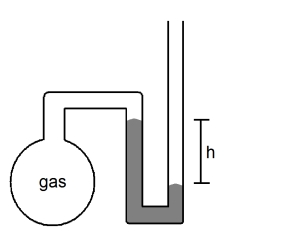
(Short Answer)
4.7/5 (73)
(73) At constant temperature, the volume of the container that a sample of nitrogen gas is in is doubled.As a result the pressure of the nitrogen gas is halved.The amount of nitrogen gas is unchanged in this process.This is an example of:
(Multiple Choice)
4.8/5 (92)
(92) A 707 mg sample of a gas containing only carbon and oxygen occupies a volume of 452 mL at 63 °C and 745 mmHg.Identify the gas in the sample.(R = 0.08206 L.atm/K.mol)
(Multiple Choice)
4.9/5 (75)
(75) At constant temperature and volume, a sample of oxygen gas is added to a sample of nitrogen gas.The pressure of the mixture is found by adding the pressures of the two individual gases.This is an example of:
(Multiple Choice)
4.8/5 (68)
(68) A pressure that will support a column of Hg to a height of 256 mm would support a column of water to what height? The density of mercury is 13.6 g/cm3; the density of water is 1.00 g/cm3.
(Multiple Choice)
4.9/5 (86)
(86) Calculate the volume of H2(g)at 273 K and 2.00 atm that will be formed when 275 mL of 0.725 M HCl solution reacts with excess Mg to give hydrogen gas and aqueous magnesium chloride.
(Multiple Choice)
4.7/5 (85)
(85) An aerosol can with a volume of 0.50 L has a bursting point of 2.6 atm.If the can contains 1.0 g CO2 and is heated to 400°C, will it burst?
(Short Answer)
4.8/5 (88)
(88) A gas-filled balloon with a volume of 12.5 L at 0.90 atm and 21°C is allowed to rise to the stratosphere where the temperature is -5°C and the pressure is 1.0 millibar.What is the final volume of the balloon in Liters? 1.000 atm = 1.013 bar.
(Short Answer)
4.8/5 (88)
(88) Phosgene, a chemical warfare agent used in World War I, consists of 12.41% C, 16.17% O, and 71.69% Cl.1.00 L of this gas at STP has a mass of 4.42 g.What is the molecular formula of phosgene?
(Short Answer)
4.9/5 (79)
(79) Baking powder is made up of sodium hydrogen carbonate and calcium hydrogen phosphate.When baking powder is wet, these components react to produce carbon dioxide.The equation for this reaction is given below.
NaHCO3(aq)+ CaHPO4(aq) NaCaPO4(aq)+ CO2(g)+ H2O(l)
Assuming all of the carbon dioxide was released as a gas, how many liters of CO2(g)would be formed at room temperature from 4.00 g of NaHCO3 and excess CaHPO4?
(Short Answer)
4.9/5 (86)
(86) A 45 mL sample of nitrogen gas is cooled from 135ºC to 15°C in a container that can contract or expand at constant pressure, what is the new volume of the nitrogen gas?
(Multiple Choice)
4.7/5 (84)
(84) A 0.271 g sample of an unknown vapor occupies 294 mL at 140.°C and 847 mmHg.The empirical formula of the compound is CH2.What is the molecular formula of the compound?
(Multiple Choice)
4.9/5 (88)
(88) Calculate the volume occupied by 25.2 g of CO2 at 0.84 atm and 25°C.R = 0.08206 L.atm/K.mol.
(Multiple Choice)
4.8/5 (76)
(76) The molecules of different samples of an ideal gas have the same average kinetic energies, at the same
(Multiple Choice)
4.8/5 (78)
(78) A 1.17 g sample of an alkane hydrocarbon gas occupies a volume of 674 mL at 28°C and 741 mmHg.Alkanes are known to have the general formula CnH2n+2.What is the molecular formula of the gas in this sample? (R = 0.08206 L.atm/K.mol)
(Multiple Choice)
4.9/5 (73)
(73) Which of these gases will have the greatest density at the same specified temperature and pressure?
(Multiple Choice)
4.8/5 (78)
(78) Determine the pressure of the gas trapped in the apparatus shown below when the atmospheric pressure is 695 mmHg. 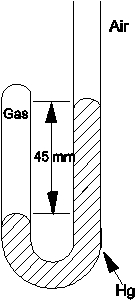
(Multiple Choice)
4.8/5 (85)
(85) A sample of hydrogen gas was collected over water at 21°C and 685 mmHg.The volume of the container was 7.80 L.Calculate the mass of H2(g)collected.(Vapor pressure of water = 18.6 mmHg at 21°C.)
(Multiple Choice)
4.8/5 (81)
(81) 
Filters
- Essay(0)
- Multiple Choice(0)
- Short Answer(0)
- True False(0)
- Matching(0)