



 Chat with AI
Exam 19: Nuclear Chemistry

Exam 1: Chemistry: the Study of Change168 Questions
Exam 2: Atoms, Molecules, and Ions156 Questions
Exam 3: Mass Relationships in Chemical Reactions194 Questions
Exam 4: Reactions in Aqueous Solutions186 Questions
Exam 5: Gases121 Questions
Exam 6: Thermochemistry118 Questions
Exam 7: Quantum Theory and the Electronic Structure of Atoms136 Questions
Exam 8: Periodic Relationships Among the Elements144 Questions
Exam 9: Chemical Bonding I: Basic Concepts137 Questions
Exam 10: Chemical Bonding Ii: Molecular Geometry and Hybridization of Atomic Orbitals147 Questions
Exam 11: Intermolecular Forces and Liquids and Solids149 Questions
Exam 12: Physical Properties of Solutions122 Questions
Exam 13: Chemical Kinetics130 Questions
Exam 14: Chemical Equilibrium109 Questions
Exam 15: Acids and Bases178 Questions
Exam 16: Acid-Base Equilibria and Solubility Equilibria131 Questions
Exam 17: Entropy Free Energy and Equilibrium128 Questions
Exam 18: Electrochemistry154 Questions
Exam 19: Nuclear Chemistry133 Questions
Exam 20: Chemistry in the Atmosphere50 Questions
Exam 21: Metallurgy and the Chemistry of Metals63 Questions
Exam 22: Nonmetallic Elements and Their Compounds52 Questions
Exam 23: Transition Metal Chemistry and Coordination Compounds92 Questions
Exam 24: Organic Chemistry67 Questions
Exam 25: Synthetic and Natural Organic Polymers50 Questions
Select questions type




Which of the following is characteristic of a nuclear reaction? I.Electrons in atomic orbitals are involved in the breaking and forming of bonds
II.Elements are converted from one to another
III.Reaction rates are typically not affected by catalysts
IV.Atoms are rearranged by the breaking and forming of chemical bonds
(Multiple Choice)
4.7/5  (74)
(74) Determine the decay rate for a radioisotope sample with an activity of 12 microcuries? [1 curie = 3.7 × 10¹⁰ disintegrations/s]
(Short Answer)
4.7/5 (78)
(78) Carbon-11 is a radioactive isotope of carbon.Its half-life is 20.3 minutes.What fraction of the initial number of carbon-11 atoms in a sample will remain after 81 minutes?
(Multiple Choice)
5.0/5 (69)
(69) Consider the following decay series: 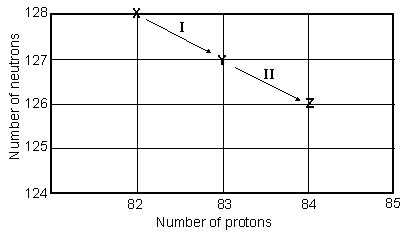 What type of nuclear process occurs at the transformation labeled I?
 (Multiple Choice)
4.9/5 (80)
(80) Cobalt-60 is a beta emitter with a half-life of 5.3 years.Approximately what fraction of cobalt-60 atoms will remain in a particular sample after 26.5 years?
(Multiple Choice)
5.0/5 (78)
(78) On a neutron number versus proton number plot, the nucleus of oxygen-15 lies below the belt of stability.Write an equation for the radioactive decay of oxygen-15.
(Essay)
5.0/5 (83)
(83) List the different types of nuclear radiation (alpha, beta, gamma)in order of increasing penetrating power.
(Multiple Choice)
4.8/5 (76)
(76) Determine how much energy is released when polonium-210 decays according to  .[Atomic masses: polonium-210 = 209.982857 amu; helium-4 = 4.002603 amu; lead-206 = 205.974449 amu]
 (Multiple Choice)
4.9/5 (66)
(66) Charcoal found under a stone at Stonehenge, England, has a carbon-14 activity that is 0.60 that of new wood.How old is the charcoal? (The half-life of carbon-14 is 5,730 years.)
(Multiple Choice)
4.8/5 (79)
(79) The isotope of iodine with mass number 128 undergoes beta decay with a half-life of 25.00 minutes.Write a balanced nuclear reaction for this process.
(Essay)
4.8/5 (88)
(88) 
Describe the role of a moderator in a fission reactor, and give examples of two substances that are used as moderators.
(Essay)
4.8/5 (80)
(80) Tritium is a radioisotope of hydrogen having a half-life of 12.3 years.If you initially had 1.0 × 10⁻⁷ mole of tritium, how many moles of tritium would be left after 78 years?
(Short Answer)
4.7/5 (88)
(88)  or
 .
The carbon-14 activity of some ancient Indian corn was found to be 7.0 disintegrations per minute (dpm)per gram of carbon.If present-day plant life has 16 dpm per gram of carbon, how old is the Indian corn? (t1/2 = 5,730 yr)
(Multiple Choice)
4.9/5 (79)
(79) Consider the following decay series:  Which type of nuclear process occurs in steps a and b, respectively?
 (Multiple Choice)
4.8/5 (70)
(70) 
Filters
- Essay(0)
- Multiple Choice(0)
- Short Answer(0)
- True False(0)
- Matching(0)