



 Chat with AI
Exam 17: Entropy Free Energy and Equilibrium

Exam 1: Chemistry: the Study of Change168 Questions
Exam 2: Atoms, Molecules, and Ions156 Questions
Exam 3: Mass Relationships in Chemical Reactions194 Questions
Exam 4: Reactions in Aqueous Solutions186 Questions
Exam 5: Gases121 Questions
Exam 6: Thermochemistry118 Questions
Exam 7: Quantum Theory and the Electronic Structure of Atoms136 Questions
Exam 8: Periodic Relationships Among the Elements144 Questions
Exam 9: Chemical Bonding I: Basic Concepts137 Questions
Exam 10: Chemical Bonding Ii: Molecular Geometry and Hybridization of Atomic Orbitals147 Questions
Exam 11: Intermolecular Forces and Liquids and Solids149 Questions
Exam 12: Physical Properties of Solutions122 Questions
Exam 13: Chemical Kinetics130 Questions
Exam 14: Chemical Equilibrium109 Questions
Exam 15: Acids and Bases178 Questions
Exam 16: Acid-Base Equilibria and Solubility Equilibria131 Questions
Exam 17: Entropy Free Energy and Equilibrium128 Questions
Exam 18: Electrochemistry154 Questions
Exam 19: Nuclear Chemistry133 Questions
Exam 20: Chemistry in the Atmosphere50 Questions
Exam 21: Metallurgy and the Chemistry of Metals63 Questions
Exam 22: Nonmetallic Elements and Their Compounds52 Questions
Exam 23: Transition Metal Chemistry and Coordination Compounds92 Questions
Exam 24: Organic Chemistry67 Questions
Exam 25: Synthetic and Natural Organic Polymers50 Questions
Select questions type


For the reaction CuS(s)+ H2(g)  H2S(g)+ Cu(s),
G°f (CuS)= -53.6 kJ/mol
G°f (H2S)= -33.6 kJ/mol
H°f (CuS)= -53.1 kJ/mol
H°f (H2S)= - 20.6 kJ/mol
Calculate the value of the equilibrium constant (Kp)for this reaction at 298 K.
H2S(g)+ Cu(s),
G°f (CuS)= -53.6 kJ/mol
G°f (H2S)= -33.6 kJ/mol
H°f (CuS)= -53.1 kJ/mol
H°f (H2S)= - 20.6 kJ/mol
Calculate the value of the equilibrium constant (Kp)for this reaction at 298 K. (Short Answer)
4.8/5  (79)
(79) Which one of the following reactions would you expect to have the lowest S°?
(Multiple Choice)
4.9/5 (81)
(81) For the reaction SbCl5(g)  SbCl3(g)+ Cl2(g),
G°f (SbCl5)= -334.34 kJ/mol
G°f (SbCl3)= -301.25 kJ/mol
H°f (SbCl5)= -394.34 kJ/mol
H°f (SbCl3)= -313.80 kJ/mol
Calculate the value of the equilibrium constant (Kp)for this reaction at 298 K.
SbCl3(g)+ Cl2(g),
G°f (SbCl5)= -334.34 kJ/mol
G°f (SbCl3)= -301.25 kJ/mol
H°f (SbCl5)= -394.34 kJ/mol
H°f (SbCl3)= -313.80 kJ/mol
Calculate the value of the equilibrium constant (Kp)for this reaction at 298 K. (Short Answer)
4.8/5 (85)
(85) Which of these species has the highest entropy (S°)at 25°C?
(Multiple Choice)
4.8/5 (93)
(93) At 700 K, the equilibrium constant for the reaction CO(g)+ H2O(g)  CO2(g)+ H2(g)is 5.10.What is G° for this reaction at this temperature?
 (Short Answer)
4.9/5 (92)
(92) For the reaction 3H2(g)+ N2(g)  2NH3(g), Kc = 9.0 at 350°C.In what direction does the reaction proceed when 1.0 mol NH3, 5.0 mol N2, and 5.0 mol H2 are mixed in a 2.5 L reactor?
 (Short Answer)
4.7/5 (80)
(80) Which of the following is consistent with a reaction at equilibrium?
(Multiple Choice)
5.0/5 (75)
(75) Calculate S° at 25°C for the reduction of PbO(s), 2PbO(s)+ C(s) 2Pb(s)+ CO2(g)given these absolute entropies: 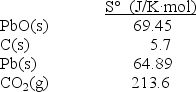
(Multiple Choice)
4.8/5 (67)
(67) Calculate the equilibrium constant for the decomposition of water 2H2O(l)  2H2(g)+ O2(g)
At 25°C, given that G°f (H2O(l))= -237.2 kJ/mol.
2H2(g)+ O2(g)
At 25°C, given that G°f (H2O(l))= -237.2 kJ/mol. (Multiple Choice)
4.9/5 (71)
(71) The standard free energy of formation of gaseous hydrogen iodide is 1.30 kJ/mol at 25°C.Find Kp for the reaction H2(g)+ I2(s)  2HI(g)at this temperature.
 (Multiple Choice)
4.9/5 (82)
(82) For the reaction 2 SO2(g)+ O2(g) 2 SO3(g), if initially P(SO2)= 1.2 atm, P(O2)= 1.8 atm, and P(SO3)= 2.1 atm, calculate G for this reaction at 25°C.The following data is valid at 25°C: 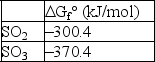
(Multiple Choice)
4.9/5 (90)
(90) In the gas phase, formic acid forms a dimmer, 2HCOOH(g)  (HCOOH)2(g).For this reaction, H° = -60.1 kJ/mol and G° = -13.9 kJ/mol at 25°C.Find the equilibrium constant (Kp)for this reaction at 75 °C.
 (Multiple Choice)
4.8/5 (83)
(83) Arrange these reactions according to increasing S.
1)H2O(g) H2O(l)
2)2NO(g) N2(g)+ O2(g)
3)MgCO3(s) MgO(s)+ CO2(g)
(Multiple Choice)
5.0/5 (99)
(99) For the reaction SbCl5(g)  SbCl3(g)+ Cl2(g),
G°f (SbCl5)= -334.34 kJ/mol
G°f (SbCl3)= -301.25 kJ/mol
H°f (SbCl5)= -394.34 kJ/mol
H°f (SbCl3)= -313.80 kJ/mol
Calculate G at 800 K and 1 atm pressure (assume S° and H° do not change with temperature).
SbCl3(g)+ Cl2(g),
G°f (SbCl5)= -334.34 kJ/mol
G°f (SbCl3)= -301.25 kJ/mol
H°f (SbCl5)= -394.34 kJ/mol
H°f (SbCl3)= -313.80 kJ/mol
Calculate G at 800 K and 1 atm pressure (assume S° and H° do not change with temperature). (Short Answer)
4.9/5 (81)
(81) Which of these species would you expect to have the lowest standard entropy (S°)?
(Multiple Choice)
4.7/5 (77)
(77) Sodium carbonate can be made by heating sodium bicarbonate: 2NaHCO3(s) Na2CO3(s)+ CO2(g)+ H2O(g)
Given that H° = 128.9 kJ/mol and G° = 33.1 kJ/mol at 25°C, above what minimum temperature will the reaction become spontaneous under standard state conditions?
(Multiple Choice)
4.8/5 (82)
(82) Given the following data, calculate the boiling point of HCOOH (formic acid). 
(Short Answer)
4.8/5 (99)
(99) For the reaction H2O2(g) H2O(g)+ 1/2O2(g), H° = -106 kJ/mol and S° = 58 J/K·mol at 25°C.Is H2O2(g)stable with respect to dissociation into water vapor and oxygen gas at 25°C?
(Short Answer)
4.7/5 (79)
(79) Predict the normal boiling point of triethylborane (C6H15B)using the following data: 
(Multiple Choice)
4.8/5 (71)
(71) Given the following data, estimate the boiling point of bromine, Br2, assuming that S° and H° are temperature-independent. 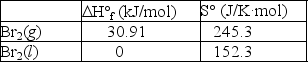
(Short Answer)
4.9/5 (80)
(80) 
Filters
- Essay(0)
- Multiple Choice(0)
- Short Answer(0)
- True False(0)
- Matching(0)