



 Chat with AI
Exam 17: Entropy Free Energy and Equilibrium

Exam 1: Chemistry: the Study of Change168 Questions
Exam 2: Atoms, Molecules, and Ions156 Questions
Exam 3: Mass Relationships in Chemical Reactions194 Questions
Exam 4: Reactions in Aqueous Solutions186 Questions
Exam 5: Gases121 Questions
Exam 6: Thermochemistry118 Questions
Exam 7: Quantum Theory and the Electronic Structure of Atoms136 Questions
Exam 8: Periodic Relationships Among the Elements144 Questions
Exam 9: Chemical Bonding I: Basic Concepts137 Questions
Exam 10: Chemical Bonding Ii: Molecular Geometry and Hybridization of Atomic Orbitals147 Questions
Exam 11: Intermolecular Forces and Liquids and Solids149 Questions
Exam 12: Physical Properties of Solutions122 Questions
Exam 13: Chemical Kinetics130 Questions
Exam 14: Chemical Equilibrium109 Questions
Exam 15: Acids and Bases178 Questions
Exam 16: Acid-Base Equilibria and Solubility Equilibria131 Questions
Exam 17: Entropy Free Energy and Equilibrium128 Questions
Exam 18: Electrochemistry154 Questions
Exam 19: Nuclear Chemistry133 Questions
Exam 20: Chemistry in the Atmosphere50 Questions
Exam 21: Metallurgy and the Chemistry of Metals63 Questions
Exam 22: Nonmetallic Elements and Their Compounds52 Questions
Exam 23: Transition Metal Chemistry and Coordination Compounds92 Questions
Exam 24: Organic Chemistry67 Questions
Exam 25: Synthetic and Natural Organic Polymers50 Questions
Select questions type


Rubidium has a heat of vaporization of 69.0 kJ/mol at its boiling point (686°C).Calculate S for this process, Rb(l) Rb(g), at 1 atm and 686°C.
(Short Answer)
4.8/5  (78)
(78) Which of the following is expected to have zero entropy? I.N2(g)at 273 K
II.SiO2(s, amorphous)at 0 K
III.NaCl(s)perfectly ordered crystal at 25 K
IV.Na(s)perfectly ordered crystal at 0 K
(Multiple Choice)
4.9/5 (83)
(83) Using the thermodynamic data provided below, calculate the standard change in entropy when one mole of sodium nitrate is dissolved in water? 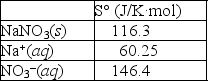 Will the solubility of sodium nitrate increase or decrease if the temperature of the system is increased?
 (Essay)
4.9/5 (69)
(69) Which response includes all the following processes that are accompanied by an increase in entropy? 1)2SO2(g)+ O2(g) SO3(g)
2)H2O(l) H2O(s)
3)Br2(l) Br2(g)
4)H2O2(l) H2O(l)+ 1/2O2(g)
(Multiple Choice)
4.9/5 (72)
(72) With respect to the system only, a reaction with H < 0 and S > 0 is predicted to be:
(Multiple Choice)
4.8/5 (74)
(74) Aluminum forms a layer of aluminum oxide when exposed to air which protects the bulk metal from further corrosion. 4Al(s)+ 3O2(g) 2Al2O3(s)
Using the thermodynamic data provided below, calculate S° for this reaction. 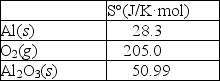
(Multiple Choice)
4.7/5 (84)
(84) For the reaction H2(g)+ S(s) H2S(g), H° = -20.2 kJ/mol and S° = +43.1 J/K·mol.Which of these statements is true?
(Multiple Choice)
4.9/5 (84)
(84) The normal boiling point of acetic acid is 118.1°C.If a sample of the acetic acid is at 125.2°C, Predict the signs of H, S, and G for the boiling process at this temperature.
(Multiple Choice)
4.8/5 (81)
(81) The normal melting point sulfur is 113 °C.If a sample of solid sulfur is at 95 °C, Predict the signs of H, S, and G for the melting process at this temperature.
(Multiple Choice)
4.8/5 (78)
(78) The free energy of formation of nitric oxide, NO, at 1000 K (roughly the temperature in an automobile engine during ignition)is about 78 kJ/mol.Calculate the equilibrium constant Kp for the reaction N2(g)+ O2(g)  2NO(g)at this temperature.
 (Short Answer)
4.8/5 (72)
(72) Using the thermodynamic data provided below, calculate Ksp for ZnS(s)at 25°. 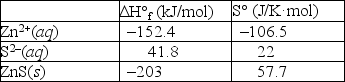
(Essay)
4.8/5 (76)
(76) HI has a normal boiling point of -35.4°C, and its Hvap is 21.16 kJ/mol.Calculate the molar entropy of vaporization ( Svap).
(Multiple Choice)
4.9/5 (76)
(76) The entropy change S° for the reaction NH4Cl(s) NH3(g)+ HCl(g)will be negative.
(True/False)
5.0/5 (101)
(101) Sulfur can be separated from lead in the mineral galena, PbS(s), by "roasting" the ore in the presence of oxygen as shown in the following reaction:
2PbS(s)+ 3O2(g) 2PbO(s)+ 2SO2(g)
Determine G for the above reaction at 850°C. 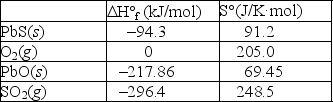
(Short Answer)
4.9/5 (79)
(79) With respect to the system only, a reaction with H > 0 and S < 0 is predicted to be:
(Multiple Choice)
4.8/5 (80)
(80) Consider the reaction CO(g)+ 2H2(g)  CH3OH(l)at 25°C.
G°f (CO)= -137.3 kJ/mol
G°f (CH3OH)= -166.3 kJ/mol
H°f (CO)= -110.5 kJ/mol
H°f (CH3OH)= -238.7 kJ/mol
S°(CO)= 197.9 J/K·mol
S°(CH3OH)= 126.8 J/K·mol
Calculate S°(H2(g)).
CH3OH(l)at 25°C.
G°f (CO)= -137.3 kJ/mol
G°f (CH3OH)= -166.3 kJ/mol
H°f (CO)= -110.5 kJ/mol
H°f (CH3OH)= -238.7 kJ/mol
S°(CO)= 197.9 J/K·mol
S°(CH3OH)= 126.8 J/K·mol
Calculate S°(H2(g)). (Short Answer)
4.9/5 (82)
(82) Which of these species would you expect to have the lowest standard entropy (S°)?
(Multiple Choice)
4.9/5 (83)
(83) For the reaction 3H2(g)+ N2(g)  2NH3(g), Kc = 9.0 at 350°C.In what direction does this reaction proceed at 350°C under standard state conditions?
 (Short Answer)
4.9/5 (88)
(88) Which of the following is consistent with a reaction that proceeds spontaneously in the reverse direction (assume all variables are in terms of the forward direction only)?
(Multiple Choice)
4.8/5 (84)
(84) Dissolving an ionic solid in water always results in an increase in entropy.
(True/False)
4.9/5 (70)
(70) 
Filters
- Essay(0)
- Multiple Choice(0)
- Short Answer(0)
- True False(0)
- Matching(0)