



 Chat with AI
Exam 17: Entropy Free Energy and Equilibrium

Exam 1: Chemistry: the Study of Change168 Questions
Exam 2: Atoms, Molecules, and Ions156 Questions
Exam 3: Mass Relationships in Chemical Reactions194 Questions
Exam 4: Reactions in Aqueous Solutions186 Questions
Exam 5: Gases121 Questions
Exam 6: Thermochemistry118 Questions
Exam 7: Quantum Theory and the Electronic Structure of Atoms136 Questions
Exam 8: Periodic Relationships Among the Elements144 Questions
Exam 9: Chemical Bonding I: Basic Concepts137 Questions
Exam 10: Chemical Bonding Ii: Molecular Geometry and Hybridization of Atomic Orbitals147 Questions
Exam 11: Intermolecular Forces and Liquids and Solids149 Questions
Exam 12: Physical Properties of Solutions122 Questions
Exam 13: Chemical Kinetics130 Questions
Exam 14: Chemical Equilibrium109 Questions
Exam 15: Acids and Bases178 Questions
Exam 16: Acid-Base Equilibria and Solubility Equilibria131 Questions
Exam 17: Entropy Free Energy and Equilibrium128 Questions
Exam 18: Electrochemistry154 Questions
Exam 19: Nuclear Chemistry133 Questions
Exam 20: Chemistry in the Atmosphere50 Questions
Exam 21: Metallurgy and the Chemistry of Metals63 Questions
Exam 22: Nonmetallic Elements and Their Compounds52 Questions
Exam 23: Transition Metal Chemistry and Coordination Compounds92 Questions
Exam 24: Organic Chemistry67 Questions
Exam 25: Synthetic and Natural Organic Polymers50 Questions
Select questions type


Under what conditions (always, never, high temperature only, low temperature only)is the expansion of an ideal gas into a vacuum expected to be spontaneous?
(Short Answer)
5.0/5  (74)
(74) Predict the signs (-, +, or 0)of H and S, in that order, for the reaction: 6CO2(g)+ 6H2O(g) C6H12O6(g)+ 6O2(g).
(Short Answer)
4.8/5 (90)
(90) The following reaction is spontaneous under standard state conditions at 25°C:
AgCl(s) Ag+(aq)+ Cl-(aq)( G° = 55 kJ/mol)
(True/False)
4.8/5 (72)
(72) The following reaction is nonspontaneous at 25°C:
Cu2O(s) 2Cu(s)+ 1/2O2(g), G° = 141 kJ/mol
If S° = 75.8 J/K·mol, what is the lowest temperature at which the reaction will be spontaneous?
(Short Answer)
4.8/5 (92)
(92) Using the thermodynamic data provided below, calculate the standard change in entropy when one mole of sodium sulfate is dissolved in water? 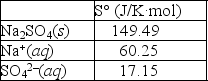 Will the solubility of sodium nitrate increase or decrease if the temperature of the system is increased?
 (Essay)
4.7/5 (77)
(77) Which of the following is consistent with a nonspontaneous process in the forward direction?
(Multiple Choice)
4.9/5 (67)
(67) Hydrogen peroxide (H2O2)decomposes according to the equation H2O2(l) H2O(l)+ 1/2O2(g).
Calculate Kp for this reaction at 25°C.( H° = -98.2 kJ/mol, S° = 70.1 J/K·mol)
(Multiple Choice)
4.7/5 (73)
(73) The normal freezing point of ammonia is -78°C.Predict the signs of H, S, and G for ammonia when it freezes at -80°C and 1 atm: NH3(l) NH3(s) 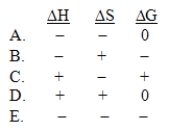
(Multiple Choice)
4.8/5 (76)
(76) Choose the substance with the higher entropy per mole at a given temperature: O2(g)at 5 atm or O2(g)at 0.5 atm.
(Short Answer)
4.9/5 (80)
(80) Using the thermodynamic data provided below, calculate Ka2 for H2CO3(aq)at 25°. 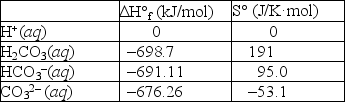
(Essay)
4.8/5 (72)
(72) Calculate G° for the combustion of ethanol vapor, C2H5OH(g), at 750°C in oxygen to form carbon dioxide and water vapor.The following data is valid at 25°C: 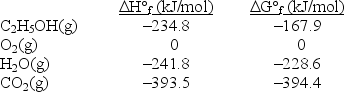
(Multiple Choice)
4.9/5 (89)
(89) Predict the signs (-, +, or 0)of H and S, in that order, for the reaction: O2(g) 2O(g).
(Short Answer)
4.9/5 (93)
(93) Kw for the auto-ionization of water, H2O(l) H+(aq)+ OH- (aq), is 1.0 × 10⁻¹⁴.What are the signs (+/-)of S° and H° for the reaction at 25°C?
(Multiple Choice)
4.8/5 (74)
(74) Consider the reaction CO(g)+ 2H2(g)  CH3OH(l)at 25°C.
G°f (CO)= -137.3 kJ/mol
G°f (CH3OH)= -166.3 kJ/mol
H°f (CO)= -110.5 kJ/mol
H°f (CH3OH)= -238.7 kJ/mol
S°(CO)= 197.9 J/K·mol
S°(CH3OH)= 126.8 J/K·mol
Calculate G° at 25°C.
CH3OH(l)at 25°C.
G°f (CO)= -137.3 kJ/mol
G°f (CH3OH)= -166.3 kJ/mol
H°f (CO)= -110.5 kJ/mol
H°f (CH3OH)= -238.7 kJ/mol
S°(CO)= 197.9 J/K·mol
S°(CH3OH)= 126.8 J/K·mol
Calculate G° at 25°C. (Short Answer)
4.8/5 (73)
(73) Which of the following is consistent with an exothermic reaction that is nonspontaneous at high temperatures?
(Multiple Choice)
4.9/5 (82)
(82) Which of the following is consistent with a reaction that proceeds spontaneously in the forward direction?
(Multiple Choice)
4.7/5 (85)
(85) Predict the signs (-, +, or 0)of H and S, in that order, for the process: H2O(l) H2O(s).
(Short Answer)
4.8/5 (78)
(78) Under which of the following conditions (always, never, high temperature only, low temperature only)is the reaction: 6CO2(g)+ 6H2O(g) C6H12O6(g)+ 6O2(g)expected to be spontaneous?
(Short Answer)
4.9/5 (78)
(78) Calculate Kp at 298 K for the reaction SO2(g)+ NO2(g)  SO3(g)+ NO(g).
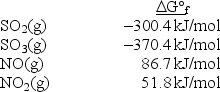
SO3(g)+ NO(g). (Multiple Choice)
4.9/5 (87)
(87) Nitrosyl chloride (NOCl)decomposes at elevated temperatures according to the equation 2NOCl(g)  2NO(g)+ Cl2(g).Calculate Kp for this reaction at 227°C.( H° = 81.2 kJ/mol, S° = 128 J/K·mol)
 (Multiple Choice)
4.8/5 (92)
(92) 
Filters
- Essay(0)
- Multiple Choice(0)
- Short Answer(0)
- True False(0)
- Matching(0)