



 Chat with AI
Exam 35: Plant Growth and Reproduction

Exam 1: The Nature of Science and the Characteristics of Life80 Questions
Exam 2: The Chemistry of Life93 Questions
Exam 3: Cell Structure and Internal Compartments89 Questions
Exam 4: Cell Membranes, Transport, and Communication89 Questions
Exam 5: Energy, Metabolism, and Enzymes85 Questions
Exam 6: Photosynthesis and Cellular Respiration89 Questions
Exam 7: Cell Division84 Questions
Exam 8: Cancer and Human Health86 Questions
Exam 9: Patterns of Inheritance86 Questions
Exam 10: Chromosomes and Human Genetics77 Questions
Exam 11: DNA and Genes83 Questions
Exam 12: From Gene to Protein88 Questions
Exam 13: DNA Technology96 Questions
Exam 14: How Evolution Works72 Questions
Exam 15: The Origin of Species76 Questions
Exam 16: The Evolution of Biodiversity102 Questions
Exam 17: Biological Diversity, Bacteria, and Archaea80 Questions
Exam 18: Protista, Plantae, and Fungi83 Questions
Exam 19: Animalia80 Questions
Exam 20: The Biosphere88 Questions
Exam 21: Growth of Populations70 Questions
Exam 22: Animal Behavior82 Questions
Exam 23: Ecological Communities105 Questions
Exam 24: Ecosystems74 Questions
Exam 25: Global Change73 Questions
Exam 26: Internal Organization and Homeostasis75 Questions
Exam 27: Nutrition and Digestion81 Questions
Exam 28: Circulation and Gas Exchange77 Questions
Exam 29: Animal Hormones79 Questions
Exam 30: Nervous and Sensory Systems76 Questions
Exam 31: Skeletons,Muscles,and Movement77 Questions
Exam 32: The Immune System80 Questions
Exam 33: Reproduction and Development86 Questions
Exam 34: Plant Structure, Nutrition, and Transport80 Questions
Exam 35: Plant Growth and Reproduction81 Questions
Select questions type


The plant body is modular,formed by the repeated addition of the same basic units.
(True/False)
4.8/5  (81)
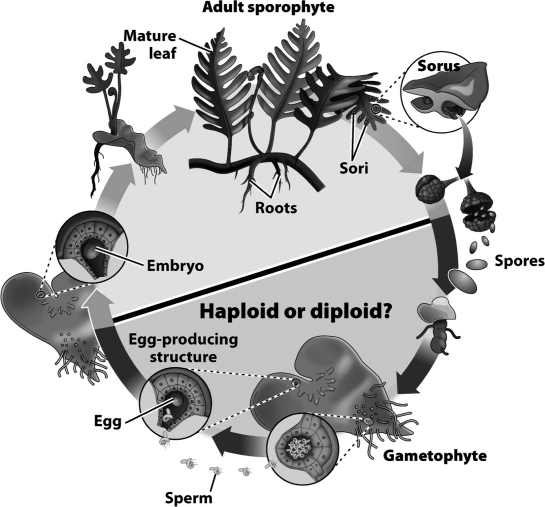
(81) The line through the center of the diagram below separates the haploid and diploid life stages of the plant life cycle.The part of the cycle that exists below the line consists of plants that are ________.
(Short Answer)
4.9/5 (78)
(78) Plant growth aboveground can be accomplished by adding new ________ units.
(Multiple Choice)
4.9/5 (72)
(72) In plants,the diploid stage of the life cycle produces ________ by ________.
(Multiple Choice)
4.8/5 (82)
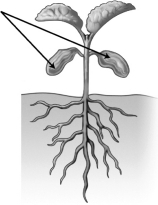
(82) Why are the structures indicated by the arrows in the diagram below of a seedling somewhat shriveled at this stage in germination?
(Multiple Choice)
4.7/5 (66)
(66) At what point in the plant life cycle does cell division convert diploid cells into haploid cells?
(Multiple Choice)
4.8/5 (92)
(92) In order to fertilize an egg,a pollen grain must first arrive at the ________.
(Short Answer)
4.9/5 (75)
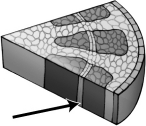
(75) The region of the diagram below indicated by the arrow is involved in the production of wood.
(True/False)
4.9/5 (78)
(78) If a mutation resulted in the formation of pollen that could NOT form a pollen tube,when the pollen landed on the stigma,
(Multiple Choice)
4.8/5 (85)
(85) At the tip of a filament within a flower you would find a(n)
(Multiple Choice)
4.8/5 (69)
(69) Some plants can sense the duration of light or dark during a 24-hour period.
(True/False)
4.8/5 (76)
(76) Which of the following components is correctly matched with its location?
(Multiple Choice)
4.9/5 (64)
(64) Endosperm is the origin of the sperm that fertilizes the embryo.
(True/False)
4.8/5 (80)
(80) Which of the following would NOT be derived from vascular cambium?
(Multiple Choice)
4.7/5 (76)
(76) Which of the following would be the LEAST likely pollinator?
(Multiple Choice)
4.8/5 (77)
(77) The growth of cells within the cork cambium results in the production of
(Multiple Choice)
4.9/5 (77)
(77) 
Filters
- Essay(0)
- Multiple Choice(0)
- Short Answer(0)
- True False(0)
- Matching(0)