



 Chat with AI
Exam 35: Plant Growth and Reproduction

Exam 1: The Nature of Science and the Characteristics of Life80 Questions
Exam 2: The Chemistry of Life93 Questions
Exam 3: Cell Structure and Internal Compartments89 Questions
Exam 4: Cell Membranes, Transport, and Communication89 Questions
Exam 5: Energy, Metabolism, and Enzymes85 Questions
Exam 6: Photosynthesis and Cellular Respiration89 Questions
Exam 7: Cell Division84 Questions
Exam 8: Cancer and Human Health86 Questions
Exam 9: Patterns of Inheritance86 Questions
Exam 10: Chromosomes and Human Genetics77 Questions
Exam 11: DNA and Genes83 Questions
Exam 12: From Gene to Protein88 Questions
Exam 13: DNA Technology96 Questions
Exam 14: How Evolution Works72 Questions
Exam 15: The Origin of Species76 Questions
Exam 16: The Evolution of Biodiversity102 Questions
Exam 17: Biological Diversity, Bacteria, and Archaea80 Questions
Exam 18: Protista, Plantae, and Fungi83 Questions
Exam 19: Animalia80 Questions
Exam 20: The Biosphere88 Questions
Exam 21: Growth of Populations70 Questions
Exam 22: Animal Behavior82 Questions
Exam 23: Ecological Communities105 Questions
Exam 24: Ecosystems74 Questions
Exam 25: Global Change73 Questions
Exam 26: Internal Organization and Homeostasis75 Questions
Exam 27: Nutrition and Digestion81 Questions
Exam 28: Circulation and Gas Exchange77 Questions
Exam 29: Animal Hormones79 Questions
Exam 30: Nervous and Sensory Systems76 Questions
Exam 31: Skeletons,Muscles,and Movement77 Questions
Exam 32: The Immune System80 Questions
Exam 33: Reproduction and Development86 Questions
Exam 34: Plant Structure, Nutrition, and Transport80 Questions
Exam 35: Plant Growth and Reproduction81 Questions
Select questions type


The flower is an organ found on the ________ of a flowering plant.
(Multiple Choice)
4.9/5  (86)
(86) The structure labeled A in this figure is usually designed to attract pollinators.
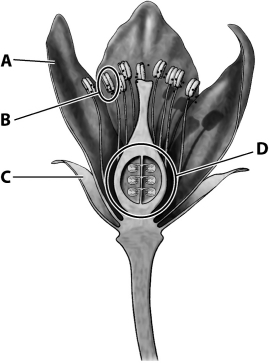
(True/False)
4.9/5 (91)
(91) The rate of tree migration northward is lower than the rate of climate change.
(True/False)
4.9/5 (83)
(83) In the alternation of generations,plants have a diploid life stage that produces haploid spores through the process of mitosis.
(True/False)
4.8/5 (76)
(76) The addictive chemical in tobacco called ________ is toxic to herbivores.
(Short Answer)
4.8/5 (94)
(94) The growth of a plant zygote into an embryo occurs within the ________.
(Short Answer)
4.9/5 (65)
(65) The practice of moving plants to more northern locations in anticipation of the effects of global climate change is known as ________.
(Short Answer)
4.7/5 (76)
(76) When a plant germinates from a seed it has ________ root apical meristem(s)and ________ shoot apical meristem(s).
(Multiple Choice)
4.8/5 (75)
(75) The structure indicated by the arrow in this diagram of a fruit developed from the
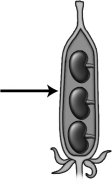
(Multiple Choice)
4.7/5 (86)
(86) Groups of perpetually young,undifferentiated cells from which new cells arise are called
(Multiple Choice)
4.9/5 (83)
(83) Most flowering plants rely on animals rather than wind to transport pollen.
(True/False)
4.9/5 (84)
(84) A plant's physiological response to day length is called ________.
(Short Answer)
4.8/5 (80)
(80) Which of the following is NOT a concern about the assisted migration of trees to Canada?
(Multiple Choice)
4.8/5 (90)
(90) After plant gametes fuse,they undergo mitosis to produce the
(Multiple Choice)
4.9/5 (80)
(80) 
Filters
- Essay(0)
- Multiple Choice(0)
- Short Answer(0)
- True False(0)
- Matching(0)