



 Chat with AI
Exam 20: The Biosphere

Exam 1: The Nature of Science and the Characteristics of Life80 Questions
Exam 2: The Chemistry of Life93 Questions
Exam 3: Cell Structure and Internal Compartments89 Questions
Exam 4: Cell Membranes, Transport, and Communication89 Questions
Exam 5: Energy, Metabolism, and Enzymes85 Questions
Exam 6: Photosynthesis and Cellular Respiration89 Questions
Exam 7: Cell Division84 Questions
Exam 8: Cancer and Human Health86 Questions
Exam 9: Patterns of Inheritance86 Questions
Exam 10: Chromosomes and Human Genetics77 Questions
Exam 11: DNA and Genes83 Questions
Exam 12: From Gene to Protein88 Questions
Exam 13: DNA Technology96 Questions
Exam 14: How Evolution Works72 Questions
Exam 15: The Origin of Species76 Questions
Exam 16: The Evolution of Biodiversity102 Questions
Exam 17: Biological Diversity, Bacteria, and Archaea80 Questions
Exam 18: Protista, Plantae, and Fungi83 Questions
Exam 19: Animalia80 Questions
Exam 20: The Biosphere88 Questions
Exam 21: Growth of Populations70 Questions
Exam 22: Animal Behavior82 Questions
Exam 23: Ecological Communities105 Questions
Exam 24: Ecosystems74 Questions
Exam 25: Global Change73 Questions
Exam 26: Internal Organization and Homeostasis75 Questions
Exam 27: Nutrition and Digestion81 Questions
Exam 28: Circulation and Gas Exchange77 Questions
Exam 29: Animal Hormones79 Questions
Exam 30: Nervous and Sensory Systems76 Questions
Exam 31: Skeletons,Muscles,and Movement77 Questions
Exam 32: The Immune System80 Questions
Exam 33: Reproduction and Development86 Questions
Exam 34: Plant Structure, Nutrition, and Transport80 Questions
Exam 35: Plant Growth and Reproduction81 Questions
Select questions type


Tropical regions receive approximately the same amount of solar radiation as the polar regions.
(True/False)
4.9/5  (77)
(77) Some floating plastic toys were released accidentally in the Pacific Ocean in 1992 and were seen in the North Atlantic in 2000 near where the Titanic sank off Newfoundland.Given the general ocean currents in the Atlantic,where would you most likely expect these toys to appear next?
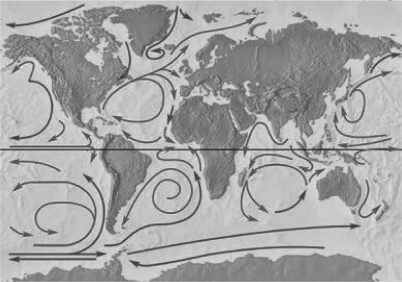
(Multiple Choice)
4.9/5 (67)
(67) The seafloor drops sharply to a depth of about 6,000 meters where the ________ ends.
(Short Answer)
4.8/5 (84)
(84) A(n)________ studies the many levels of interaction between organisms and their environments.
(Short Answer)
4.8/5 (83)
(83) Species that are accidentally or intentionally released into new geographic regions are called ________ species.
(Short Answer)
5.0/5 (81)
(81) Which of the following best explains why a given biome is NOT found in each location where it could potentially exist?
(Multiple Choice)
4.8/5 (75)
(75) Which of the following terms describes all organisms on Earth plus their environments?
(Multiple Choice)
4.8/5 (83)
(83) The following figure illustrates the rain shadow effect.
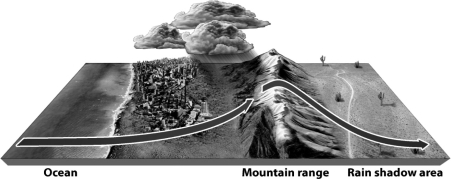 What best explains why the leeward side of the mountain experiences less rainfall?
 (Multiple Choice)
4.8/5 (73)
(73) Which of the following is NOT a major factor in shaping the climate of a local region?
(Multiple Choice)
4.8/5 (71)
(71) Meteorologists use the term ________ to describe the temperature,precipitation,wind speed,and other physical conditions at a specific place over a short period of time.
(Short Answer)
5.0/5 (83)
(83) When a predator is removed or displaced from its ecosystem,only its preferred prey is affected.
(True/False)
4.9/5 (78)
(78) Coniferous plants are the predominant vegetation in which biome?
(Multiple Choice)
4.8/5 (71)
(71) Which of these biomes shows the greatest species diversity?
(Multiple Choice)
4.8/5 (85)
(85) Dumping ballast water,such as this ship is doing,has the potential to introduce new organisms to aquatic environments far from their native habitats,but no organisms have been transferred this way so far.
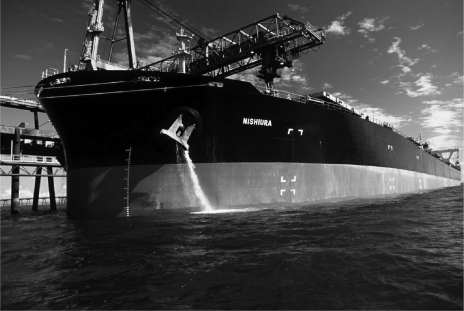
(True/False)
4.9/5 (77)
(77) Rivers are not greatly influenced by bordering terrestrial biomes.
(True/False)
4.7/5 (81)
(81) In the northern ocean basins,ocean currents generally flow ________ between continents.
(Multiple Choice)
4.9/5 (83)
(83) Species that are accidentally introduced into new geographic regions
(Multiple Choice)
4.9/5 (72)
(72) Which of the following best explains how a single volcanic eruption in Hawaii can have an effect on the weather elsewhere in the world?
(Multiple Choice)
4.8/5 (79)
(79) 
Filters
- Essay(0)
- Multiple Choice(0)
- Short Answer(0)
- True False(0)
- Matching(0)